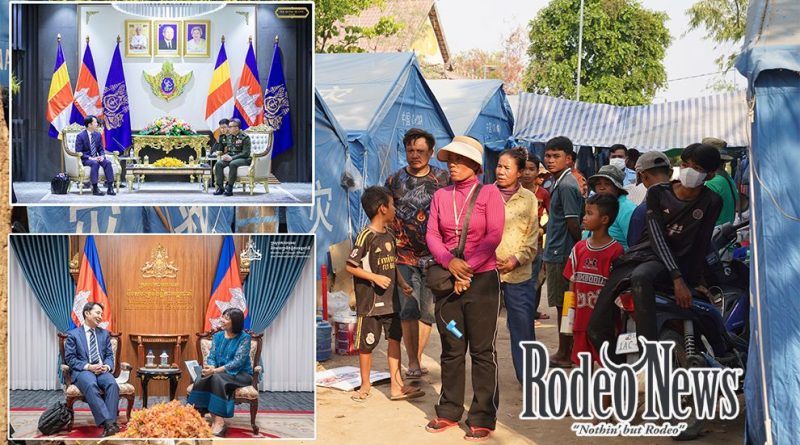
Japan Steps In to Ease Cambodia–Thailand Border Tensions, Links Stability to Mekong Future
PHNOM PENH – Japan has intensified its diplomatic engagement over rising tensions along the Cambodia–Thailand border, warning that stable relations between the two Southeast Asian neighbours are critical to the future of the wider Mekong region.
During a visit to Phnom Penh on February 25, Japan’s Ambassador for Mekong Cooperation, Hayashi Teiji, held talks with Cambodia’s acting Minister of Foreign Affairs and International Cooperation, Eat Sophea, as well as Minister of National Defence Tea Seiha. The meetings focused heavily on the evolving situation along the contested border.
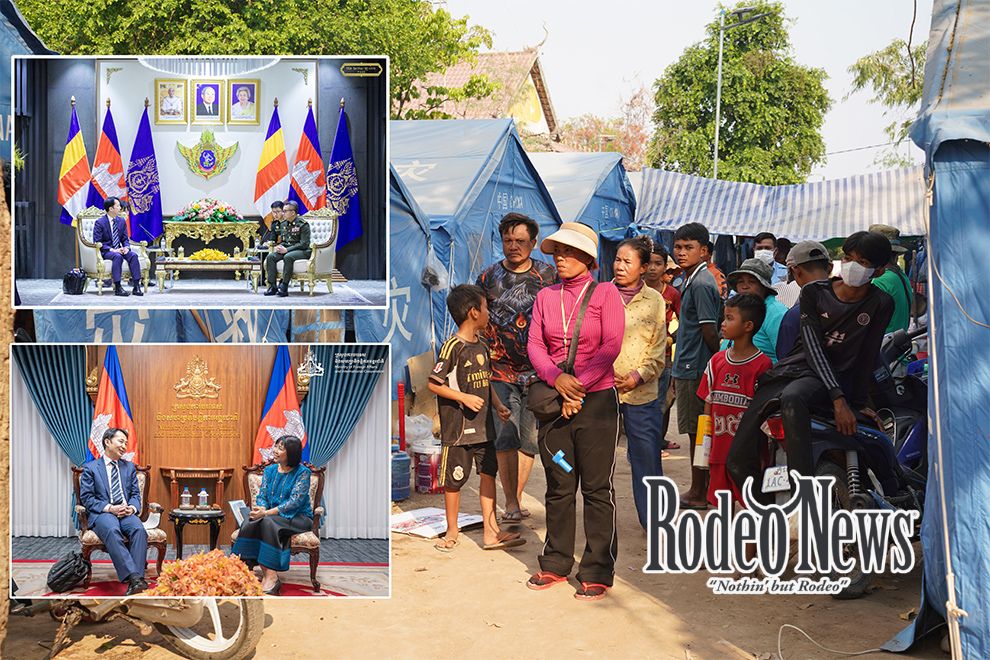
According to the Japanese embassy, Hayashi underscored that “sound relations between Cambodia and Thailand are the foundation for the stability and development of the entire Mekong region,” emphasizing that dialogue remains the only viable path toward a peaceful resolution.
He also conveyed Tokyo’s readiness to deepen cooperation and provide further support aimed at easing tensions.
Border Issue Dominates Talks
While both sides reaffirmed their commitment to strengthening the Cambodia–Japan Comprehensive Strategic Partnership, diplomatic sources indicated that the border situation overshadowed broader bilateral discussions.
Tensions have lingered since armed clashes between December 7 and 27 last year, which heightened regional anxieties and prompted renewed international attention. Though a ceasefire agreement has held, concerns remain over sporadic friction and the humanitarian impact in affected communities.
Sophea briefed the Japanese delegation on recent developments, reiterating Cambodia’s adherence to the ceasefire and its stated commitment to resolving the dispute peacefully.
Phnom Penh has maintained that it seeks a negotiated settlement and continues to engage through regional mechanisms to prevent escalation.
Humanitarian Concerns Persist
The diplomatic push comes amid ongoing humanitarian challenges in border villages impacted by the December clashes.
Japanese embassy councillor Matsuda Junsaku, who accompanied Hayashi during the visit, described conditions on the ground as still difficult following a recent field inspection.
“I discovered that many people are still suffering,” Matsuda said, acknowledging the hardship faced by displaced families.
He noted that Cambodian authorities have made significant efforts to provide food supplies and improve sanitation systems in affected areas. Days earlier, Sophea led a delegation to Chouk Chey, Prey Chan and Boeung Trakoun villages, where Cambodian officials say Thai military forces have maintained positions since the December confrontations.
The delegation met residents and assessed living conditions, highlighting the continued fragility of the situation despite the ceasefire.
ASEAN’s Monitoring Role
Japan has already extended humanitarian assistance and is supporting the ASEAN Observer Teams (AOT), a regional mechanism deployed to monitor developments along the disputed frontier under the auspices of the Association of Southeast Asian Nations.
Matsuda stressed that the observer teams play a crucial role in preventing renewed hostilities and fostering trust between the two sides.
“We believe that the AOT has a crucial role in the resolution of the situation,” he said, adding that Japan would continue close consultations with ASEAN member states, including the Philippines, which currently chairs the bloc.
Following his Phnom Penh visit, Hayashi travelled to Manila to continue discussions with regional stakeholders, underscoring Tokyo’s broader diplomatic engagement in Southeast Asia.
Stability and the Mekong’s Future
Japan has long positioned itself as a key development partner in the Mekong subregion, investing heavily in infrastructure, connectivity and sustainable growth initiatives spanning Cambodia, Thailand and their neighbours.
By linking bilateral border stability to the future of Mekong cooperation, Tokyo is sending a clear message: unresolved tensions risk undermining not only bilateral ties but also broader regional integration and economic progress.
The Mekong region, which includes Cambodia and Thailand, has become an increasingly strategic corridor for trade, energy and infrastructure projects. Any prolonged instability could complicate cross-border investment and development initiatives that rely on predictable political conditions.
Diplomats say Japan’s approach reflects a calculated balance—supporting peaceful dialogue while reinforcing ASEAN-led mechanisms, rather than taking a confrontational stance.
For Cambodia and Thailand, both founding members of ASEAN, the pressure to maintain regional credibility is significant. The bloc’s principle of peaceful dispute resolution remains central to its identity, and renewed conflict would test that framework.
As tensions simmer but open hostilities remain contained, Japan’s diplomatic intervention illustrates how external partners are seeking to prevent a localized dispute from evolving into a broader regional fault line.
For now, the ceasefire holds. But with humanitarian needs unresolved and political sensitivities still raw, sustained engagement—both bilateral and multilateral—may prove decisive in shaping the Mekong region’s stability in the months ahead.