Germany’s Leader Issues Direct Trade Warning to China During High-Stakes Beijing Visit
German Chancellor Friedrich Merz arrived in Beijing with a carefully balanced message: Germany seeks closer cooperation with China — but not at the expense of what he called fair competition.
Standing before an audience that included Chinese Premier Li Qiang, Merz laid out a pointed critique of Beijing’s economic policies during a meeting of the German-Chinese Business Advisory Council. His remarks were notably sharper than those delivered by other Western leaders who have visited China in recent months in efforts to stabilize relations amid mounting global trade turbulence.
Merz insisted he was not in Beijing to “lecture.” Yet his speech carried unmistakable demands.
A Call for Fairer Economic Ground
The German leader urged China to reduce state subsidies for domestic manufacturers, allow its currency — the renminbi — to appreciate more freely, and ensure uninterrupted exports of critical raw materials vital to European industry.
Such measures, Merz argued, would help rebalance trade and restore confidence among German companies that increasingly feel squeezed by what they view as distorted market conditions.
“In view of the uncertainties caused by customs policy that we see around the world,” Merz said, addressing Li directly, “we can now set a different example in our bilateral relations through the reliability and security of the economic relations between our two countries.”
His message was clear: Germany wants partnership — but not asymmetry.
Strategic Diplomacy Under Pressure
Merz’s visit unfolded against a tense geopolitical backdrop. Trade relations between Europe and the United States have grown increasingly strained following renewed tariff disputes linked to former President Donald Trump. European officials recently paused aspects of a transatlantic trade arrangement after legal uncertainty clouded parts of Washington’s tariff policy.
With Europe navigating friction on multiple fronts, China has sought to present itself as a stabilizing alternative partner. Chinese President Xi Jinping has intensified outreach to Western allies unsettled by Washington’s unpredictability.
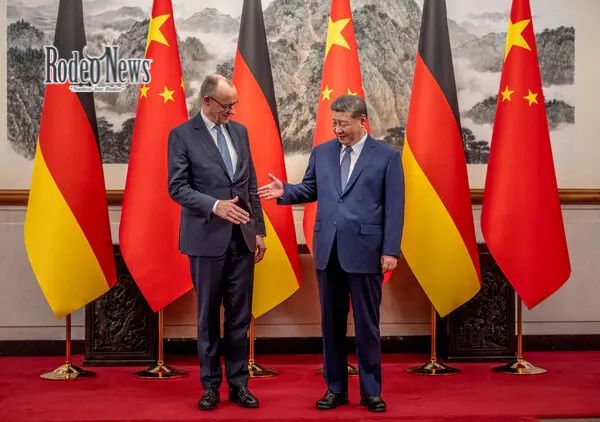
Meeting Merz at Beijing’s Diaoyutai State Guesthouse, Xi spoke in sweeping terms about strategic cooperation and mutual trust. He avoided directly addressing the specific trade grievances raised by Germany but emphasized the need for stronger communication in what he described as an increasingly chaotic global environment.
“The more the world becomes chaotic and intertwined,” Xi said, “the more China and Germany must strengthen their strategic communication and enhance strategic mutual trust.”
The rhetoric underscored Beijing’s broader diplomatic effort to prevent Europe from drifting further toward economic decoupling.
Economic Wins — and Lingering Frictions
Despite tensions, the visit yielded tangible economic announcements. Merz revealed that China had pledged to order up to 120 aircraft from European aerospace giant Airbus, a deal that could provide a significant boost to Germany’s industrial sector.
“After today, I am very optimistic,” Merz said following his meetings. “This is a good path for German-Chinese relations, both in the coming months and years.”
The chancellor was accompanied by executives from more than two dozen major German firms, including Volkswagen, BMW, and Siemens. He was also scheduled to meet representatives of Mercedes-Benz and visit the headquarters of Unitree Robotics in Hangzhou.
Yet beneath the handshake diplomacy lies a harder reality.
From Growth Engine to Strategic Rival
For decades, China was a central driver of German export growth. But that relationship has shifted. German firms now face intensified competition from Chinese companies that have climbed the value chain, particularly in automotive manufacturing, chemicals, and advanced machinery.
In 2023, Berlin formally labeled China a “partner, competitor and systemic rival,” signaling a more cautious approach. Germany has since tightened export controls and worked to reduce critical dependencies on Chinese supply chains — part of a broader European strategy known as “de-risking.”
German industry groups argue that Beijing’s heavy industrial subsidies have created unfair competition, contributing to a widening trade imbalance and a surge of Chinese exports into European markets. At the same time, German manufacturers are losing global market share to lower-cost Chinese rivals, leading to industrial job losses at home.
What was once seen as a pillar of prosperity now presents strategic vulnerability.
Ukraine and Taiwan Add to Tensions
Trade was not the only sensitive topic on the agenda.
Merz and Xi also discussed the war in Ukraine. According to Chinese state media, Xi reiterated Beijing’s longstanding position that the conflict should be resolved through dialogue while addressing the “legitimate concerns of all parties” — phrasing that European leaders often view as implicitly sympathetic to Moscow.
Germany has urged China to use its influence over Russia to advance meaningful peace efforts. After the meeting, Merz said he welcomed China’s stated commitment to regional peace but offered few details of any substantive progress.
The chancellor also made clear that Germany opposes any attempt by China to use military force against Taiwan, underscoring Europe’s growing unease about stability in the Indo-Pacific.
A Relationship at a Crossroads
China’s economy, meanwhile, faces its own internal pressures, including a prolonged property sector downturn that has dampened domestic growth. Maintaining access to European markets is increasingly critical for Beijing as exports remain a key engine of economic activity.
Chinese officials have expressed concern not only about U.S. protectionism but also about potential European restrictions on Chinese goods. Beijing hopes Berlin will soften its rhetoric and reconsider labeling China a systemic rival.
For Germany, however, the calculus is changing.
China remains an indispensable market — but also a formidable competitor and strategic challenge. Merz’s visit highlighted that Berlin is seeking equilibrium: deeper engagement without economic dependency, cooperation without concession.
Whether that balance can be sustained will shape not only Germany’s industrial future but also the broader trajectory of Europe’s relationship with China in an increasingly fragmented global order.