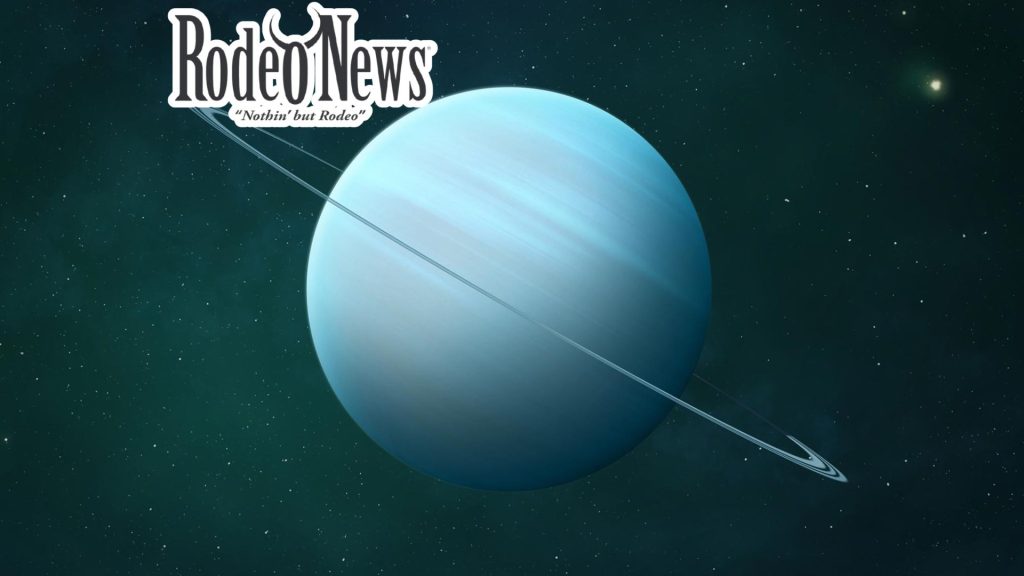
Decades Later, Scientists Finally Explain Voyager 2’s Bizarre Readings at Uranus
On January 24, 1986, the spacecraft Voyager 2 completed its only close flyby of Uranus, returning a trove of surprising data. Among the most puzzling were extremely intense electron radiation belts — far more energetic than scientists expected, especially for a planet so radically different from the more familiar gas giants.
For decades, these readings fueled the idea that Uranus possessed an unusually violent and exotic magnetosphere. But now — nearly 40 years later — researchers at Southwest Research Institute (SwRI) believe they may finally have cracked the mystery.
Solar Storms, Not Planetary Quirks
The new analysis argues that the extreme radiation wasn’t a permanent feature of Uranus — but a snapshot in time, caused by a rare and significant solar wind event. Specifically, the team points to a “co-rotating interaction region” — a fast-moving stream of solar particles that likely slammed into Uranus’s magnetosphere as Voyager 2 passed by.
On Earth, similar solar wind disturbances are known to trigger powerful “chorus waves,” electromagnetic emissions that can accelerate electrons to high energies. The researchers propose that the same mechanism played out at Uranus — supercharging its radiation belts at just the moment of observation.
In other words: Voyager 2 didn’t encounter a typical Uranus — it caught the planet on a “bad weather day.” If the timing had been only a few days different, Uranus’s magnetosphere might have looked far more benign.
Why This Changes Everything
- For decades, the data from Voyager 2 shaped scientists’ mental models of Uranus — its magnetosphere was considered uniquely extreme. This new interpretation suggests much of that picture was skewed by poor timing.
- It tempers assumptions about cathartic, persistent radiation belts around Uranus, meaning previous theories about its internal structure, atmosphere, and space-environment interactions may need revisiting.
- It strengthens the case for a dedicated mission to Uranus (and perhaps its sibling outer planet Neptune). As SwRI’s lead scientist put it: “This is just one more reason to send a mission targeting Uranus.”
What Comes Next
The findings underscore the value of re-examining legacy data with fresh theoretical frameworks — and urge renewed interest in targeted missions to the ice giants. By revisiting Voyager 2’s measurements using what we now know about solar wind–driven wave acceleration (from decades of Earth observations), researchers have opened the door to a simpler, less exotic — but more accurate — understanding of Uranus’s radiation environment.
As plans for future ice-giant exploration advance, this new insight may reshape mission design: not only to study Uranus’s interior and rings — but to capture how solar activity truly affects its magnetosphere under “normal” conditions