A Web of Unseen Proportions
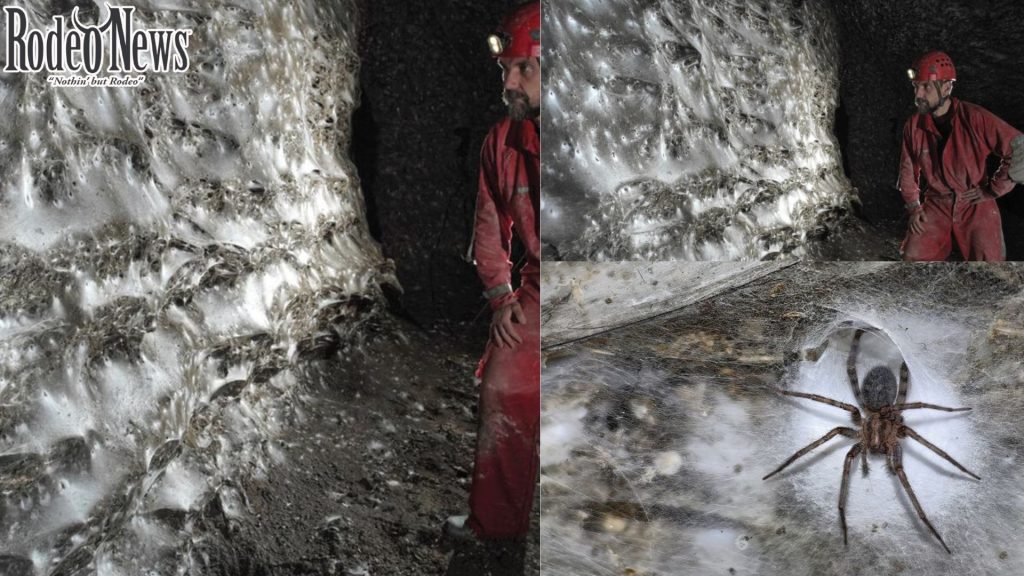
Deep within a nearly pitch-black section of the cavern known as the Sulfur Cave—on the border between Greece and Albania—researchers have documented a spectacular spider colony. The web complex spans approximately 106 square metres (about 1,140 square feet) and supports an estimated 111,000 spiders from two species.
This structure is likely the world’s largest known spiderweb, and the behavioural ecology of the spiders therein challenges long-held assumptions about how spiders live and cooperate.
Two Species, One Massive Colony
The colony comprises two otherwise solitary species: Tegenaria domestica (commonly called the barn funnel weaver or domestic house spider) and Prinerigone vagans (a sheet-weaving spider). In this cave, researchers estimated about 69,000 individuals of T. domestica and over 42,000 of P. vagans.
What makes this startling is that these species are not known to share webs or live communally in this way. The cave environment appears to have enabled a radical shift from solitary to communal living.
A Food Web Fueled by Sulfur
The cave ecosystem is extreme: no sunlight penetrates the chamber where the web is located, and hydrogen-sulfide-rich water flows through, sustaining microbes that oxidise sulfur.
These microbes form biofilms that feed non-biting midges, which in turn become prey for the spiders. In other words: microbes → midges → spiders.
Because of this unusual food base, the spiders have diverged genetically and in their microbiome from surface-dwelling counterparts. Their diets and isolation appear to have triggered evolutionary adaptation.
Why the Discovery Matters
- Ecological surprise: Shows that even well-known species can surprise us when placed in extreme or isolated environments. As lead researcher István Urák put it, “nature still holds countless surprises.”
- Behavioural insight: Two typically solitary spider species collaborating in a massive web overturns expectations about spider social behaviour.
- Biodiversity & conservation: Such a unique subterranean ecosystem underscores the importance of preserving hidden habitats—and examining how life adapts to extreme, low-light, high-chemical environments.
- Evolutionary study: The genetic divergence of the cave spiders offers a natural laboratory for studying adaptation, isolation and species-level change in action.
What’s Next?
Researchers are preparing further investigations into the cave’s ecosystem: mapping additional fauna (mites, beetles, centipedes), studying the micro-environmental conditions more closely, and exploring how stable the spider colony is over time.
Conservation challenges also loom: the cave straddles two countries, and its fragile world could be disrupted by human access, climate change or chemical alteration of the stream that feeds the ecosystem.
In Summary
In the dark recesses of the Sulfur Cave on the Greek-Albanian border lies what may be the largest spiderweb ever found—over 100 m² in size, home to roughly 111,000 spiders from two species. Their communal living, sustained by a sulfur-based food chain far removed from sunlight, challenges our notions of spider behaviour and highlights how life can flourish in the most extreme places