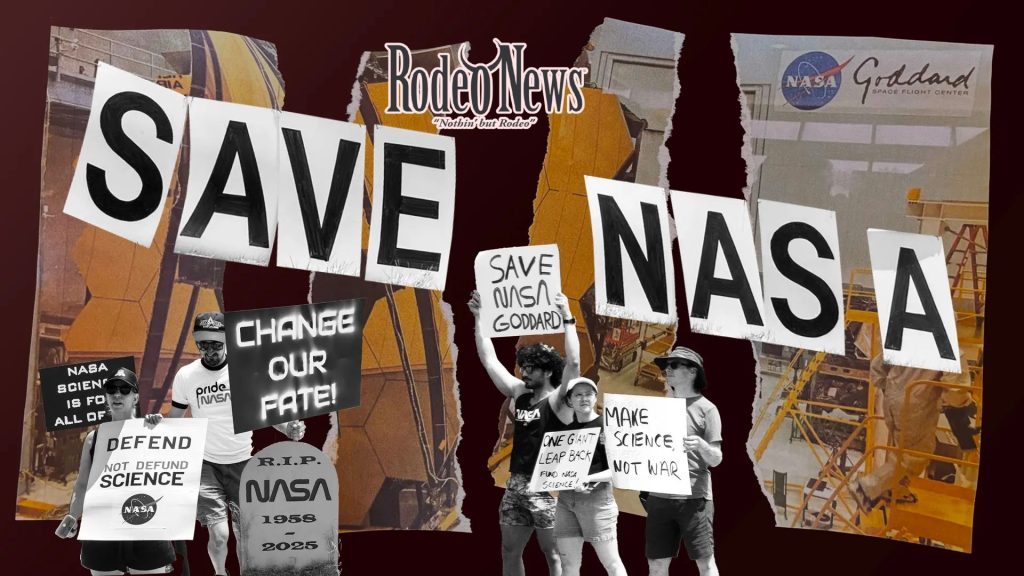
NASA’s Flagship Science Centre Under Siege: Alleged Pre-emptive Cuts Amid Government Shutdown
The nation’s premier science hub for NASA is facing a dramatic upheaval — and it’s happening at a time when the agency’s funding is being negotiated, not finalised. According to internal documents and multiple interviews, NASA appears to be implementing its Fiscal-Year 2026 budget priorities ahead of Congressional approval.
Targeting the Science Core
At the heart of the controversy lies the Goddard Space Flight Center (GSFC) in Greenbelt, Maryland — home to roughly 10,000 scientists, engineers and contractors and the central base for NASA’s Science Mission Directorate and Engineering and Technology Directorate.
Space
Staff there report that re-organisation, building closures and workforce reductions have been pushed through under the guise of aligning with a budget that hasn’t yet passed Congress.
One former employee summarised the mood saying:
“There is just a general acknowledgement that a lot of what is happening is illegal… but people have been told to do it.”
The concern is that NASA’s leadership is acting not on lawfully appropriated funds, but on a Presidential Budget Request — which lacks the force of law.
Science Missions and Workforce at Risk
The FY 2026 budget request released by the White House proposed deep cuts: roughly a 24% reduction in NASA’s overall funding and a 47% cut to its science programmes, according to advocacy groups.
The immediate consequence: missions already operating — like Chandra X‑ray Observatory, Juno and New Horizons — were told to plan for shutdown despite minimal upkeep costs.
Workforce reductions have also been accelerated. At GSFC, more than 17 % of civil service staff opted for voluntary separation programmes in one wave, driven by fear of imminent job loss.
Scientists interviewed said the loss of institutional memory, expertise and critical safety oversight could have long-term, even irreversible, effects.
Building Closures and Campus Shrink-down
The disruptions are not only personnel-based. GSFC’s 20-year master plan — originally spanning up to 2037 — has been compressed into a six-month timeline. Numerous buildings and research facilities are being marked for abandonment or demolition by March 2026.
The closure list includes operational safety, health, recreation and visitor facilities. Some staff were told to vacate labs with sensitive hardware in just hours.
For example, the agency shuttered the visitor centres at GSFC and its Wallops Flight Facility — cutting off public engagement and outreach — and told employees to depart or relocate workspaces rapidly.
Legal and Governance Questions
The legal argument is significant. Congressional appropriations are law. A Presidential Budget Request is a proposal. By beginning to implement major changes based on the request, NASA could be seen as circumventing Congress’s authority over spending. A Senate committee report described this as an “unconstitutional plot to gut the agency.”
Agency leadership denies any wrongdoing. They state they are “executing our available appropriated funding … in accordance with established fiscal policies” and remain committed to safety and mission integrity.
The Broader Implications
The consequences extend far beyond one centre. If NASA science takes a back seat to other priorities, the risk isn’t just delayed missions — it’s lost capability, diminished global leadership in space science, and compromised safety protocols. As one former astronaut put it, once hardware is cancelled and people depart, “you’re not just going to get them back.”
Employees and scientists point to the irony: A government shutdown is being used as the backdrop for deep organisational and financial change, rather than as a pause until appropriation. What was meant to be a temporary disruption is now part of an accelerated transformation.
What Happens Next?
Congress has started to push back. The Senate Appropriations Committee advanced a funding measure to maintain NASA at FY 2025 levels, and bipartisan support exists to restore science programmes.
But people on the ground worry it’s too late: the damage — closures, talent loss, mission disbandment — may already be done.
For NASA and the scientific community, this is a pivotal moment: will the agency preserve its science core while navigating political and budgetary turmoil, or will the pre-emptive cuts and reorganisations fundamentally reshape it for a new era?