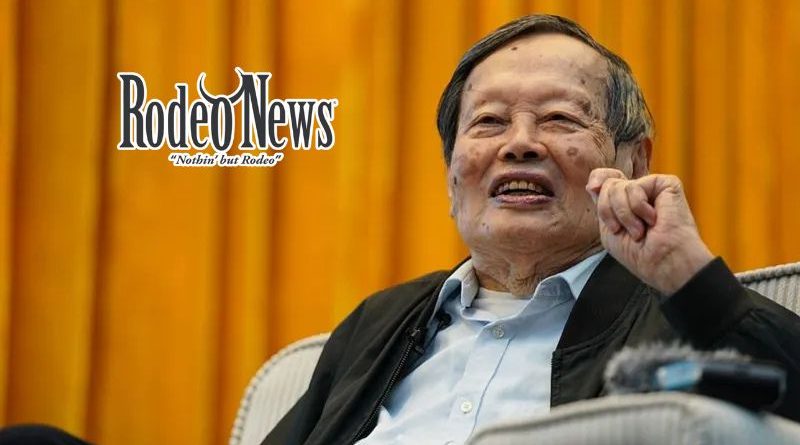
Chinese Nobel Laureate and Physicist Chen Ning Yang Dies at 103
Chen Ning Yang, one of the most influential and pioneering physicists of the 20th century, has passed away at the age of 103, according to Chinese state media. The news was confirmed in an obituary issued by CCTV, which stated that illness was the cause of his death.
Yang’s groundbreaking contributions to the world of physics earned him the Nobel Prize in 1957, an honor he shared with fellow theoretical physicist Lee Tsung-Dao. Their work on the law of parity—an exploration into the symmetry of elementary particles—revolutionized the understanding of the fundamental building blocks of matter.
A Legacy in Physics and Education
Born in 1922 in Anhui province, China, Yang was the eldest of five children. He grew up on the campus of Tsinghua University in Beijing, where his father was a professor of mathematics. This academic environment profoundly shaped Yang’s intellectual development, and as a teenager, he expressed a bold ambition: “One day, I want to win the Nobel Prize.”
At just 35 years old, Yang saw that dream come true. His work with Lee on the violation of parity laws, which had long been believed to be fundamental to the laws of physics, challenged established scientific thought. The Nobel committee lauded their “penetrating investigation” into elementary particles, which laid the groundwork for further discoveries in particle physics.
Beyond his research, Yang also had a long and distinguished career as an educator. He served as a professor at Tsinghua University and later became an honorary dean of the Institute for Advanced Study at the institution. Yang’s impact extended far beyond his groundbreaking theoretical work, as he mentored countless students who would go on to shape their own paths in the world of science.
Early Life and Educational Journey
Yang’s early education was steeped in both Chinese and Western academic traditions. After completing his undergraduate studies in China, he traveled to the United States in 1945 on a fellowship from Tsinghua University. He attended the University of Chicago, where he studied under the guidance of the legendary physicist Enrico Fermi, who famously built the world’s first nuclear reactor.
Following the conclusion of World War II, Yang’s research began to expand into statistical mechanics and symmetry principles, areas in which he would make lasting contributions to the understanding of both quantum mechanics and thermodynamics. His intellectual curiosity and passion for physics were boundless, making him one of the most revered minds in the field.
Personal Life and Later Years
Throughout his life, Yang was not only committed to his scientific endeavors but also to his family. He married Chih Li Tu in 1950, with whom he had three children. Following her death in 2003, Yang married Weng Fan in 2004, a woman more than 50 years his junior. The couple first met in 1995 when Weng was a student at a physics seminar, and their relationship grew into a deep connection over the years. Yang later referred to Weng as “my final blessing from God.”
Yang’s contributions to science were not limited to the theoretical realm. His work laid the foundation for future advancements in particle physics, quantum mechanics, and even nuclear physics. For his pioneering work, Yang received numerous prestigious awards, including the Albert Einstein Commemorative Award in 1957 and an honorary doctorate from Princeton University in 1958.
The End of an Era
Chen Ning Yang’s death marks the end of an era in modern physics. His work continues to inspire physicists around the world, and his legacy will live on in the countless discoveries that have followed from his groundbreaking research. Yang’s pioneering spirit and dedication to the pursuit of knowledge left an indelible mark on the scientific community.
Though he is gone, his contributions to science and his unwavering commitment to understanding the universe will remain a guiding light for future generations of physicists.