Nebraska Football Answers Big Questions With Michigan State Win
Nebraska football entered its first Big Ten game of the 2026 season with plenty to prove. After opening the year 3-0 against a nonconference schedule, the Cornhuskers finally faced a road test against Michigan State in East Lansing.
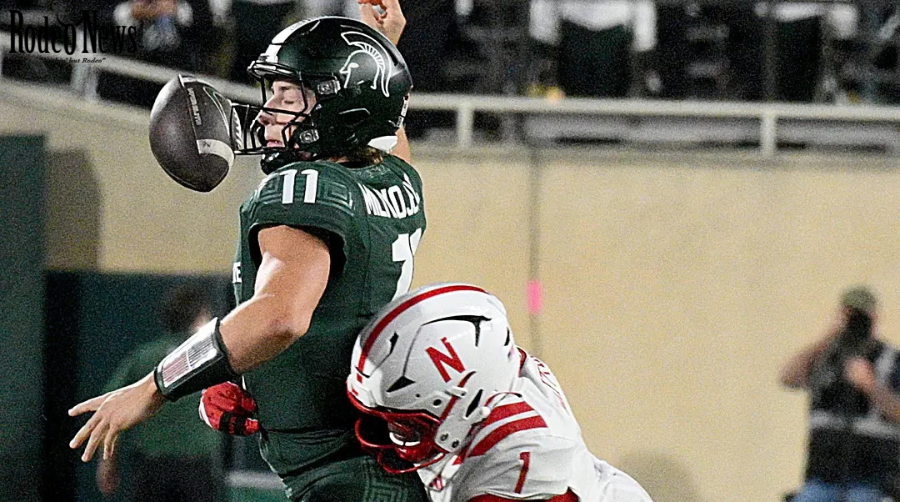
The Huskers responded with a convincing 31-13 victory, moving to 4-0 overall and 1-0 in Big Ten play. Nebraska also won its first game at Michigan State since 2012.
The result was important for more than the win column. Nebraska had questions surrounding its quarterback, defense, ability to handle a hostile road environment and readiness for Big Ten competition.
Against the Spartans, several of those questions received encouraging answers.
Anthony Colandrea showed he could make plays against a Power Four opponent. The defense generated consistent pressure. The running game continued to produce despite an early injury to Jamal Rule. Most importantly, Nebraska avoided the type of collapse that has frustrated the program in previous seasons.
The Huskers are still only four games into the season, so one victory cannot establish where the team will ultimately finish.
But the Michigan State game provided a meaningful early test.
Nebraska Football Showed It Could Handle a Road Test
The first major question entering the game was simple: How would Nebraska football respond when it finally left Memorial Stadium?
Nebraska had played its first three games at home. That meant the Michigan State matchup represented the team’s first true road environment of the season and its first Big Ten game.
Spartan Stadium had an announced crowd of 68,161, creating the kind of environment that can make an inexperienced team uncomfortable. Instead, Nebraska played with composure and controlled much of the game.
Michigan State scored first with a 48-yard field goal, but Nebraska answered almost immediately.
Colandrea connected with Kwazi Gilmer for a spectacular 44-yard touchdown that gave the Huskers a 7-3 advantage. Nebraska then continued building its lead instead of allowing the early deficit to create panic.
That response was significant.
Road games in the Big Ten can quickly become difficult when a visiting team makes mistakes or allows the home crowd to dictate momentum. Nebraska did not allow that to happen for long.
The Huskers eventually took a 24-10 lead into halftime and never surrendered control of the game.
Anthony Colandrea Answered the Biggest Question
Perhaps the most important individual storyline was quarterback Anthony Colandrea.
The transfer from UNLV entered Nebraska’s program with considerable expectations after a productive 2025 season. The question was whether his production would translate when he faced stronger competition.
Michigan State provided the first opportunity to find out.
Colandrea finished the game 15-of-27 passing for 212 yards and two touchdowns. He also rushed for 66 yards, giving Nebraska another dimension when passing opportunities became difficult.
His mobility was especially important.
Michigan State’s defense was able to make portions of Nebraska’s rushing attack less effective than it had been during the opening weeks. Rather than repeatedly forcing throws into difficult situations, Colandrea used his legs to extend possessions and gain valuable yardage.
His 44-yard touchdown pass to Gilmer was also one of the game’s defining offensive plays.
Colandrea was not perfect, but perfection was never the realistic standard for his first Big Ten road start.
What mattered was how he responded to pressure.
The quarterback remained involved throughout the game and helped Nebraska finish with 369 total yards. His combination of passing and rushing production gave the Huskers an offensive escape valve when Michigan State’s defense created problems.
That could become increasingly important as Nebraska’s Big Ten schedule becomes more demanding.
Nebraska’s Defense Delivered a Major Statement
If Colandrea answered questions on offense, Nebraska’s defense supplied perhaps the clearest statement of the afternoon.
The Huskers held Michigan State to 257 total yards, including only 39 rushing yards. Nebraska also forced three turnovers: two interceptions and one lost fumble.
The pass rush was particularly disruptive.
Nebraska recorded six sacks, including two from Williams Nwaneri. The Huskers also recorded four tackles for loss, repeatedly putting Michigan State behind schedule.
That performance addressed one of the key questions entering Big Ten play.
Could Nebraska’s defense stop a physical Michigan State rushing attack?
For most of the afternoon, the answer was yes.
The Spartans entered the game with a strong emphasis on running the football. Nebraska defensive coordinator Rob Aurich had warned during the week that Michigan State’s offensive identity was built around establishing the run and using it to create opportunities for the passing game.
Nebraska ultimately disrupted that plan.
The Spartans were forced to rely more heavily on the passing game, while Nebraska’s defensive front repeatedly pressured the quarterback.
That type of defensive performance is particularly valuable in conference play.
Turnovers Became a Difference-Maker
One of the clearest statistical themes from the game was Nebraska’s ability to win the turnover battle.
The Huskers forced three turnovers and did not give the ball away themselves.
That created additional opportunities for the offense and prevented Michigan State from generating sustained momentum.
One of the interceptions came from Owen Chambliss, and Nebraska immediately converted the possession into points. The Huskers moved the ball into field-goal range, allowing Kyle Cunanan to extend the lead to 17-3.
Winning games against quality conference opponents often requires more than simply producing yards.
Field position, turnovers, third downs and situational execution can determine whether a competitive game turns into a comfortable victory.
Nebraska checked several of those boxes in East Lansing.
The Running Game Survived a Major Setback
Nebraska’s rushing attack entered the game as one of the team’s biggest strengths.
Freshman running back Jamal Rule had already emerged as an explosive weapon during the opening three games. He entered the Michigan State matchup with 329 rushing yards and five touchdowns.
However, Rule suffered an ankle injury during the first quarter and did not return.
That could have dramatically changed Nebraska’s offensive plan.
Instead, the Huskers found production elsewhere.
Mekhi Nelson finished with 61 rushing yards and a touchdown, while Vincent Genatone stepped into a larger role and produced two touchdowns. Genatone scored once on the ground and once through the air, with his receiving touchdown marking the first reception of his career.
That depth matters.
A long Big Ten season will inevitably involve injuries, and teams that depend too heavily on one player can struggle when that player is unavailable.
Nebraska demonstrated that it had alternative options.
The offense was not dominant on every possession, but it found enough production to keep Michigan State from turning Rule’s absence into a decisive advantage.
Kwazi Gilmer Emerged as Another Offensive Weapon
Another encouraging development for Nebraska football was the performance of wide receiver Kwazi Gilmer.
Gilmer caught four passes for 101 yards, giving him his first career 100-yard receiving game. His 44-yard touchdown reception also provided Nebraska with its first touchdown of the afternoon.
His production gave Colandrea a legitimate explosive target downfield.
That matters because Nebraska’s offense cannot rely exclusively on the running game or quarterback scrambling.
Against better Big Ten defenses, the Huskers will need receivers capable of turning limited opportunities into major gains.
Gilmer demonstrated that potential against Michigan State.
His 38-yard reception on third-and-7 late in the game was another important play, helping Nebraska maintain control when the Spartans needed a defensive stop.
Nebraska Football Still Has More to Prove
Despite the encouraging performance, it would be too early to declare Nebraska a finished product.
The Huskers are now 4-0, but Michigan State entered the game at 2-1 and was already rebuilding under first-year coach Pat Fitzgerald. The Spartans also lost running back Cam Edwards to injury during the game, which affected their offensive approach.
Those circumstances should be considered when evaluating the result.
Nebraska proved it could win on the road.
It proved it could handle its first Big Ten game.
It proved its defense could generate pressure and create turnovers.
It also showed that Colandrea could produce when the competition level increased.
But the Huskers will face tougher challenges as the season continues.
The victory therefore should be viewed as an important data point rather than a final answer about Nebraska’s place in the Big Ten.
What the Michigan State Win Means for Matt Rhule
For head coach Matt Rhule, the victory provided another encouraging step in Year 4 of his Nebraska tenure.
Rhule emphasized after the game that he did not feel his team panicked when Michigan State challenged it. Instead, he praised the players for continuing to attack throughout the contest.
That mental response may ultimately become as important as any individual statistic.
Nebraska has experienced difficult seasons in recent years, including consecutive 7-6 campaigns entering 2026. That history created questions about whether the program had genuinely moved forward.
A single win cannot answer that question completely.
However, the Michigan State game showed a Nebraska team capable of responding to adversity without allowing the game to spiral.
That is exactly the type of development Rhule needs as the schedule gets more difficult.
Nebraska’s Next Challenge Is Maryland
Nebraska now returns home to face Maryland on Saturday, Oct. 3.
The Terrapins enter that matchup following a 54-3 loss to UCLA, creating another opportunity for Nebraska to continue its unbeaten start. The game is scheduled for 3 p.m. CT and will be televised on FS1.
The challenge for Nebraska will be maintaining the same level of focus after an emotional road victory.
That may be one of the most important tests of all.
The Michigan State game showed what Nebraska can do when facing its first major challenge of the season. Maryland will provide an opportunity to show whether that performance can become a consistent standard rather than a one-game peak.
Final Takeaway
Nebraska football left East Lansing with more than a 31-13 victory.
The Huskers answered several of the questions that surrounded them entering Big Ten play.
They handled their first road game of the season. They protected the football. They forced turnovers. They pressured the quarterback. They held Michigan State to just 39 rushing yards. And when Jamal Rule went down with an injury, other offensive players stepped forward.
Colandrea’s performance may be the most significant development.
The quarterback showed that his playmaking ability can translate into Big Ten competition, while his rushing ability gave Nebraska another way to move the football when the passing game became difficult.
At the same time, Nebraska’s defense delivered the type of performance that can travel.
The Huskers are not yet proven as one of the Big Ten’s top teams. Four games are not enough to settle that question.
But the Michigan State victory provided evidence that Nebraska should not be treated as an easy opponent.
For a program trying to establish a new standard under Rhule, that is an important step.
The next challenge is turning that step into a trend.