Guyana Oil Boom Is Reshaping a Small Nation
The Guyana oil boom has transformed one of South America’s smaller economies into a rapidly expanding energy producer, creating enormous new revenues while exposing deep challenges involving inequality, infrastructure, governance and regional security.
The transformation has accelerated dramatically in 2026. Guyana produced an average of about 902,000 barrels of crude oil per day during the first half of the year, compared with roughly 639,000 barrels per day during the same period in 2025, according to Guyanese government data. Crude oil exports reached about $15.05 billion during the first six months of 2026.
The country’s economic growth has been equally striking. Guyana reported estimated real GDP growth of 33.3% in the first half of 2026, while its non-oil economy expanded by 10.1%. The government subsequently revised its full-year GDP growth forecast to 20.8%.
That growth is changing Georgetown, attracting investment and creating new opportunities. Yet the benefits of the petroleum boom are not being felt equally by everyone.
The experience is becoming a test of whether Guyana can turn extraordinary natural-resource wealth into broad-based prosperity without falling into the familiar problems associated with resource-dependent economies.
Guyana Oil Boom Has Created a New Energy Powerhouse
The origins of the transformation date back to 2015, when ExxonMobil announced a major discovery in the offshore Stabroek Block.
The discovery fundamentally changed Guyana’s economic prospects. The country, which historically relied heavily on agriculture, mining and services, suddenly found itself sitting on an enormous offshore petroleum resource.
The Stabroek Block is now the center of Guyana’s oil industry. ExxonMobil operates the project, with Chevron and CNOOC also holding interests following Chevron’s acquisition of Hess.
The scale of the development continues to expand.
In August, Guyana announced the arrival of Errea Wittu, the fifth and largest floating production, storage and offloading vessel, or FPSO, associated with the country’s offshore development. The vessel is expected to push production beyond one million barrels per day once it begins operations.
That would be a remarkable production level for a country with a population of fewer than one million people.
The Council on Foreign Relations has described Guyana as the world’s newest petrostate and estimated that the country has roughly 11 billion barrels of recoverable oil reserves, most of them concentrated in the offshore Stabroek Block.
The result is a dramatic change in Guyana’s position in global energy markets.
1. Oil Revenue Is Surging at an Extraordinary Rate
One of the clearest signs of the Guyana oil boom is the speed at which petroleum revenues are increasing.
The Guyanese government now expects petroleum revenues of approximately $6.5 billion in 2026. That figure is more than double the government’s original forecast for the year.
According to government data, the increase reflects both higher production and stronger international oil prices. During the first half of 2026, crude export earnings increased more than 80% compared with the same period a year earlier.
The change is particularly significant because Guyana’s population is so small.
Large oil revenues divided among fewer than one million people can have an enormous effect on government finances and public spending. The government has already pointed to investments in infrastructure and social programs as evidence that petroleum wealth is being redirected toward citizens.
Guyana has also seen its share of production increase as the costs incurred by the ExxonMobil-led consortium have been recovered. The government said its share of production from the Stabroek Block had risen to approximately 39.8% by August 2026.
That means Guyana can receive a larger portion of production without requiring a proportional increase in its own oil output.
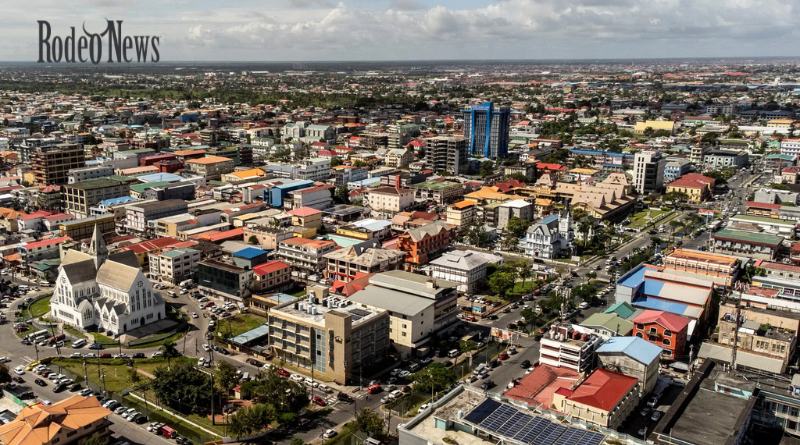
2. Georgetown Is Experiencing a Visible Transformation
The oil boom is not confined to offshore platforms.
Its effects are visible in Georgetown, Guyana’s capital.
New restaurants, luxury vehicles, construction projects and commercial developments have become increasingly prominent. The influx of oil-related money has also attracted foreign companies, workers and investors.
The New York Times reported that Georgetown has seen growing displays of wealth alongside persistent problems involving housing, infrastructure, sanitation and public services.
That contrast is central to understanding Guyana’s current economic transformation.
On paper, the country’s income statistics increasingly resemble those of much wealthier nations. The World Bank has recognized Guyana’s transition into the high-income category, while annual income per person has risen sharply.
But economic statistics do not automatically translate into better living conditions for every household.
Georgetown still faces flooding risks, inadequate drainage, housing shortages and aging infrastructure. Rapid construction is also changing the city’s architectural character.
The challenge for policymakers is therefore not simply generating more oil wealth. It is converting that wealth into durable improvements in transportation, housing, education, healthcare, utilities and public services.
3. The Guyana Oil Boom Is Creating a Growing Inequality Debate
Rapid economic growth can produce winners and losers, and Guyana is increasingly debating how evenly its petroleum wealth is being distributed.
The government argues that oil revenues are improving living standards through tax reductions, infrastructure investment, education initiatives and direct financial support.
At the same time, critics say the country’s impressive GDP numbers can obscure everyday economic difficulties.
This tension is particularly important because oil wealth can raise prices and increase demand faster than local businesses and infrastructure can respond.
Housing is one example.
As international companies and energy workers enter the market, demand for accommodation increases. Property values and rents can rise, making it harder for lower-income residents to compete.
The same dynamic can affect restaurants, transportation, construction materials and other services.
Economists often refer to one version of this problem as the resource curse. A country becomes extremely dependent on natural resources, and the resulting wealth can contribute to inflation, corruption, inequality or the weakening of other economic sectors.
Guyana’s rapid expansion therefore presents both an opportunity and a warning.
4. Guyana Still Depends on Imported Fuel Despite Its Oil Wealth
Perhaps one of the most striking contradictions of the Guyana oil boom is that the country produces enormous quantities of crude but does not have the infrastructure needed to refine that oil into all the fuels it consumes.
That means Guyana remains dependent on imported gasoline and diesel.
The contradiction became particularly visible during the energy disruptions associated with the wider Middle East conflict in 2026.
While Guyana was producing hundreds of thousands of barrels of crude oil every day, domestic consumers still faced exposure to international fuel markets.
This highlights an important distinction between being an oil producer and being energy self-sufficient.
Crude oil production generates export revenue, but it does not automatically provide a domestic supply of gasoline, diesel, jet fuel or other refined petroleum products.
Building additional energy infrastructure could therefore become an important part of Guyana’s long-term development strategy.
However, refinery projects are expensive and technically complex. The government must balance the potential benefits against construction costs, environmental considerations and the economics of importing refined products.
5. The Oil Boom Is Increasing Guyana’s Strategic Importance
Guyana’s petroleum resources are also changing its geopolitical position.
The country’s offshore discoveries are located near the waters of Essequibo, a region claimed by neighboring Venezuela.
The territorial dispute has existed for generations, but the discovery of enormous offshore oil resources has dramatically increased its economic and strategic significance.
Venezuela claims sovereignty over more than half of Guyana’s territory. Guyana rejects that claim, and the dispute is currently before the International Court of Justice.
The issue has become particularly sensitive because oil exploration and production are taking place offshore in an area connected to the territorial dispute.
The New York Times reported that Guyana’s growing petroleum industry has contributed to worsening tensions with Venezuela, while the United States has increasingly viewed Guyana as an important strategic partner in the Western Hemisphere.
The Council on Foreign Relations similarly identified the Venezuela dispute as one of the major geopolitical risks surrounding Guyana’s emergence as an oil producer.
For Guyana, the oil industry therefore represents much more than an economic project.
It is increasingly connected to national security, foreign policy and regional diplomacy.
ExxonMobil’s Role Is Becoming Even More Important
ExxonMobil has become one of the central corporate players in Guyana’s transformation.
The company’s consortium operates the Stabroek Block, where multiple offshore developments are progressively increasing production.
The government’s production-sharing agreement determines how petroleum revenue is divided between Guyana and the companies involved.
As development costs are recovered, Guyana’s share increases, giving the government greater financial leverage.
The country’s future economic performance will therefore remain closely connected to both the production trajectory of the Stabroek Block and global crude prices.
That creates another long-term challenge.
Oil prices are volatile. Production can rise while prices fall, potentially reducing government revenue. Conversely, geopolitical disruptions can push prices higher and generate unexpectedly large windfalls.
Guyana must therefore manage its finances with the assumption that oil markets will eventually change.
Guyana’s Non-Oil Economy Matters Too
One encouraging development is that Guyana’s economic expansion is not entirely dependent on petroleum.
Government figures show that the non-oil economy grew by an estimated 10.1% during the first half of 2026.
That suggests activity is spreading into other areas.
Construction, transportation, services, agriculture and other industries can benefit from increased investment and consumer spending.
The challenge will be maintaining that diversification.
If the oil sector becomes overwhelmingly dominant, workers and capital could move away from traditional industries. Over time, that could leave the country vulnerable when petroleum production eventually declines.
A diversified economy would give Guyana more protection against future oil-market shocks.
The Next Phase of the Guyana Oil Boom
The next stage could be even larger.
With additional FPSOs entering service and production expected to rise beyond one million barrels per day, Guyana’s importance in global oil markets is likely to increase.
Government figures already show how quickly production has expanded. First-half output in 2026 was approximately 163.3 million barrels, compared with 115.7 million barrels during the same period in 2025.
The country is therefore entering a period in which decisions about public spending, savings, infrastructure and economic diversification could have consequences for decades.
The central question is no longer whether oil has transformed Guyana.
It clearly has.
The more difficult question is what Guyana will do with the wealth that follows.
A Historic Opportunity With Serious Risks
The Guyana oil boom has delivered one of the most dramatic economic transformations in the modern Americas.
A country of fewer than one million people is now producing close to one million barrels of oil per day, recording extraordinary GDP growth and collecting billions of dollars in petroleum revenue.
Yet the transformation also exposes contradictions.
Luxury developments can appear alongside inadequate housing. Rising national income can coexist with poor infrastructure. Massive crude exports can coexist with dependence on imported fuel. And rapidly growing wealth can intensify political and geopolitical tensions.
Guyana therefore faces a defining period in its history.
If oil revenue is invested effectively, the country could use its temporary petroleum advantage to build infrastructure, strengthen public services, diversify its economy and create opportunities beyond the oil industry.
If wealth becomes concentrated or institutions fail to keep pace with the industry’s expansion, the same boom could deepen existing divisions.
For now, Guyana stands at the center of a remarkable shift in the global energy landscape.
Its oil has already changed the country’s economic trajectory.
The decisions made during the next several years will determine how deeply that transformation reaches everyday life.