
Supermassive Black Hole Jet Revealed in 27-Year Study
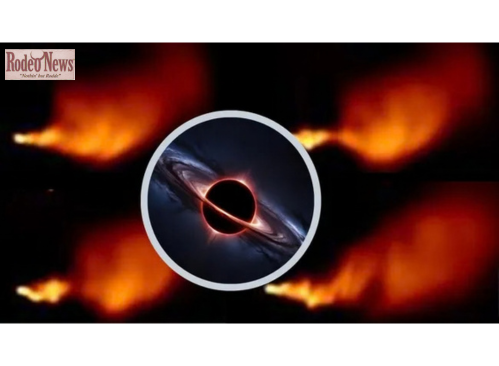
Astronomers have created an unprecedented 27-year reconstruction of a supermassive black hole jet, allowing scientists to watch how plasma moves through one of the most extreme environments in the universe. The research focuses on the distant blazar 3C 345, located about 5.5 billion light-years from Earth.
Instead of relying on individual snapshots, researchers used decades of radio observations to reconstruct a continuous movie of the powerful jet. The approach gives scientists a much clearer view of how material travels outward from the region surrounding a supermassive black hole.
The result has already produced a surprising finding. Bright structures moving through the jet appear to travel at almost the same speed as the underlying flow of plasma. That observation does not overturn the standard explanation for black hole jets, but it challenges that explanation in the specific case of 3C 345 and gives researchers a new way to investigate these extraordinary cosmic structures.
A Supermassive Black Hole Jet Pointing Toward Earth
The object at the center of the research is 3C 345, a type of active galactic nucleus known as a blazar.
Supermassive black holes sit at the centers of many galaxies. When one actively consumes surrounding gas and dust, the material can form a rapidly rotating accretion disk around the black hole. Powerful magnetic fields in this environment can help launch streams of plasma away from the central region at speeds approaching that of light.
These streams are known as relativistic jets.
When an active galactic nucleus is observed from a direction in which one of its jets is pointed approximately toward Earth, astronomers classify it as a blazar. That alignment makes these objects particularly useful for studying extreme astrophysical processes.
The jet from 3C 345 therefore provides an extraordinary laboratory for studying matter, magnetic fields and gravity under conditions that cannot be reproduced on Earth.
Researchers are especially interested in these objects because the physics involved occurs in an extreme gravitational environment. As lead researcher Marianna Foschi of the California Institute of Technology explained to Space.com, black-hole jets provide an opportunity to test general relativity and investigate how gravity and spacetime behave under extreme conditions.
Why 27 Years of Observations Matter
Studying a supermassive black hole jet is difficult because the structures involved are enormously distant and evolve over time.
Traditional observations often provide individual images. Scientists can compare those images to estimate how bright features move through a jet, but the approach has an important limitation.
It is similar to trying to understand a football match by looking at photographs taken every few minutes. The photographs reveal where players were at particular moments, but they do not show everything that happened between the pictures.
The new reconstruction attempts to fill that gap.
The researchers combined a large collection of observations made over approximately 27 years and used an artificial-intelligence-based reconstruction technique known as Kine. The system uses a deep-learning model to map brightness across both space and time.
The result is effectively a continuous movie rather than a collection of disconnected astronomical images.
According to the research team, the technique achieved approximately two orders of magnitude better dynamic range and four times better resolution compared with previous images of the source. The continuous reconstruction also makes it possible to apply standard video-processing techniques to track individual regions within the jet.
That is a major advantage for astronomers.
Rather than simply asking where a bright feature is located in one image compared with another, researchers can examine how structures develop and move through the jet over time.
VLBI Gives Scientists a Closer Look
A key part of the research was a radio astronomy technique called very long baseline interferometry, or VLBI.
VLBI combines observations from widely separated radio telescopes to produce extremely high-resolution measurements. The technique has already played a major role in black-hole astronomy, including the observations that helped produce the first image of a black hole.
For blazars, VLBI is particularly valuable because the jets are compact on the sky despite their enormous physical scale.
The observations allow astronomers to investigate the structure of plasma close to the central black hole and follow changes as material travels outward.
However, VLBI observations collected over many years do not automatically form a movie. The researchers therefore needed a computational method capable of turning individual observations into a coherent reconstruction.
That is where Kine becomes important.
Kine Turns Astronomical Snapshots Into a Movie
The Kine system uses a neural network designed to learn spatial and temporal relationships within the observations.
Instead of treating every image independently, the algorithm searches for patterns that connect the data across time. It then creates a smoother reconstruction that can represent the evolving jet.
The technique allowed researchers to move beyond tracking only large, isolated components.
Previous approaches often represented a jet as a collection of discrete bright features. Scientists could follow those features, but they had less information about the continuous plasma flow surrounding them.
The new reconstruction provides a more complete picture.
The team described it as a significant advance in studying jet dynamics because researchers can examine the movement of individual points within the reconstructed flow.
That opens the possibility of studying other blazars with similarly long observation records.
The Surprising Finding About Plasma Motion
The most interesting result concerns the relationship between bright components and the bulk plasma flow.
One widely used explanation for bright regions inside relativistic jets involves traveling shock fronts.
In that picture, disturbances move through the plasma and produce bright features. The shock front is expected to move differently from the underlying flow of material.
Scientists therefore expected a measurable difference between the speed of the bright components and the speed of the bulk plasma.
But 3C 345 did not behave as expected.
The researchers found that the bright compact components appeared to move at almost the same speed as the bulk flow of plasma.
That does not mean the shock model has been disproved.
The researchers emphasized that they studied only one blazar. As a result, the finding should not be interpreted as evidence that shock fronts are generally absent from black-hole jets.
Instead, it raises a more focused question: What is producing the bright structures observed in 3C 345?
Answering that question will require observations of additional objects.
What Powers a Supermassive Black Hole Jet?
One of the biggest mysteries surrounding these systems is how black holes produce such powerful, narrow streams of material.
A black hole itself does not simply fire plasma outward from its event horizon.
Instead, the process involves material surrounding the black hole.
As gas and dust fall toward a supermassive black hole, the material can form an accretion disk. The disk becomes extremely hot and interacts with powerful magnetic fields.
Those magnetic fields can help channel charged particles away from the central region and into narrow jets.
The jets can then travel across enormous distances at speeds close to the speed of light.
Exactly how the jets are accelerated, collimated and structured remains an active area of research. The 3C 345 study is valuable because following the plasma over many years can reveal details that individual observations cannot provide.
The Discovery Does Not Mean Earth Is in Danger
The description of 3C 345 as a black hole “blasting plasma at our planet” sounds alarming, but the object is approximately 5.5 billion light-years away.
The jet is pointed broadly along our line of sight, which is one reason astronomers classify the source as a blazar. However, the enormous distance means there is no immediate danger to Earth from the jet.
In fact, the fact that scientists can observe the jet is precisely what makes its orientation useful.
When a relativistic jet points toward Earth, effects associated with its high velocity and alignment can make the source especially bright and observable.
Astronomers can therefore use blazars as natural laboratories for studying extreme physics across the universe.
A New Test for Black Hole Physics
The importance of the research goes beyond producing an impressive astronomical video.
Black-hole jets are among the most extreme environments known in nature. They involve powerful magnetic fields, relativistic particles and intense gravitational effects.
That makes them valuable for testing theoretical models.
General relativity describes gravity as the curvature of spacetime caused by matter and energy. Although the theory has survived numerous tests, astronomers continue searching for environments where its predictions can be examined under increasingly extreme conditions.
A supermassive black hole jet offers one such environment.
By following how plasma moves near a black hole and comparing observations with theoretical predictions, scientists can test whether current models correctly explain the behavior of matter and radiation.
The 3C 345 reconstruction therefore represents both an astronomical observation and a new measurement tool.
Scientists Want to Study More Blazars
The researchers are not stopping with 3C 345.
Their next goal is to apply Kine to observations of other blazars. Many of these objects have been monitored for decades, creating exactly the type of long-term data set that the technique is designed to exploit.
Studying a larger sample could determine whether the unusual behavior seen in 3C 345 is common or exceptional.
If similar results appear in many blazars, astronomers may need to reconsider how they explain bright structures inside relativistic jets.
If other blazars show a clear difference between shock speeds and bulk plasma speeds, meanwhile, 3C 345 could prove to be an unusual case.
Either result would be scientifically useful.
A broader comparison could help researchers identify which physical mechanisms control jet formation and evolution.
Artificial Intelligence Is Changing Astronomy
The study also highlights a growing role for machine learning in astronomy.
Astronomers now have access to enormous archives of observations collected over decades. The challenge is often no longer simply gathering data but finding effective ways to extract information from it.
Machine-learning techniques can help identify patterns across large data sets and reconstruct phenomena that would be difficult to analyze manually.
In the case of 3C 345, the Kine algorithm helped turn decades of separate observations into a dynamic representation of the jet.
That does not mean artificial intelligence replaces telescopes or astronomers.
Instead, it provides researchers with new tools for interpreting observations and testing physical models.
The approach could become particularly powerful as observatories continue producing larger and more detailed data sets.
What This Means for Black Hole Research
The 27-year reconstruction of 3C 345 represents an important step toward understanding how relativistic jets actually behave.
For decades, astronomers have known that supermassive black holes can launch extraordinarily powerful jets. Yet the detailed physics controlling those jets remains difficult to observe.
The new reconstruction gives scientists a more continuous view of that process.
Most importantly, it demonstrates that long-term observations contain information that can be missed when researchers study individual images.
The unexpected similarity between the speed of bright components and the underlying plasma flow is one example.
Rather than providing a final answer, the discovery creates a new question for astronomers to investigate.
That is often how major advances in science begin.
The Future of Supermassive Black Hole Jet Studies
The next generation of research could transform the way scientists study black-hole jets.
As more observations accumulate, techniques such as Kine could reconstruct longer and more detailed sequences. Comparing multiple blazars could reveal whether their jets follow the same physical rules or whether different mechanisms dominate in different systems.
The approach could also help researchers distinguish between competing explanations for bright features within jets.
The research team says the method can be applied systematically to sources with decades of observations, giving astronomers an opportunity to turn archival data into new scientific discoveries.
That is particularly valuable because astronomical archives preserve observations of objects that may no longer be monitored as intensively today.
A Cosmic Movie Opens a New Window
The 27-year study of 3C 345 has transformed a long sequence of radio observations into something much easier to understand: a moving picture of a distant supermassive black hole jet.
The reconstruction shows how modern astronomy increasingly combines powerful telescopes, decades of archived observations and artificial intelligence.
It also demonstrates how much remains unknown about the most energetic objects in the universe.
For 3C 345, the unexpected behavior of its bright jet components has raised new questions about shock fronts and plasma motion. Researchers now plan to examine other blazars to determine whether the same pattern appears elsewhere.
At a distance of roughly 5.5 billion light-years, 3C 345 is impossibly far from Earth. Yet the new reconstruction allows scientists to study its violent plasma jet in unprecedented detail.
The result is more than a striking cosmic movie. It is a new way to investigate how supermassive black holes influence their surroundings, how relativistic jets form and evolve, and how the laws of physics behave in some of the most extreme environments the universe has to offer. The underlying research was published in Nature in August 2026.