Peter Max Legacy: The Artist Who Colored the ’60s
Peter Max, the flamboyant artist whose bright colors, cosmic imagery and psychedelic designs became closely associated with the optimism of the 1960s, has died at 88. His death marked the end of a career that stretched far beyond traditional galleries, taking his distinctive visual language into homes, advertisements, public events, consumer products and popular culture.
Max died Sept. 14 in New York, according to his family. He had been living with advanced dementia in his later years. His death has renewed attention on an artist whose work was both widely celebrated by the public and often viewed differently by the traditional art establishment.
Peter Max Built a New Kind of Art Career
Peter Max became famous at a time when American culture was changing rapidly. His work appeared during the rise of the counterculture, when young Americans were embracing new ideas about music, fashion, spirituality and personal expression.
His artwork was immediately recognizable. Bright oranges, pinks, greens and blues filled his compositions, while stars, planets, butterflies, flowers, rainbows and floating figures created a dreamlike universe.
But Max did not limit those images to paintings.
His designs appeared on posters, clothing, household products and other commercial goods. His name became a brand as much as an artistic identity, allowing his imagery to reach millions of people who might never have visited an art museum.
The New York Times described that commercial reach as central to his success, noting that Max developed distribution and licensing operations that helped turn his imagery into a mass-market phenomenon.
His Art Became Part of Everyday American Life
Max’s success was unusual because his work could be encountered almost anywhere.
A person might see a Peter Max poster on a bedroom wall, encounter his designs on consumer products or recognize his colorful imagery at a major sporting event. His work was also commissioned for prominent national occasions, including the Olympics, the Super Bowl, the Indianapolis 500 and other major events.
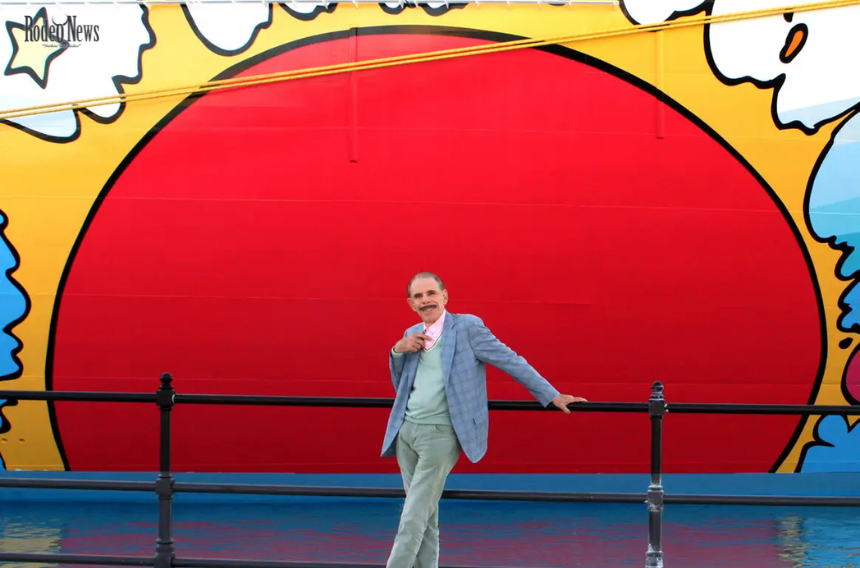
He also designed artwork connected with transportation and tourism. His colorful style appeared on a Boeing 777 and a Norwegian Cruise Line ship, demonstrating how far his visual identity had traveled from the conventional gallery system.
One of his most recognizable themes was the “Cosmic Jumper,” a youthful figure moving through an imagined universe. The character appeared on a U.S. Postal Service stamp created for Expo ’74, helping connect Max’s psychedelic style with a major national cultural event.
Peter Max and the Counterculture Era
Max’s rise coincided with a period when American artists were increasingly challenging traditional ideas about what art could be.
His images were not designed to be difficult to understand. Instead, they offered immediate visual impact. The combination of cheerful colors, simple forms and cosmic themes made his work accessible to a huge audience.
That accessibility was also part of the reason critics sometimes treated his work differently from artists who operated primarily within museums and galleries.
The Times appraisal of Max’s career argued that commercial distribution was not merely a side effect of his fame. It was fundamental to it. His posters and licensed products helped create a model in which an artist’s imagery could become a mass cultural product.
From Berlin to New York
Max was born Peter Max Finkelstein in Berlin in 1937. His family left Germany when he was an infant and spent time in Shanghai, Tibet and other locations before eventually settling in New York when he was a teenager.
He studied art in New York and initially developed his career in graphic design.
During the 1960s, his visual style began attracting major attention. As his popularity increased, advertising agencies, businesses and cultural organizations sought his work.
However, commercial success eventually created a conflict for Max. He later expressed frustration that his business activities had taken him away from painting.
In the early 1970s, he stepped back from some of that commercial activity and returned his attention to fine art.
Peter Max Painted the Statue of Liberty
One of Max’s most notable later projects involved the Statue of Liberty.
In 1981, he created a series of paintings featuring the landmark, including work produced at the White House at the invitation of first lady Nancy Reagan. The project became another example of Max’s ability to combine his distinctive visual style with major American symbols.
His subjects over the decades included political figures, musicians and celebrities. His connections to the music world were particularly notable, with portraits involving figures such as Jimi Hendrix, Mick Jagger and other major performers.
Taylor Swift also identified Max as an artistic influence. In 2010, he created an adaptation of one of her album-cover photographs.
A Complicated Final Chapter
Max’s later years were accompanied by serious personal and legal controversies.
In 1997, he pleaded guilty to concealing more than $1 million in income from federal authorities. He was required to pay back taxes and a fine and perform community service.
Years later, disputes involving his family, business associates and the management of his artwork generated lawsuits and competing accusations. Questions were also raised about the production and sale of artwork as his health declined.
Those controversies complicated the legacy of an artist whose public image had long been associated with happiness, peace and optimism.
A Lasting Cultural Legacy
Peter Max’s importance may ultimately be measured less by traditional art-world rankings than by the extraordinary reach of his imagery.
His work became part of the visual vocabulary of an entire generation. Millions of people encountered his art through posters, products, public commissions and popular culture.
That broad reach also created an unusual contradiction. Max was both an artist and a commercial phenomenon, operating between fine art, graphic design, advertising and mass entertainment.
His death closes the life of a figure who helped demonstrate how a recognizable artistic style could move from canvas to virtually every corner of American culture.
For many people, Peter Max’s work remains inseparable from the colorful optimism of the 1960s. His stars, rainbows, planets and smiling figures offered an uncomplicated vision of a brighter world.
That vision, more than half a century later, remains one of the clearest reasons his art is still instantly recognizable.