Modi Urges Putin to End Ukraine War for Humanity’s Sake
Indian Prime Minister Narendra Modi has urged Russian President Vladimir Putin to move toward ending the war in Ukraine, saying that the conflict must ultimately give way to peace for the sake of humanity. The appeal came during a bilateral meeting between the two leaders in Bishkek, Kyrgyzstan, on the sidelines of the Shanghai Cooperation Organisation summit on August 31, 2026.
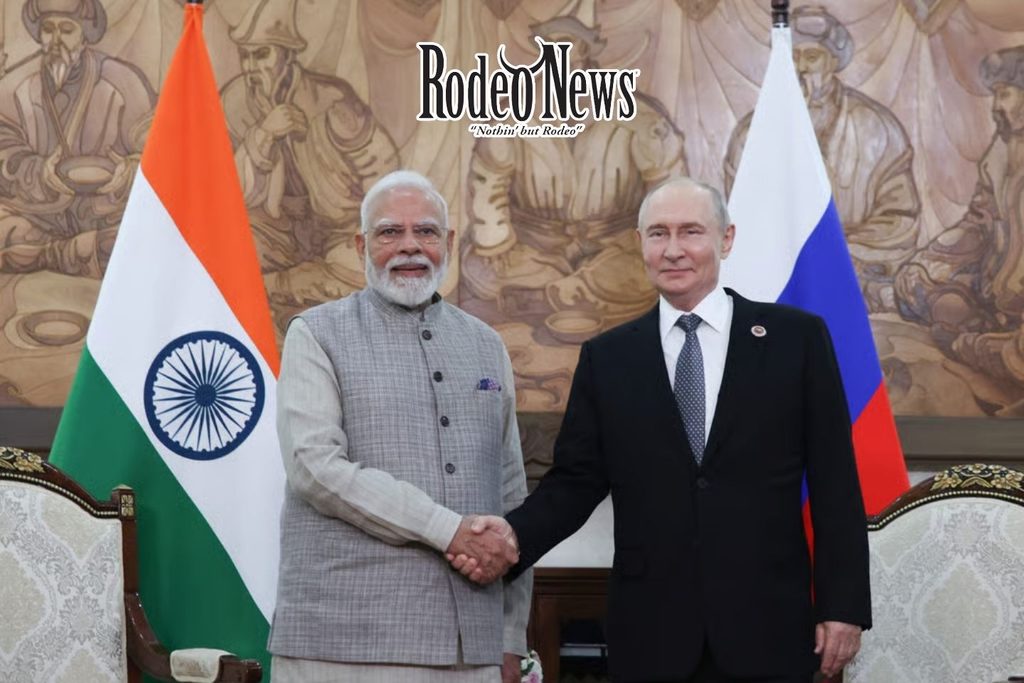
Modi’s message was notable because it came during a meeting that also highlighted the strength of India’s strategic relationship with Russia. While New Delhi continues to maintain close economic, energy and diplomatic ties with Moscow, the Indian prime minister again emphasized dialogue and diplomacy as the path toward resolving international conflicts.
The meeting therefore carried two messages at once. India wants to preserve its important relationship with Russia, but it also wants the war in Ukraine to move toward a negotiated conclusion.
Modi Urges Putin to End Ukraine War
At the beginning of the talks, Modi told Putin that India supports efforts aimed at ending the fighting and would continue to support peace initiatives.
The Indian leader framed the issue in broader humanitarian terms. He argued that every additional day of war represents a setback for humanity, while progress toward peace offers hope.
Modi called for a transition away from what he described as an endless war and toward an end to hostilities. His remarks reinforced India’s long-standing preference for dialogue, diplomacy and negotiations rather than an open-ended military confrontation.
The language was significant because Modi was speaking directly to Putin, whose government continues to prosecute the war while describing Russia’s actions as a “special military operation.”
Although India’s message was not presented as a public ultimatum, it was nevertheless a clear call for Moscow to pursue a peaceful settlement.
A Delicate Message From a Key Russian Partner
India’s position on the Ukraine war has long involved a careful balancing act.
New Delhi has avoided joining Western sanctions against Russia and has maintained substantial energy and defense relationships with Moscow. At the same time, Indian officials have repeatedly emphasized that disputes should be resolved through dialogue and diplomacy.
That approach allows India to maintain its strategic relationship with Russia while avoiding full alignment with Moscow’s position on the war.
The latest meeting illustrates that balancing strategy. Modi referred to Putin as a friend and praised the development of bilateral ties. Yet he also made clear that the continuation of the war carries consequences beyond the battlefield.
India’s government said the two leaders reviewed cooperation across political, economic, defense, energy, space, mobility and people-to-people ties. They also discussed international issues, including conflicts affecting maritime trade and the security of Indian seafarers.
India and Russia Continue to Strengthen Economic Ties
The peace appeal did not overshadow the broader strategic relationship between India and Russia.
The two countries have continued to cooperate in areas ranging from energy and defense to space and trade. India has also become one of the major buyers of Russian crude oil since the war began.
That energy relationship has become especially important since Western sanctions disrupted many of Russia’s traditional European energy markets. India, together with China, has emerged as a major destination for Russian oil, helping Moscow maintain export revenues.
For New Delhi, access to affordable energy is an important national interest. Maintaining energy security while pursuing diplomatic engagement with Moscow has therefore become a central feature of India’s foreign policy.
The relationship is also broader than oil.
India and Russia cooperate in defense, nuclear energy, space technology, fertilizers and other sectors. India’s Prime Minister’s Office said the latest meeting reviewed progress across these areas and emphasized the resilience of the two countries’ “Special and Privileged Strategic Partnership.”
Putin Acknowledges India’s Position
Putin responded to Modi’s comments while emphasizing the continuing importance of the India-Russia relationship.
According to the Kremlin, Putin thanked Modi for his personal attention to bilateral ties and described the relationship as a special and privileged strategic partnership. He also highlighted coordination between the two countries through international organizations including the United Nations, BRICS, the G20 and the SCO.
The Russian president also updated Modi on the situation surrounding the war in Ukraine, according to Russian government reporting cited by Reuters.
However, Moscow’s position on how the conflict should end remains substantially different from that of Kyiv and many Western governments. Russia has continued to insist that any settlement must address its security and territorial demands, while Ukraine has rejected conditions it regards as unacceptable.
That gap means Modi’s call for an end to the war does not automatically translate into a practical negotiating framework.
The Ukraine War Remains a Major Global Challenge
More than four years after Russia launched its full-scale invasion of Ukraine in February 2022, the conflict continues to have consequences far beyond the two countries.
The war has reshaped European security, disrupted energy markets, affected food and fertilizer supplies and contributed to wider geopolitical tensions.
It has also intensified competition between Russia and Western countries while encouraging Moscow to strengthen relationships with major non-Western powers such as India and China.
For India, the conflict presents a particularly complicated diplomatic challenge.
New Delhi wants stable relations with Moscow, but it also has expanding economic and strategic relationships with the United States and European countries. India therefore has an interest in avoiding a prolonged confrontation that could further divide the international system.
Modi’s repeated calls for dialogue reflect that position.
Modi’s Peace Message Builds on Earlier Appeals
The latest remarks are not the first time Modi has publicly encouraged Putin to pursue peace.
India has repeatedly argued that dialogue and diplomacy are necessary for resolving the Ukraine conflict. Modi has previously used high-level meetings with Putin to stress that war cannot provide a sustainable solution.
That diplomatic language has become a recognizable feature of India’s approach to the conflict.
Rather than publicly condemning Moscow in the same terms used by many Western governments, New Delhi has attempted to maintain channels with both sides while presenting itself as a potential voice for dialogue.
The strategy has given Modi an opportunity to speak directly with Putin while maintaining India’s broader international partnerships.
SCO Summit Provides Important Diplomatic Setting
The meeting took place during the 26th Shanghai Cooperation Organisation summit in Bishkek.
The SCO has become an increasingly important platform for non-Western powers, with India, Russia, China and other member states using the organization to discuss security, economic cooperation and regional affairs.
The gathering also brought together leaders whose countries have different positions on the Ukraine war and on relations with the United States.
For Russia, maintaining close relationships with India and China is strategically important as Moscow continues to face Western pressure.
For India, the SCO offers another platform for maintaining diplomatic engagement with Russia while also strengthening its role in a changing international order.
The Bishkek meeting therefore had significance beyond the immediate discussion of Ukraine.
India Wants Dialogue, but the Path to Peace Remains Difficult
Modi’s call to end the Ukraine war could carry diplomatic weight because India maintains a relationship with Moscow that many Western governments do not possess.
However, there are major obstacles to converting diplomatic appeals into an actual peace agreement.
Russia and Ukraine continue to disagree over territory, security arrangements and the political conditions required for a settlement. The two sides have also struggled to establish a framework capable of resolving their fundamental differences.
As a result, India’s influence may be more significant as a channel for communication than as a direct mediator capable of imposing a settlement.
Still, maintaining communication can be valuable.
A country that remains trusted by both sides may have opportunities to encourage negotiations when political conditions become more favorable.
India Balances Peace With National Interest
The meeting also demonstrated the central principle guiding India’s relationship with Russia: national interest remains a priority.
Modi praised the progress in India-Russia cooperation while simultaneously pressing for an end to the war. India’s government says the bilateral partnership continues to grow despite wider geopolitical uncertainty.
That combination is unlikely to disappear soon.
India needs energy supplies, defense cooperation and strategic flexibility. Russia, meanwhile, values India’s continued economic and diplomatic engagement at a time when Moscow faces significant pressure from Western governments.
Both countries therefore have strong incentives to preserve their relationship.
At the same time, India has made clear that maintaining ties with Russia does not mean endorsing endless warfare.
BRICS Meeting Could Bring Another Opportunity
The diplomatic relationship will receive another major test in September.
Modi said he looks forward to welcoming Putin to India for the 18th BRICS Summit, scheduled for September 12-13, 2026.
That meeting could provide another opportunity for the two leaders to discuss Ukraine and broader global security issues.
BRICS has become an increasingly important diplomatic forum as countries seek alternatives to traditional Western-led institutions. India’s chairmanship in 2026 gives New Delhi an additional opportunity to shape discussions among major emerging economies.
If the Ukraine conflict remains unresolved, the issue is likely to remain part of the wider diplomatic environment surrounding the summit.
What Modi’s Message Means for the Ukraine War
Modi’s latest appeal does not mean India has changed its fundamental relationship with Russia.
Instead, it reinforces a policy that combines strategic cooperation with diplomatic pressure for peace.
The Indian prime minister’s message was direct: the conflict should not continue indefinitely, and diplomacy must eventually replace military confrontation.
Whether Moscow is prepared to move in that direction remains uncertain.
For now, Russia continues to pursue its objectives in Ukraine, while Kyiv and its international partners remain opposed to a settlement that would compromise Ukraine’s sovereignty or territorial integrity.
That makes the road to peace extremely difficult.
Nevertheless, Modi’s intervention demonstrates that the diplomatic pressure for an end to the conflict is not limited to Western governments. Major countries outside the Western alliance, including India, are also increasingly emphasizing the need for a political resolution.
A Significant Moment in India-Russia Diplomacy
The Modi-Putin meeting in Bishkek ultimately highlighted the complexity of modern international diplomacy.
India is maintaining a close partnership with Russia while simultaneously urging Moscow to end the war in Ukraine. Modi’s decision to deliver that message directly to Putin shows how New Delhi is attempting to use its relationship with Moscow to promote dialogue without abandoning its own strategic interests.
The coming weeks could provide further opportunities for that diplomacy, particularly with Putin expected in India for the BRICS summit in September.
For now, however, Modi’s appeal remains primarily a diplomatic message rather than a breakthrough agreement.
The significance lies in who delivered it and where.
A leader who maintains strong economic and strategic ties with Moscow has publicly told Putin that the war must eventually end and that every step toward peace offers hope to the wider world.
As the conflict continues, that message is likely to remain central to India’s diplomatic strategy: preserve relationships, keep channels open and push, however cautiously, for a path from prolonged war toward peace.