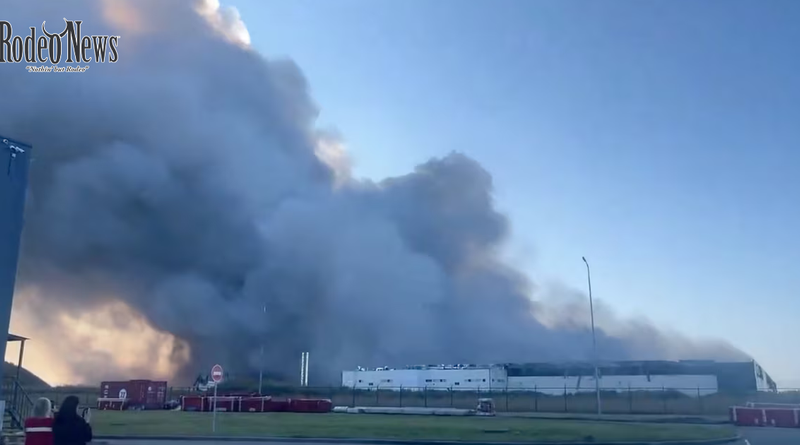
Wildberries Warehouse Fire Destroys Major Russian Logistics Hub
The Wildberries warehouse fire in Russia’s Tambov region has destroyed a major logistics facility after an overnight drone attack, according to regional authorities and Reuters. The incident took place at a Wildberries logistics center in Kotovsk, where roughly 100,000 square meters of warehouse space were engulfed by flames.
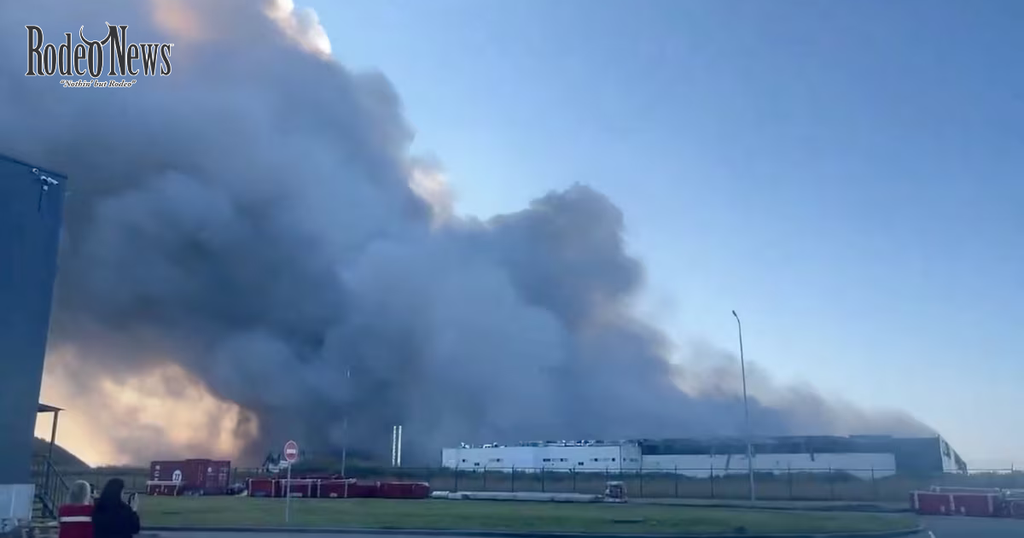
Tambov Governor Evgeniy Pervyshov said two people were wounded in the attack and that the logistics center was eventually completely destroyed by fire. The scale of the damage highlights the growing vulnerability of Russia’s commercial infrastructure as Ukraine expands its long-range drone campaign beyond traditional military targets.
The attack is also significant because Wildberries is Russia’s largest online marketplace and one of the country’s most important e-commerce companies. Its distribution network connects millions of customers and merchants across the country, making large logistics facilities essential to the wider consumer economy.
Read the original Reuters report
Wildberries Warehouse Fire Hit 100,000 Square Meters
The size of the Wildberries warehouse fire was one of the most striking aspects of the incident.
According to Governor Pervyshov, approximately 100,000 square meters of the facility were burning. Reuters compared that area with roughly 14 soccer pitches, illustrating the enormous physical scale of the logistics complex.
The governor later said the facility had been completely destroyed by fire. Two people were reported wounded in the overnight strike.
The warehouse was located in Kotovsk, a city in the Tambov region southeast of Moscow. The region is far from the immediate front line of the Russia-Ukraine war, underscoring how Ukraine’s drone campaign has increasingly reached deep inside Russian territory.
The attack did not simply affect a single building. A logistics center of this size can support the movement, storage and processing of enormous quantities of consumer goods. Damage to such infrastructure can therefore create disruptions beyond the physical site itself.
Wildberries has previously experienced attacks on its facilities, making the latest destruction part of a wider pattern rather than an isolated incident.
Why Ukraine Is Targeting Wildberries
Ukraine has been targeting Wildberries facilities since mid-July as part of a broader effort to strike Russian economic and logistics infrastructure.
Kyiv has argued that attacks on commercial logistics networks can weaken Russia’s ability to sustain its war effort. Moscow and Wildberries, meanwhile, have rejected claims that the retailer’s facilities are being used for military purposes.
Reuters reported that the campaign has recently expanded to include Ozon, Wildberries’ main domestic competitor. This suggests that the strategy is increasingly focused on Russia’s wider e-commerce and distribution infrastructure rather than one company alone.
The broader significance is economic. Wildberries and Ozon operate some of the largest distribution networks in Russia and are major participants in one of the country’s fastest-growing economic segments.
That makes their warehouses attractive targets if the objective is to create economic disruption without directly attacking traditional military bases.
More Than 20 Warehouses Have Been Attacked
The destruction in Tambov comes after a series of attacks against warehouses operated by Wildberries and Ozon.
According to Reuters analysis of satellite imagery, more than 20 Wildberries and Ozon facilities have been attacked, with at least 1.9 million square meters of warehouse space severely damaged by fire.
The numbers indicate that the attacks are becoming a substantial challenge for Russia’s logistics sector.
Large distribution centers are difficult to replace quickly. Even when companies can reroute goods to other warehouses, transportation distances, processing capacity and inventory management can become more complicated.
For online retailers, logistics are especially important because customers expect rapid delivery. A major disruption at one hub can therefore affect merchants, consumers, transport operators and warehouse workers at the same time.
The cumulative impact could be more important than the destruction of any single facility.
Ozon Has Also Become a Target
The escalation has not been limited to Wildberries.
In recent days, Ukrainian drone attacks have also struck logistics facilities belonging to Ozon, Russia’s second-largest online retailer. Reuters reported that several Ozon hubs were targeted across Russian regions, with some facilities evacuated or forced to suspend operations.
One of the attacks caused a major fire at an Ozon logistics facility in Makhachkala. Other facilities were affected in regions including Krasnodar, Adygeya, Stavropol, Samara and Orenburg.
The attacks demonstrate a broader shift toward economic infrastructure.
Instead of limiting long-range drone operations to oil refineries, airfields and military installations, Ukraine appears increasingly willing to target the commercial networks that keep Russia’s domestic economy moving.
That strategy could create pressure on businesses even when individual strikes cause no direct military damage.
A Growing Economic Pressure Campaign
The Wildberries warehouse fire comes against a backdrop of increasing pressure on Russia’s economy.
After more than four years of full-scale war, Russia has maintained substantial economic activity despite Western sanctions and military spending. However, Reuters has reported that the Russian economy is close to stagnation, making disruptions to major commercial networks more significant.
E-commerce has been one of the brighter parts of the Russian economy.
Consumers have increasingly shifted toward online shopping, while companies such as Wildberries and Ozon have built enormous networks of warehouses, delivery points and transportation routes.
That growth has also made the sector strategically important.
When a large logistics hub is destroyed, the effects can extend to thousands of merchants that depend on the platform. Products may need to be redirected, deliveries can be delayed and inventory can become temporarily inaccessible.
For a company operating at national scale, rebuilding a destroyed 100,000-square-meter facility would also require significant time and investment.
Russia Moves to Protect Vulnerable Infrastructure
The growing attacks on commercial and industrial facilities have prompted a response from the Russian government.
On August 24, President Vladimir Putin issued a decree allowing the Russian state to temporarily take control of critical infrastructure considered inadequately protected from drone attacks and other threats. The measure covers areas including energy, fuel, industry, communications, transport and logistics.
Russian officials said the measure was not intended as a general nationalization policy. Instead, they described it as a way to respond to security problems and ensure that important infrastructure can continue operating.
The timing is notable.
The decree came shortly before the destruction of the Wildberries facility in Tambov and amid a rapidly expanding series of attacks against Russian logistics and energy infrastructure.
The government is therefore facing two challenges at once: protecting critical facilities from drones and maintaining economic activity when some sites are damaged or destroyed.
The Wildberries Attack Is Part of a Wider Drone War
The latest attack also illustrates how the geography of the Russia-Ukraine war has changed.
Drones allow Ukraine to strike targets hundreds of kilometers from the front line. Russia has repeatedly reported intercepting large numbers of Ukrainian drones, but falling debris and successful strikes have still caused fires, damage and casualties.
On the same day as the Tambov incident, Russian authorities reported deaths in other regions following drone-related incidents.
In neighboring Lipetsk, a man and a 14-year-old were killed in a fire caused by a falling drone, according to local authorities. A woman was also reported killed in a drone attack in Belgorod, which borders Ukraine.
Both Russia and Ukraine have repeatedly denied deliberately targeting civilians.
The continuing attacks nevertheless show how drone warfare is increasingly affecting areas far from active ground combat.
What the Warehouse Destruction Means for Wildberries
For Wildberries, the immediate challenge is replacing lost logistics capacity.
A facility covering approximately 100,000 square meters represents a substantial amount of storage and processing space. The company will need to determine how much inventory was destroyed, what operations can be transferred elsewhere and how quickly alternative facilities can absorb additional demand.
The company has previously faced disruptions after attacks on its logistics centers.
Reuters reported in July that two Wildberries hubs had been targeted, killing workers and disrupting operations. The Kremlin subsequently acknowledged that the company and merchants using its platform had suffered losses.
The repeated attacks could therefore create a longer-term challenge for the retailer.
Even if individual operations can be restored, a sustained campaign against multiple warehouses could force the company to spend more on security, alternative logistics routes and emergency capacity.
Those costs could ultimately affect merchants and consumers.
Why E-Commerce Infrastructure Matters to Russia
Wildberries is more than a conventional retailer.
Its platform connects consumers with a huge number of merchants and relies on a nationwide logistics network. That makes warehouses, sorting centers and delivery infrastructure essential components of the broader Russian consumer economy.
The same is true of Ozon.
The two companies have become major forces in Russian retail, particularly as online shopping has expanded. Their logistics systems help move goods across a country spanning multiple time zones and thousands of kilometers.
That explains why attacks on their facilities can have economic significance even when the facilities are not military targets.
From Ukraine’s perspective, disrupting logistics can potentially increase the cost of maintaining Russia’s economy during wartime.
From Russia’s perspective, protecting those facilities has become an increasingly urgent security issue.
No Sign Yet of an End to the Attacks
The destruction of the Tambov facility does not appear to mark the end of Ukraine’s campaign against Russian logistics infrastructure.
The recent shift toward Ozon suggests that the strategy is broader than Wildberries alone. At the same time, Ukrainian strikes have continued to target Russian oil facilities and other infrastructure considered important to Moscow’s war effort.
Ukraine has also claimed responsibility for strikes against multiple Russian targets, including oil and logistics facilities.
The Russian government, meanwhile, is trying to strengthen defenses around important infrastructure and has introduced new mechanisms for state intervention when private facilities are deemed insufficiently protected.
The result is an expanding economic dimension to the drone war.
Bottom Line
The Wildberries warehouse fire in Kotovsk is significant not only because of the size of the facility that was destroyed, but also because it reflects a broader transformation in the Russia-Ukraine drone war.
Approximately 100,000 square meters of logistics space were engulfed before the facility was declared completely destroyed, while two people were reported wounded. Reuters analysis indicates that more than 20 Wildberries and Ozon warehouses have been attacked since the campaign against Russian e-commerce infrastructure intensified.
The attacks demonstrate that Russia’s commercial infrastructure is increasingly exposed to long-range drone warfare.
For Wildberries, the immediate priority will be restoring logistics capacity. For Russia, the challenge is broader: protecting the economic networks that support everyday commerce while the war continues to expand into areas far from the battlefield.
As attacks increasingly focus on warehouses, oil facilities and other infrastructure, the economic consequences of the war are becoming harder to separate from its military consequences.
Internal link suggestion: Add a link here to your existing article covering the Russia-Ukraine war, Ukrainian drone attacks, or Russian economic developments.
External source: Reuters — Wildberries warehouse destroyed in Tambov drone attack
Related external source: Reuters — Ukraine targets Ozon logistics hubs