Ukraine Wartime Elections Face New Political Test
The debate over Ukraine wartime elections has intensified after President Volodymyr Zelenskyy rejected calls for a national vote while Russia’s full-scale invasion continues, warning that elections under current conditions could seriously divide the country.
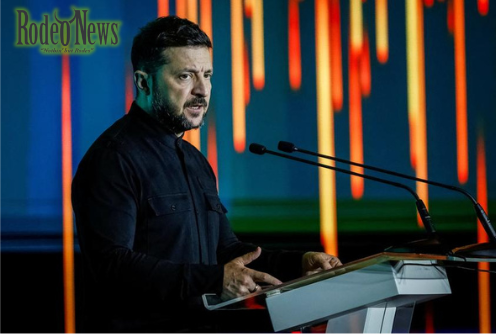
Speaking to journalists on Sunday, Zelenskyy argued that holding elections during an active war would expose Ukraine to enormous political and security risks. His comments came after former Defence Minister Mykhailo Fedorov publicly called for elections, adding a new layer of tension to Ukraine’s already difficult domestic political environment.
Zelenskyy’s position reflects a fundamental dilemma facing Ukraine. On one side is the principle of democratic elections and political accountability. On the other is the practical reality of a country fighting a major war, with parts of its territory occupied, millions of citizens displaced and Russian attacks continuing across Ukrainian cities.
For Kyiv, the question is therefore not simply whether an election can technically be organized. The larger issue is whether a vote could be considered safe, fair and legitimate while the war remains active.
Ukraine Wartime Elections Could Deepen Political Divisions
Zelenskyy delivered one of his strongest warnings yet against holding elections during the conflict.
The Ukrainian president said an election at this stage could become a destabilizing event rather than a demonstration of democratic strength. He described the potential consequences as severe, arguing that political competition during wartime could create divisions that Russia could exploit.
That concern comes at a particularly sensitive moment for Ukraine’s leadership.
Fedorov, who was dismissed as defence minister last month, has emerged as a prominent critic of the current political direction. His decision to publicly advocate elections created an unusual challenge for Zelenskyy, particularly because Fedorov had previously been closely associated with Ukraine’s wartime modernization and digital transformation efforts.
The controversy has already demonstrated how quickly the election question can become politically explosive.
Calls for Fedorov’s reinstatement initially generated protests, but the momentum weakened after he pushed for wartime elections. Reuters reported that supporters and protesters subsequently backed away from the election demand, while polling has indicated that many Ukrainians remain reluctant to hold a national vote while the fighting continues.
The dispute suggests that the election debate is about more than Zelenskyy’s political future. It is also becoming a broader argument about how Ukraine should preserve democratic institutions without undermining national unity during an existential conflict.
Why Elections Are Difficult Under Martial Law
The legal environment presents another major obstacle to Ukraine wartime elections.
Ukraine has operated under martial law since Russia’s full-scale invasion in February 2022. Ukrainian law prohibits presidential, parliamentary and local elections while martial law remains in force, meaning that holding a nationwide vote would require major legal and political changes.
The issue is especially complicated because Ukraine’s normal electoral timetable has already been disrupted by the war.
The presidential election that would ordinarily have taken place in 2024 did not occur. Parliamentary elections have also been delayed. Ukraine’s political institutions have continued operating under the legal framework governing wartime conditions.
This means an election cannot simply be scheduled like an ordinary peacetime contest.
A credible national vote would need to address security, voter registration, campaigning, media access, voting procedures and the participation of Ukrainians who are serving in the military or living abroad.
The situation becomes even more complicated in territories occupied by Russia.
Millions of Ukrainians have been displaced internally or have left the country since the invasion. Meanwhile, Russian forces continue to occupy Ukrainian territory. Ensuring that displaced and overseas citizens can participate while preventing coercion or manipulation would represent an enormous logistical challenge.
Security Would Be the Biggest Challenge
The first major risk surrounding Ukraine wartime elections is security.
Ukraine continues to face Russian missile and drone attacks, including strikes on civilian infrastructure. Zelenskyy has warned that Russian military pressure could intensify further, while Kyiv is also struggling with shortages of air-defence interceptors.
Under those circumstances, protecting polling stations would be extraordinarily difficult.
A national election would require thousands of polling locations operating simultaneously. Election workers, candidates and voters could all potentially become targets.
Even a limited number of attacks could disrupt voting in particular regions and raise questions about whether the overall result accurately represented the population.
The problem would not necessarily be limited to physical attacks.
Cyberattacks, disinformation campaigns and attempts to manipulate voters could also threaten the credibility of the process. Russia has repeatedly used information operations alongside its military campaign, making election infrastructure an especially attractive target.
A contested result under such circumstances could create the exact political instability that Zelenskyy says he wants to avoid.
The Challenge of Voting From Occupied Areas
The second major risk involves territory controlled by Russia.
A democratic election requires citizens to have a meaningful opportunity to vote. But Ukrainians living under Russian occupation could face serious security risks if they attempted to participate in a Ukrainian election.
At the same time, excluding occupied territories would create another difficult political question.
Ukraine would have to determine how those populations are represented and how their votes are incorporated into the national result.
The problem is not unique to Ukraine, but the scale of the territorial dispute makes it unusually complicated.
The country also faces the challenge of millions of displaced citizens. Some Ukrainians now live elsewhere in Europe, while others are internally displaced. Maintaining an accurate voter registry and ensuring that citizens do not accidentally vote multiple times would require extensive preparation.
These issues demonstrate why international support could become essential if Ukraine eventually decides to hold elections before the conflict is fully resolved.
Zelenskyy has said he would consider elections if Ukraine’s international partners could provide sufficient security guarantees and help create conditions for a democratic process. However, he said that concrete proposals addressing those concerns have not yet been provided.
Russia Could Benefit From Political Instability
The third major concern is the possibility that Russia could exploit divisions created by an election.
Ukraine is already under enormous military and economic pressure. Russia continues to attack Ukrainian infrastructure while attempting to strengthen its military position.
Zelenskyy has warned that Moscow could seek to increase its troop numbers after Russia’s September elections, with Kyiv estimating that hundreds of thousands of additional recruits could potentially be mobilized. Reuters reported that Zelenskyy also warned about continued Russian pressure in the Donbas region and a growing demand for air-defence capabilities.
In that environment, an election campaign could become another battlefield.
Candidates could disagree sharply over military strategy, negotiations with Russia, international aid and the future of occupied territories. Those debates are normal in a democracy, but during an active invasion they could also expose deep divisions over national strategy.
Russia could then attempt to amplify those disagreements through propaganda and disinformation.
That does not mean elections would necessarily weaken Ukraine. A credible and secure election could potentially strengthen democratic legitimacy. But the conditions required to achieve that outcome would be substantially more demanding than during peacetime.
Fedorov’s Election Push Raises Political Stakes
The election debate gained new momentum after Fedorov called for a national vote.
His intervention was significant because he had previously been a key member of Zelenskyy’s government. His dismissal and subsequent political campaign have therefore become part of a wider discussion about Ukraine’s leadership.
Zelenskyy has publicly criticized Fedorov’s political actions and indicated that he viewed the election push as potentially destabilizing. The president has also linked the broader dispute to concerns about maintaining unity during the war.
Fedorov’s move nevertheless highlights an important question: how long can Ukraine postpone electoral competition without creating concerns about political accountability?
That question is likely to become more prominent if the war continues for an extended period.
For now, however, Ukraine’s political leadership appears to remain focused on maintaining wartime stability rather than opening a nationwide election campaign.
Zelenskyy’s Position Is Not Simply Anti-Election
Despite his strong criticism of the idea, Zelenskyy’s position does not amount to an outright rejection of elections.
His argument is that the conditions must first exist for a legitimate and secure democratic process.
That distinction is important.
Zelenskyy has indicated that Ukraine could consider an election if its allies help guarantee security and ensure that citizens—including those displaced abroad and people living close to the front—can participate.
The president’s position therefore leaves open the possibility of an election under a different set of circumstances.
A ceasefire or substantial reduction in hostilities could dramatically change the calculation.
So could stronger international guarantees, expanded air-defence coverage and a detailed mechanism for voting by soldiers, displaced people and citizens overseas.
Until those conditions exist, however, Kyiv appears unwilling to take the risk.
What Happens Next for Ukraine’s Elections?
The future of Ukraine wartime elections will likely depend on developments both on the battlefield and in international diplomacy.
If Russia’s military pressure decreases and a credible ceasefire emerges, pressure for elections could increase quickly. Western governments could also play a major role by helping Ukraine design secure voting procedures and providing technical and financial assistance.
If the war intensifies, the opposite is more likely.
Continued Russian missile attacks, military mobilization and fighting in eastern Ukraine would make a nationwide election increasingly difficult to organize.
The domestic political debate will also remain important.
Fedorov’s challenge demonstrates that disagreements over Ukraine’s political future are becoming more visible even as the country remains at war. At the same time, Zelenskyy’s continued emphasis on national unity suggests that he believes political stability must remain the priority.
For Ukraine, the central challenge is finding a balance between democratic legitimacy and national survival.
An election can strengthen a democracy when voters can participate freely and candidates can campaign safely. But an election conducted amid widespread attacks, territorial occupation and displacement could produce the opposite effect if large parts of the population cannot participate or if the results are immediately disputed.
That is the dilemma at the heart of the current debate.
A High-Stakes Decision for Kyiv
The debate over Ukraine wartime elections is unlikely to disappear.
Zelenskyy’s latest warning shows that the issue has moved beyond an abstract constitutional question. It is now part of a larger political struggle over Ukraine’s wartime leadership, its democratic institutions and the country’s strategy for confronting Russia.
For now, Zelenskyy believes an election during the current phase of the war could fracture the country rather than strengthen it. His government is instead concentrating on military defence, international support and preventing further Russian advances.
Yet the pressure for a political transition may continue to grow as the conflict enters another prolonged phase.
The eventual solution will likely require more than a decision from Kyiv alone. Ukraine’s allies may need to help create the security and logistical conditions necessary for a credible vote.
Until then, the question remains unresolved.
Ukraine must defend not only its territory but also the democratic system it says it is fighting to preserve. Finding a way to protect both will be one of the country’s most difficult political challenges in the months ahead.