Thai PM Downplays Border Conflict Risk; Experts Warn Cambodia to Stay Cautious
BANGKOK/PHNOM PENH – Thailand’s caretaker Prime Minister Anutin Charnvirakul has adopted a distinctly pacifist tone regarding the volatile frontier with Cambodia, asserting that neither nation poses a threat to the other so long as current peace declarations are upheld. However, while the message has provided a temporary reprieve for border residents, regional analysts warn that the rhetoric may be more tied to Thailand’s upcoming general election than a genuine restoration of mutual trust.
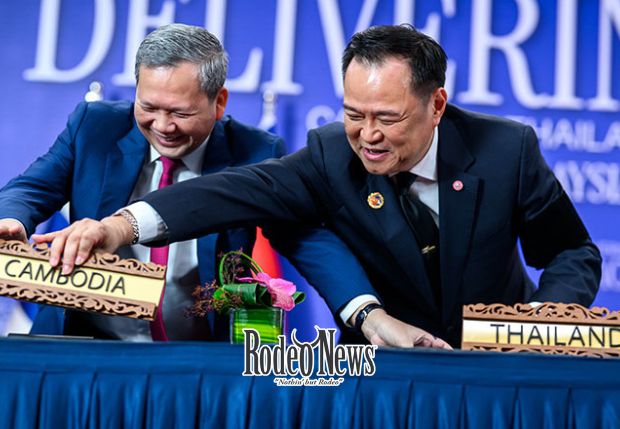
Speaking at Government House on Tuesday following a high-level visit to the border in Sa Kaeo province, Anutin stated there are currently “no indications” of a third round of military hostilities. His comments come at a sensitive time, as thousands of displaced civilians have only recently begun returning to their homes following the December 27 ceasefire.
A Narrative of De-escalation
The Prime Minister’s reassurance follows reports that Cambodian forces had begun digging new tactical trenches near the frontier opposite Thailand’s Trat province—a move that typically triggers military alarm. Anutin, however, urged the public to remain calm, noting that security agencies are in constant communication to prevent “misunderstandings.”
“Thailand will maintain its own defenses while respecting the sovereignty of the other and protecting our own,” Anutin told reporters. He further dismissed concerns regarding leaked procurement documents that allegedly showed Cambodia expanding its airstrike capabilities, suggesting such reports should not be used to destabilize Thailand’s internal political climate.
The Prime Minister also addressed the thorny issue of landmine clearance. In a shift from the more confrontational stance seen in late 2025, he described demining as a “humanitarian obligation” for Cambodia that does not infringe upon Thai interests, signaling a willingness to cooperate under international protocols.
Relief Met With Suspicion
Despite the diplomatic olive branch, experts in Phnom Penh remain skeptical. Kin Phea, Director-General of the International Relations Institute, acknowledged the positive nature of the signal but cautioned against taking it at face value.
“We hope that what he said is true, but whether there will be another clash does not rely on Cambodia,” Phea remarked, pointedly adding that Thailand had “fired the first shot” in previous skirmishes. He suggested that the softer rhetoric might be “political rhetoric” designed to bolster domestic popularity as Thailand heads toward a pivotal election in February 2026.
The Election Factor
The timing of Anutin’s pacifism is not lost on political observers. Thong Mengdavid, a lecturer at the Institute for International Studies and Public Policy, noted that a majority of the Thai population does not support an armed conflict due to its devastating socio-economic impact.
“He is trying to get on the good side of the Thai people,” Mengdavid explained. He also suggested a more cynical possibility: the Thai military may have already achieved its tactical objectives in contested areas. “At the end of the day, it is the Thai army, not the Thai premier, who decides whether there will be another war.”
The Road Ahead: Fragile Stability
While the guns have fallen silent, the situation remains far from resolved. The December 27 agreement froze troop movements and introduced an ASEAN Observer Team to monitor the frontier, but core territorial disputes—rooted in century-old colonial maps—remain unaddressed.
As of late January, over 113,000 Cambodians remain in temporary shelters, hesitant to return to a “legal gray zone” where the presence of shipping-container barriers and new trenches serves as a constant reminder of how quickly peace can fracture.
Experts recommend that Cambodia continue to bolster its military defense while simultaneously pushing for international arbitration. “Bilateral mechanisms must carry on,” Mengdavid concluded, “but filing a case at the International Court of Justice (ICJ) must also be implemented to ensure justice and compensation.”
Excerpt: Following a visit to the Sa Kaeo border, Thai PM Anutin Charnvirakul has downplayed the risk of renewed clashes with Cambodia. While the pacifist tone offers hope for the December ceasefire, analysts suggest the rhetoric is a strategic move ahead of Thailand’s February 2026 elections, urging Cambodia to maintain military vigilance.