Comet 3I/ATLAS May Harbor Cryovolcanoes
Title Separator Site title
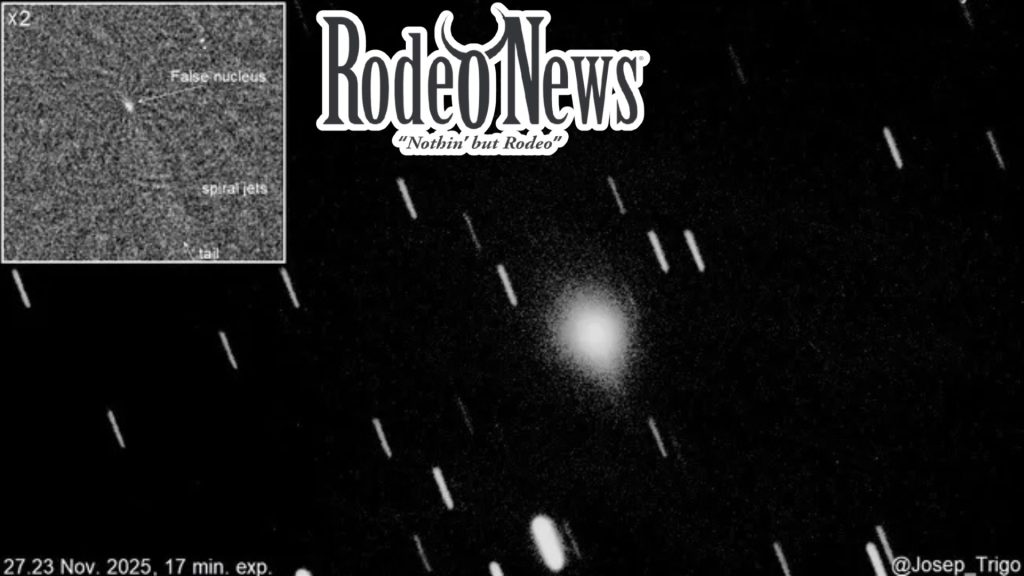
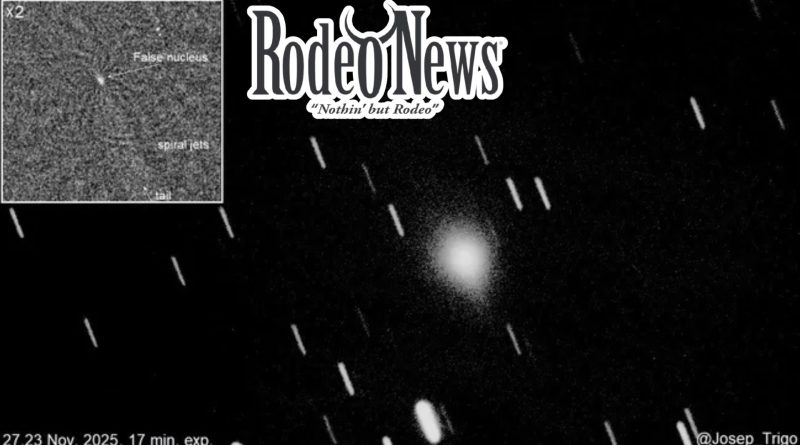
New observations of the interstellar visitor 3I/ATLAS suggest its surface may be covered in what scientists describe as cryovolcanoes — often referred to as “ice volcanoes.” According to researchers led by Josep Trigo-Rodríguez at the Institute of Space Sciences in Spain, the spiraling jets seen on the comet may be caused by volatile ices within the core sublimating and erupting as it warms near the sun.
If confirmed, this would link 3I/ATLAS to icy bodies in the outer solar system (like trans-Neptunian objects), offering fresh insights into its origin and composition.
Radiation-Eating Fungus at Chernobyl: A Candidate for Cosmic Shielding
Researchers are now spotlighting a fungus from the Chernobyl Nuclear Power Plant exclusion zone — Cladosporium sphaerospermum — which may derive energy from ionizing radiation via a process called radiosynthesis. That’s the theoretical ability to feed on radiation instead of sunlight.
If this phenomenon proves real and usable, scientists think it might help develop new ways to shield astronauts from cosmic rays — a potentially transformative idea for long-duration space travel.
Solar Storm Warning: X-class Flare Hits — More on the Way
On Nov. 30, the Sun unleashed a powerful X1.9-class solar flare — the strongest flare category — which disrupted radio signals over parts of Australia and Southeast Asia.
That flare came with a coronal mass ejection (CME), though at present, the CME is aimed away from Earth. Still, space-weather agencies warn that a cluster of active sunspots is rotating into view, boosting the chance (around 70%) of more flares between Dec. 1–5. That means potential auroras — maybe even visible at lower latitudes — plus possible disruptions to satellites and communications.
Ancient Human Journey: Modern Humans Reached Australia 60,000 Years Ago, Possibly Met “Hobbits”
A new study published in Science Advances claims that modern humans settled northern Australia around 60,000 years ago.
Intriguingly, the research suggests they may have interbred with archaic humans — like the so-called “hobbit” Homo floresiensis. The finding implies our ancestors used watercraft to reach Australia, raising the stakes on how early humans spread across oceans and interacted with other hominins.
A “Clam-Plane” Supernova: When Stars Don’t Explode Symmetrically
Telescopic observations from Chile’s Very Large Telescope (VLT) suggest that some supernovae — the explosive deaths of massive stars — may not explode in perfect spheres. Instead, their first light may come as a “clam-plane” shockwave, radiating primarily along a single axis.
This challenges the classical picture of supernovae and could reshape how astronomers model the dispersal of material — and energy — across space following these stellar deaths.
What This Week’s Science Means
- The erupting cryovolcanoes on 3I/ATLAS could link interstellar objects to icy bodies at the edge of our solar system, deepening our understanding of how systems beyond ours might look.
- The discovery of a radiation-feeding fungus at Chernobyl hints at radically different life strategies — and possible tools for human space exploration.
- The recent solar flare and potential upcoming ones are a reminder of how vulnerable modern technology still is to space weather.
- The Columbus-era tale of human migration is repeating itself — early humans bravely crossing seas to reach remote continents, possibly meeting other human species along the way.
- The unconventional geometry of a “clam-plane” supernova may force astronomers to revise how they think about stellar death and the birth of elements