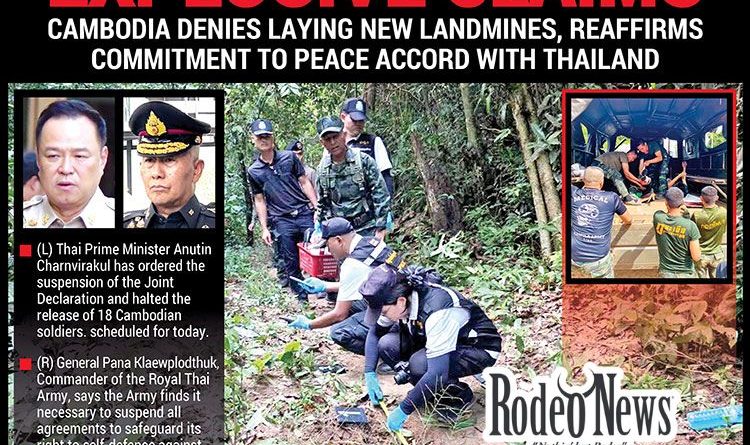
Cambodia Denies Allegations of New Landmines, Reaffirms Commitment to Peace Accord with Thailand
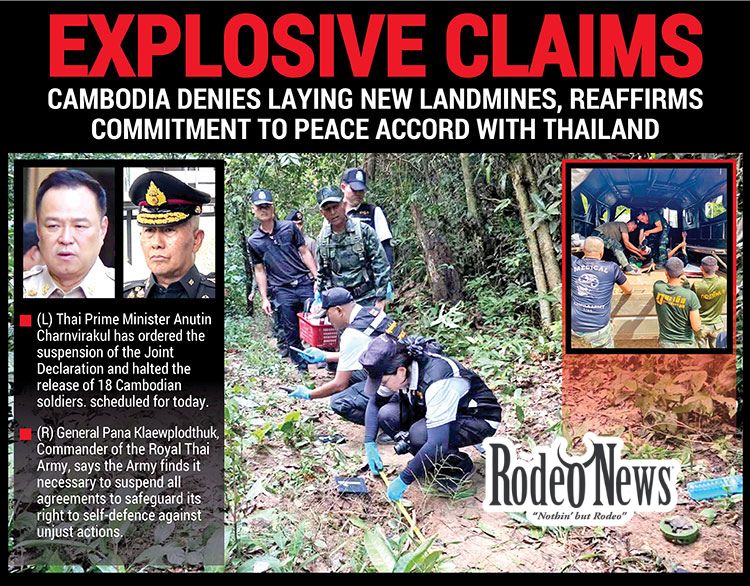
Phnom Penh, Cambodia – Cambodia has strongly denied allegations from Thailand that new landmines were laid along their shared border, following a landmine explosion that injured several Thai soldiers on November 9. The Cambodian government reiterated its full commitment to the Kuala Lumpur Joint Declaration, signed with Thailand in late October, and rejected claims that the explosion was a result of new mine placements.
The blast occurred near the Preah Vihear Temple, a disputed area along the border between the two countries. According to reports, three Thai soldiers were wounded in the explosion, prompting Thailand’s Prime Minister Anutin Charnvirakul to suspend the peace agreement and halt the release of 18 Cambodian prisoners of war that were scheduled for transfer.
Cambodian Government Responds to Allegations
In a statement released late Monday night, Cambodia’s Ministry of Foreign Affairs categorically denied the accusations, stressing that the landmines in the area were remnants of past conflicts. “The Royal Government of Cambodia categorically denies the allegations by Thailand that new landmines have been laid by Cambodia at the border with Thailand,” the statement read.
The Cambodian government emphasized that most of the landmines in the region date back to the country’s civil wars in the 1970s and 1980s and that clearing these mines remains a difficult and ongoing task due to the rugged terrain and disputed border areas.
“Cambodia, as a devoted advocate for and state party to the Anti-Personnel Mine Ban Convention, has never used any new landmines and will never do so,” the statement continued.
The Impact on the Peace Agreement
The explosion and the resulting tensions have cast doubt on the future of the peace agreement, which was signed by the prime ministers of Cambodia and Thailand in Kuala Lumpur on October 26. The agreement was hailed as a significant step toward stabilizing the border and fostering cooperation between the two countries.
Under the terms of the Kuala Lumpur Joint Declaration, both nations committed to withdrawing heavy weapons from the border, clearing landmines, and establishing confidence-building measures to reduce tensions. The declaration also called for the creation of an ASEAN Observer Team (AOT) to monitor the ceasefire and ensure compliance with the terms.
However, Thailand’s recent actions have raised concerns about the sustainability of the agreement. Thai officials have suggested that Cambodia’s alleged mine-laying activities represent a breach of the peace accord. Prime Minister Anutin chaired a meeting of Thailand’s National Security Council on Monday, where military operations were authorized in response to the incident. Anutin indicated that Thailand would consult with its Cabinet before deciding on further actions.
Cambodia’s Efforts to Clear Landmines
The Cambodian Ministry of Defense, along with the Cambodian Mine Action Centre (CMAC), has continued to stress that demining efforts along the border remain a priority. Cambodian officials have acknowledged the ongoing presence of unexploded ordnance in border areas but have insisted that the country’s landmine clearance programs are in full compliance with international standards.
Lieutenant General Maly Socheata, spokesperson for Cambodia’s Ministry of National Defense, expressed regret over the incident but reiterated that the mines responsible for the explosion were old and not newly placed. “We regret the injury to the Thai soldiers,” Socheata said, adding that the situation could have been avoided if Thailand had refrained from patrolling in known minefields.
Furthermore, the Cambodian government has emphasized its commitment to fulfilling its obligations under the Ottawa Convention, which mandates the clearance of anti-personnel mines.
Tensions Between the Nations
The latest border incident is part of a long history of disputes between Thailand and Cambodia. The two nations share a 500-mile border, much of which remains un-demarcated, leading to territorial disputes over areas like the Preah Vihear Temple, which has been the focal point of previous clashes.
Tensions reached a peak in July 2025, when a border conflict led to the deaths of dozens and displaced more than 200,000 people on both sides. While a ceasefire was reached shortly after, the recent explosion has reignited hostilities, with both countries accusing each other of violating the terms of the ceasefire.
ASEAN’s Role and Mediation Efforts
In response to the escalating tensions, ASEAN Chair Malaysia has expressed its readiness to continue mediating between Thailand and Cambodia. Malaysian Prime Minister Anwar Ibrahim has stated that he remains in close contact with both leaders and has ordered an update on the situation from the Armed Forces Chief.
“I have instructed the Armed Forces to gather the latest reports so that we can assist in resolving this issue,” Anwar said, underlining Malaysia’s commitment to supporting regional peace and stability.
Looking Ahead
As both Cambodia and Thailand continue to exchange accusations over the landmine incident, the fate of the Kuala Lumpur Joint Declaration hangs in the balance. Despite these setbacks, Cambodia has reaffirmed its commitment to the principles of peace, cooperation, and disarmament outlined in the agreement.
“The Cambodian government remains committed to working closely with Thailand to ensure the success of the peace process and to protect the lives and safety of civilians,” said a spokesperson from Cambodia’s Ministry of Foreign Affairs.
While the situation remains tense, the hope is that continued diplomatic engagement, particularly through ASEAN’s mediation efforts, will help both sides resolve their differences and restore stability along the border.