Cease‑fire: Signs of Stability, Yet Fragile
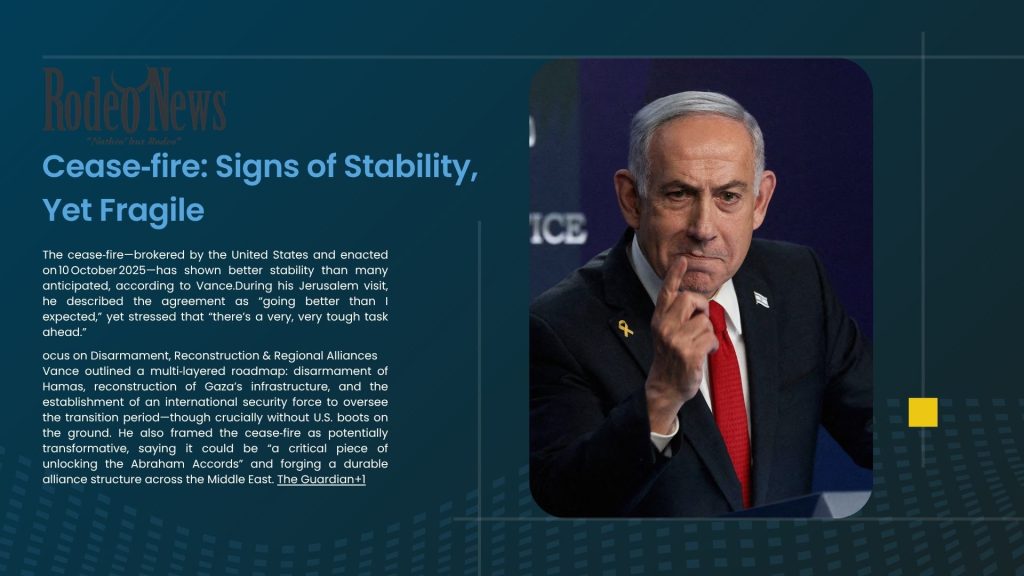
The cease‑fire—brokered by the United States and enacted on 10 October 2025—has shown better stability than many anticipated, according to Vance.During his Jerusalem visit, he described the agreement as “going better than I expected,” yet stressed that “there’s a very, very tough task ahead.”
While the truce has held in many areas, incidents of violence and accusations of violations persist—highlighting the cease‑fire’s precarious nature.
Focus on Disarmament, Reconstruction & Regional Alliances
Vance outlined a multi‑layered roadmap: disarmament of Hamas, reconstruction of Gaza’s infrastructure, and the establishment of an international security force to oversee the transition period—though crucially without U.S. boots on the ground.He also framed the cease‑fire as potentially transformative, saying it could be “a critical piece of unlocking the Abraham Accords” and forging a durable alliance structure across the Middle East.p: A Delicate Balance
At the joint press conference, Netanyahu and Vance addressed concerns that Israel might be acting under undue U.S. influence. Vance asserted firmly, “We don’t want a vassal state, and that’s not what Israel is … we want an ally.” Netanyahu, in turn, emphasised Israel’s independent security prerogatives, noting that while cooperation with the U.S. is essential, Israel retains autonomy in its defence strategy.
Governance Challenges and Competing Visions
Underlying the surface optimism is a complex array of unresolved issues: who will govern Gaza, how exactly security will be maintained, and whether regional actors such as Turkey will have a role in the future force—despite Israel’s strong objection to Turkish deployment.
Vance and Netanyahu acknowledged that the “day‑after” scenario in Gaza remains one of the most difficult phases of the peace process. The Guardian
What Happens Next?
- Continued monitoring of the cease‑fire and swift responses to any violations will be critical to maintaining momentum.
- A timeline and framework for the disarmament of Hamas must be fleshed out—and accepted by all parties.
- Reconstruction efforts in Gaza will require large-scale international investment and coordination.
- Discussions over regional diplomatic alliances could accelerate if the cease‑fire holds for the coming weeks.
- Israel‑U.S. coordination will be under the spotlight to ensure the partnership remains balanced, with Israel’s sovereignty respected.
In short, Vice President Vance’s visit underscores that while the cease‑fire is a promising step, the road ahead is fraught with challenges. The real test will lie in turning the momentum into durable peace and rebuilding not just infrastructures, but also trust.
Related news on Gaza cease‑fire & Vance’s visit