The move underscores rising political tensions and the unsettled symbolism swirling around his second term.
What happened?
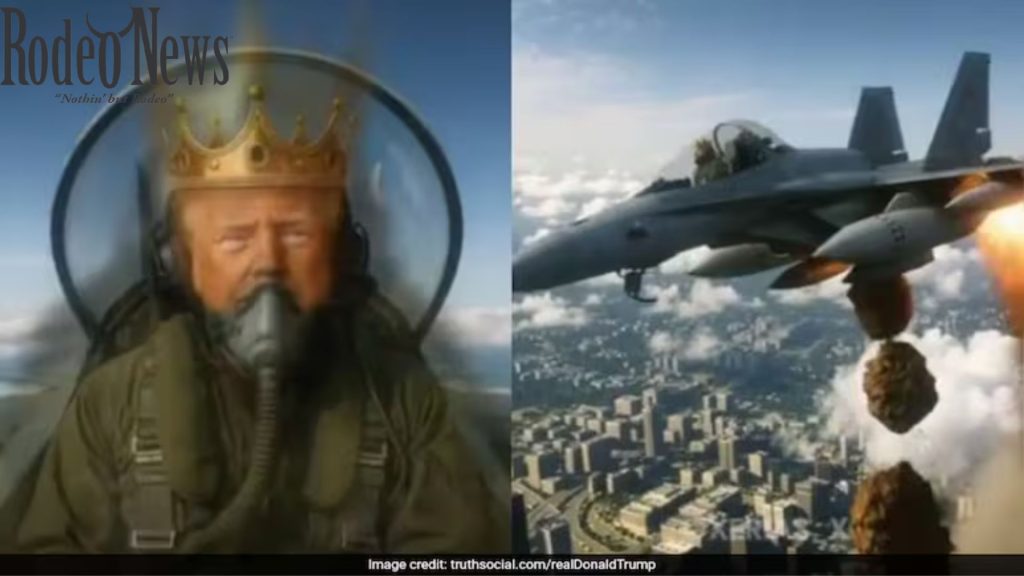
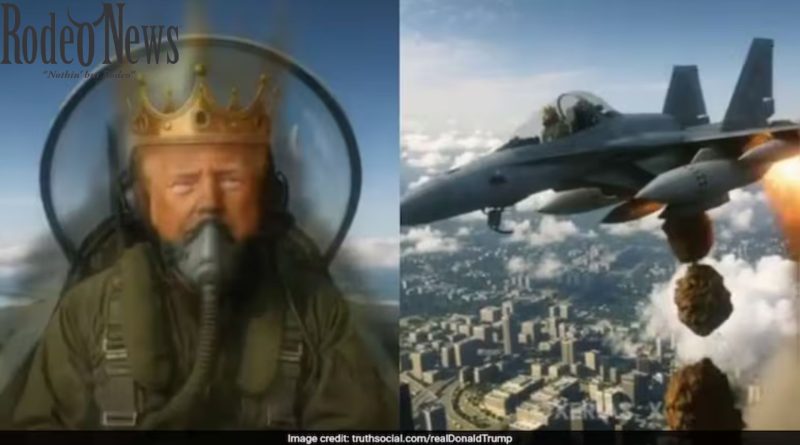
Former President Donald Trump has responded to the mass “No Kings protests” across the United States by publishing an AI-generated video showing himself wearing a crown and assuming regal imagery.
Amid the nationwide protests against perceived authoritarian drift in Trump’s administration, Trump released a video created using artificial intelligence in which he appears as a monarch-style figure. In the clip:
Trump is seen wearing a crown and waving from what appears to be a balcony, projecting the imagery of a king rather than an elected official.
The video was posted via his campaign’s social media channels shortly after the protest wave gained momentum.
Trump, in interviews ahead of the protests, explicitly claimed: “They say they’re referring to me as a king. I’m not a king.”
This combination of denial and symbolic depiction has raised questions about intent: whether the video is satire, a provocation, or a message of dominance.
The protest context
The “No Kings” protests have emerged as a nationwide expression of concern over executive power, the rule of law, and the fate of U.S. democratic norms. Key facts:
The protests on 18 October 2025 reportedly spanned more than 2,600 locations across the U.S., drawing participants from all states.
Protesters carried signs and chanted slogans such as “No kings” and “Power to the people,” framing the demonstrations as a defence of democratic checks and balances.
Republican critics strongly condemned the protests, with leaders such as Mike Johnson branding them “hate-America” events.
In this charged environment, the symbolism of a “king” motif is especially sensitive and consequential.
Why the crown matters
The crowning of Trump in the AI video serves as more than a visual curiosity — it signals layered meaning:
Symbol of ultimate power: A crown traditionally represents sovereignty and unchallenged authority. Depicting an elected official with a crown evokes fears of monarchy, not republican governance.
Contradiction with claim: Trump’s verbal denial of kingship contrasts sharply with the visual message of the video, creating a dissonance that invites interpretation.
Amplification by AI: The use of artificial intelligence heightens concerns about political messaging, authenticity and manipulation. It raises questions about how political actors may use synthetic media to craft narratives.
Protest-provocation risk: Given that the “No Kings” movement is explicitly focused on rejecting concentrated power, sending a crowned-king image into that milieu may inflame tensions rather than calm them.
While only Trump’s inner circle knows the full intention, several plausible motives include:
Defiance: The video may be a direct challenge to critics, embracing the “king” label ironically or provocatively to undermine the narrative that Trump is wallowing in royalty.
Mobilising base: Among supporters who view strong leadership favourably, the king imagery might serve to energise loyalty and differentiate from what they see as weak opposition.
Distracting from issues: By focusing attention on symbolism rather than specific policies, the video might shift the conversation away from underlying grievances (like the government shutdown or social-policy conflicts).
Testing digital boundaries: Use of AI in political content is still emerging. Releasing a bold, visually striking video lets Trump measure reactions, media uptake and protest responses.
The video and the protests together have several prospective implications:
Erosion of norms: Repeated exposure to monarchical symbolism in a republic may normalise concentrated power or undermine institutional checks.
Digital propaganda era: AI-generated political content blurs lines between satire, legitimate messaging and manipulation — raising regulatory, journalistic and civic-education challenges.
Polarisation intensification: For critics, the crowned video confirms fears; for supporters, it may signal strength. This contrast deepens divides and complicates common ground.
Electoral framing: As the next election cycle looms, both sides may use the “king” image as a framing device — Trump’s team embracing authority, protest organisations warning of tyranny.
Conclusion
The release of an AI-generated video showing Trump with a crown is a provocative act — one loaded with visual metaphor, political branding and symbolic tension. It arrives at a moment when millions of Americans are marching under the banner of “No Kings,” opposing what they perceive as authoritarian drift. Whether the crowning of Trump will resemble a fleeting moment of spectacle or a turning-point in U.S. political imagery remains to be seen.