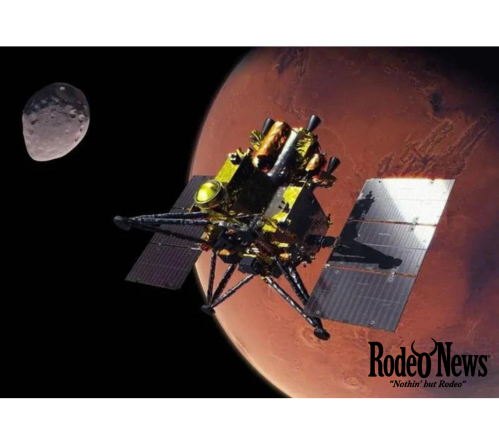
NASA-JAXA Mars Moons Mission Targets 5 Major Discoveries

The NASA-JAXA Mars moons mission is preparing to investigate two of the solar system’s most mysterious natural satellites: Phobos and Deimos. Led by the Japan Aerospace Exploration Agency (JAXA), the Martian Moons eXploration mission, known as MMX, aims to study both moons and return samples from Phobos to Earth.
The mission is scheduled to launch from Japan’s Tanegashima Space Center on October 20, 2026, Japan Standard Time, aboard an H3 rocket. NASA is contributing scientific instruments, research expertise, and communications and navigation support to the international project.
Although Mars has been explored by orbiters, landers, and robotic rovers, its two moons remain poorly understood compared with many other objects in the solar system.
Scientists still debate how Phobos and Deimos formed. They may be captured asteroids or remnants of material produced by an ancient collision involving Mars. Determining which explanation is correct could help researchers reconstruct the planet’s early history.
The MMX mission aims to address these questions through detailed observations, surface measurements, and sample collection. If successful, it will return material from Phobos to Earth in 2031, allowing scientists to analyze the moon’s composition using laboratory equipment that cannot be carried aboard a spacecraft.
Beyond its scientific goals, the mission will demonstrate technologies relevant to future deep-space exploration. Its findings could improve our understanding of Mars, the formation of planetary systems, and the movement of water-bearing materials through the early solar system.
What Is the NASA-JAXA Mars Moons Mission?
The NASA-JAXA Mars moons mission is an international scientific project led by Japan to explore Phobos and Deimos, the two moons orbiting Mars.
Its formal name, Martian Moons eXploration, reflects the mission’s central objective: to investigate the moons’ origins, physical characteristics, and relationship with the Red Planet.
Unlike a mission designed only to photograph distant objects, MMX will conduct close observations and attempt to collect material directly from Phobos.
The spacecraft is expected to reach the Martian system in 2027. It will then conduct detailed observations of the moons, examine potential landing sites, and deploy a small rover to investigate the surface of Phobos.
The main spacecraft is planned to collect at least 10 grams of material from Phobos before beginning its journey back to Earth. The sample-return operation is expected to conclude in 2031.
NASA’s contribution includes scientific equipment and technical support. One of its instruments, MEGANE, will measure gamma rays and neutrons associated with the moon’s surface, helping scientists investigate its elemental composition.
These measurements will complement images, topographic surveys, and other observations collected during the mission.
By combining information gathered in space with laboratory analysis of returned samples, scientists hope to answer questions that have remained unresolved for decades.
1. The Mission Could Reveal How Mars’ Moons Formed
One of the most important objectives of the NASA-JAXA Mars moons mission is to determine how Phobos and Deimos originated.
Scientists generally consider two leading explanations.
The first proposes that the moons are asteroids captured by Mars’ gravity. Under this scenario, the objects formed elsewhere in the solar system before entering orbits around the planet.
The second explanation suggests that the moons formed from debris generated by a massive impact involving Mars. Material thrown into orbit could have gathered together over time, creating one or both of the moons.
Both explanations have implications for the history of Mars and the early solar system.
If Phobos contains material similar to certain asteroids, that could support the captured-asteroid hypothesis. However, the evidence may be more complicated because the moon’s surface could contain a mixture of materials from different sources.
If its composition instead shows stronger links to Martian material, scientists may find additional support for an impact-related origin.
The mission’s measurements will help researchers assess these competing possibilities. No single observation is guaranteed to settle the debate, but the combination of surface analysis and returned samples could significantly improve the evidence available.
Why Sample Collection Matters
Remote observations allow scientists to study an object’s surface without visiting it. However, interpreting those observations can be difficult because several materials may produce similar signals.
Laboratory analysis offers a different level of detail.
Scientists can examine mineral structures, elemental abundances, and other chemical characteristics using instruments that are too large or complex to operate aboard a spacecraft.
Returned samples can also be studied repeatedly as analytical methods improve.
That makes sample-return missions especially valuable. The material brought home by MMX could support research long after the spacecraft completes its mission.
2. NASA’s MEGANE Instrument Will Investigate Phobos’ Composition
NASA is contributing a scientific instrument called MEGANE, short for Mars-moon Exploration with GAmma rays and NEutrons.
The instrument is designed to measure gamma rays and neutrons associated with Phobos. These signals can provide information about the elements present in the moon’s surface material.
When cosmic radiation interacts with a planetary surface, it can produce secondary particles and radiation that carry information about the composition of the material involved.
By measuring these signals, researchers can estimate the abundance of particular elements and compare the results with observations from other instruments.
This information could help scientists identify differences between Phobos and Deimos and evaluate theories about how the moons formed.
NASA’s instrument was developed with support from the Johns Hopkins Applied Physics Laboratory and Lawrence Livermore National Laboratory. It forms part of the broader scientific collaboration supporting the Japanese-led mission.
MEGANE will not operate in isolation. Its results will be interpreted alongside imaging, geological observations, and measurements collected by other instruments.
That combined approach is important because the moons’ origins may not be established through a single chemical measurement.
Instead, researchers will examine multiple lines of evidence to determine which formation scenarios best fit the available data.
3. Phobos Could Offer New Clues About Ancient Mars
Phobos is the larger of Mars’ two moons and follows an unusually close orbit around the planet.
Its proximity makes it an interesting target for scientists investigating the relationship between Mars and its surrounding environment.
If Phobos formed partly from debris ejected from Mars, its surface could preserve information about material from the planet’s early history.
However, that possibility remains a scientific question rather than an established fact.
Even if Phobos originated elsewhere, its surface may have accumulated material through impacts and interactions with its environment over billions of years.
Studying its composition could therefore reveal information about the types of material present in the region surrounding Mars.
Researchers are also interested in whether the moons contain water-bearing minerals or other compounds relevant to understanding how essential materials moved through the early solar system.
The discovery of such materials would not automatically demonstrate that life existed on Mars or its moons. Instead, it would help scientists investigate the chemical and environmental conditions that existed during the solar system’s formation.
Could Phobos Help Scientists Understand Habitability?
Habitability research examines the conditions that allow life to emerge and survive.
On Mars, scientists investigate evidence of ancient water, the planet’s changing climate, and the chemical environments that may once have supported microbial life.
Phobos could provide an additional perspective by preserving material related to Mars and the broader environment in which the planet evolved.
If returned samples contain identifiable Martian material, researchers may be able to study that material under controlled laboratory conditions.
However, determining where a sample originated will require careful analysis. Researchers must distinguish between material associated with Mars, material native to Phobos, and contributions from impacts involving other objects.
The findings could help clarify how materials moved between planetary surfaces and surrounding space.
They may also contribute to broader research into the distribution of water and organic compounds across the solar system.
4. The Mission Will Study Deimos as Well as Phobos
Although Phobos is the main target for sample collection, the NASA-JAXA Mars moons mission will also investigate Deimos.
Deimos is the smaller and more distant of Mars’ two moons. Its physical characteristics and orbital behavior differ from those of Phobos, making comparisons between the objects scientifically valuable.
The spacecraft is expected to observe Deimos from a distance during the mission. The planned observations could improve knowledge of its shape, surface properties, and composition.
Scientists want to know whether the two moons formed through the same process.
If their compositions and other characteristics are closely related, that could support the possibility that they share a common origin.
If important differences emerge, researchers may need to reconsider how the moons formed or how their surfaces changed over time.
The comparison is particularly important because the captured-asteroid and impact-debris hypotheses predict different combinations of characteristics.
Nevertheless, the evidence may not be straightforward. Space weathering, impacts, and other processes can alter a moon’s surface after its formation.
Researchers will therefore need to interpret observations in the context of each object’s geological history.
Why Deimos Is Scientifically Important
Deimos provides a second point of comparison for understanding the Martian system.
Scientists can examine whether both moons contain similar materials, whether their surfaces have changed in comparable ways, and how their orbital properties relate to their possible origins.
These comparisons could help determine whether the moons formed together or followed different evolutionary paths.
Although the mission will focus its sample-return effort on Phobos, observations of Deimos could provide important context for interpreting the returned material.
In planetary science, studying multiple related objects often helps researchers distinguish between explanations that would remain difficult to evaluate using a single target.
5. The Mission Could Improve Future Mars Exploration
The NASA-JAXA Mars moons mission is primarily a scientific project, but it could also contribute to the development of technologies for future space exploration.
Operating around a small moon presents technical challenges.
The spacecraft must navigate a complex gravitational environment, observe the surface, identify suitable landing areas, and perform sampling operations far from Earth.
Communications delays and limited opportunities for direct intervention mean that the spacecraft must rely heavily on autonomous systems and carefully planned procedures.
The mission also includes a rover intended to investigate the surface of Phobos.
Its observations could help scientists understand the physical conditions encountered by equipment operating on the moon, including the behavior of loose surface material and the challenges of moving across a small body’s terrain.
These experiences could inform future missions involving asteroids, planetary moons, and other small objects.
What Could This Mean for Human Mars Missions?
NASA and other space agencies are continuing to investigate technologies and scientific questions relevant to future human exploration of Mars.
Understanding the Martian environment is important for mission planning, but MMX should not be viewed as a direct test of a crewed Mars landing.
The mission is robotic and focuses on the moons rather than the Martian surface itself.
Its contribution will be scientific and technological.
Improved knowledge of the Martian system could help researchers understand the environment surrounding Mars, while experience with navigation and sampling may support future robotic missions.
However, major challenges associated with human Mars exploration—including radiation exposure, life support, transportation, and surface operations—will require separate research and engineering efforts.
When Will the MMX Mission Launch?
As of October 16, 2026, JAXA lists the mission’s launch for October 20, 2026, at 4:41 a.m. Japan Standard Time. That corresponds to October 19 in parts of the Americas and Europe. The spacecraft is scheduled to launch aboard Japan’s H3 rocket from Tanegashima Space Center.
The planned mission timeline extends over approximately five years.
Following launch, the spacecraft is expected to travel to the Martian system and arrive in 2027.
It will then conduct observations of Phobos and Deimos, investigate potential sampling locations, and carry out its planned surface operations.
The sample collection phase is expected to take place before the spacecraft departs the Martian system.
The return journey will bring the samples back to Earth in 2031, when the mission team plans to recover the sample capsule in Australia.
These dates represent the mission’s published schedule. Spaceflight operations can change because of technical problems, weather conditions, launch readiness, or other factors.
Readers should check JAXA’s official mission updates for any schedule changes.
How the NASA-JAXA Partnership Strengthens Space Science
International cooperation is central to the MMX mission.
JAXA leads the project, while NASA contributes scientific instruments, research expertise, and communications and navigation support. Other international partners, including European scientific organizations, also contribute to the mission.
These arrangements allow agencies to combine specialized capabilities and distribute the costs and technical demands of ambitious projects.
Japan brings experience from previous asteroid sample-return missions, including Hayabusa and Hayabusa2.
Those missions demonstrated the value of collecting material from small solar system bodies and returning it to Earth for detailed analysis.
MMX builds on that experience while introducing a different set of challenges associated with the Martian environment.
NASA’s involvement adds scientific equipment and access to its deep-space communications infrastructure.
The partnership also allows scientists from different institutions to participate in analyzing the observations and interpreting the returned samples.
If successful, MMX could become an important example of international cooperation in planetary exploration.
What Scientists Hope to Learn From the Returned Samples
The return of Phobos material is expected to be one of the mission’s most scientifically important achievements.
JAXA’s mission plan calls for the spacecraft to collect at least 10 grams of material from the moon. Although that amount may appear small, even a limited sample can provide extensive scientific information when carefully selected and analyzed.
Scientists will examine the samples to identify their mineral composition, elemental characteristics, and other properties.
They will also investigate evidence of exposure to space and the effects of impacts on the moon’s surface.
The results could help researchers determine whether Phobos formed from captured asteroid material, debris associated with Mars, or a more complicated combination of sources.
Sample analysis may also identify compounds that help reconstruct the history of water and other materials in the Martian environment.
However, these findings will require time.
Scientists must first recover, catalogue, and distribute the material under controlled conditions. Different research teams may then conduct specialized analyses, compare their results, and test competing interpretations.
The scientific value of the mission could therefore continue growing for years after the sample capsule returns to Earth.
Conclusion: A New Chapter in Mars Exploration
The NASA-JAXA Mars moons mission represents a major effort to answer long-standing questions about Phobos, Deimos, and the formation of the Martian system.
By combining close observations, surface investigations, scientific instruments, and a planned sample-return operation, MMX aims to provide evidence that cannot be obtained through distant observations alone.
The mission’s findings could help scientists determine whether Mars’ moons are captured asteroids, remnants of an ancient collision, or products of a more complicated process.
They may also provide new information about the movement of material through the early solar system and the conditions that shaped planetary evolution.
The planned launch in October 2026 marks the beginning of a journey that is expected to extend through 2031.
If the spacecraft completes its objectives, researchers will gain access to material from Phobos and a new collection of observations about both Martian moons.
The results could influence planetary science for decades, helping researchers refine their understanding of Mars and improve the scientific foundations for future exploration.
For now, the most important milestone is the launch itself. The mission’s ultimate significance will depend on the quality of its observations, the success of its sampling operations, and what scientists discover when the material finally reaches Earth.