Pope Leo XIV France Visit Puts Humanity, AI and Peace in Focus
Pope Leo XIV began his four-day visit to France on Friday with a message centered on human dignity, peace and the growing influence of artificial intelligence. His arrival in Paris marked the first official papal visit to France in 18 years and brought thousands of people into the streets to see the pontiff.
The Pope Leo XIV France visit comes as the Catholic Church faces a changing religious landscape in France, one of Europe’s most secular countries. During his first day, Leo met French President Emmanuel Macron, visited UNESCO, prayed at Notre-Dame Cathedral and addressed young people at a major gathering near Paris.
Pope Leo XIV France Visit Opens With Message on Humanity
Leo arrived in France on September 25 and was welcomed by Macron before beginning a demanding schedule of public appearances and meetings.
The pope used his opening speeches to focus on questions extending beyond religion. Artificial intelligence, scientific progress, nuclear weapons and the protection of human life were among the subjects he raised during his meetings in Paris.
At the Élysée Palace, Leo warned that rapid technological development could create a world in which machines increasingly shape human decisions and daily life. He called for greater ethical reflection so that technological progress remains connected to human dignity.
The issue of artificial intelligence has become a recurring theme of Leo’s pontificate. During his France visit, he again urged policymakers, educators and technology leaders to consider how AI could affect society and the definition of human work and responsibility.
His comments came as governments and technology companies continue to debate how artificial intelligence should be developed and regulated.
Pope Leo XIV Warns Against a “Paradise of Machines”
At UNESCO headquarters in Paris, Leo expanded his message about technology and humanity.
The pope argued that scientific progress should not be judged solely by efficiency, economic value or technological capability. He said society also needs to consider ethical questions surrounding emerging technologies and their consequences for people.
AI has become one of the Vatican’s major areas of concern under Leo. The pope has previously emphasized the importance of ensuring that artificial intelligence remains a tool serving people rather than becoming a force that reduces human beings to economic or technological calculations.
His remarks in Paris connected that concern with broader questions involving medicine, biotechnology and end-of-life decisions.
France has recently experienced major debates over issues surrounding human life and medical ethics. Those debates have placed the Catholic Church’s traditional teachings alongside a political and social environment shaped by France’s strong commitment to secularism.
France’s Secular Tradition Shapes the Visit
The Pope Leo XIV France visit is taking place in a country where religion occupies a different public role than it does in many other parts of the world.
France’s principle of laïcité establishes state neutrality toward religion while protecting freedom of belief and worship. The system developed through historical efforts to separate government institutions from religious authority, particularly the Catholic Church.
That history makes the pope’s visit significant for both religious and cultural reasons.
Leo is not expected simply to address church members. His schedule includes meetings with government officials, international organizations, young people and Catholic communities, giving him an opportunity to discuss issues that extend across French society.
The Vatican has described the journey as an opportunity to engage with France’s history, culture and role in Europe.
Thousands Gather in Paris
Despite France’s secular character, Leo’s arrival generated a substantial public response.
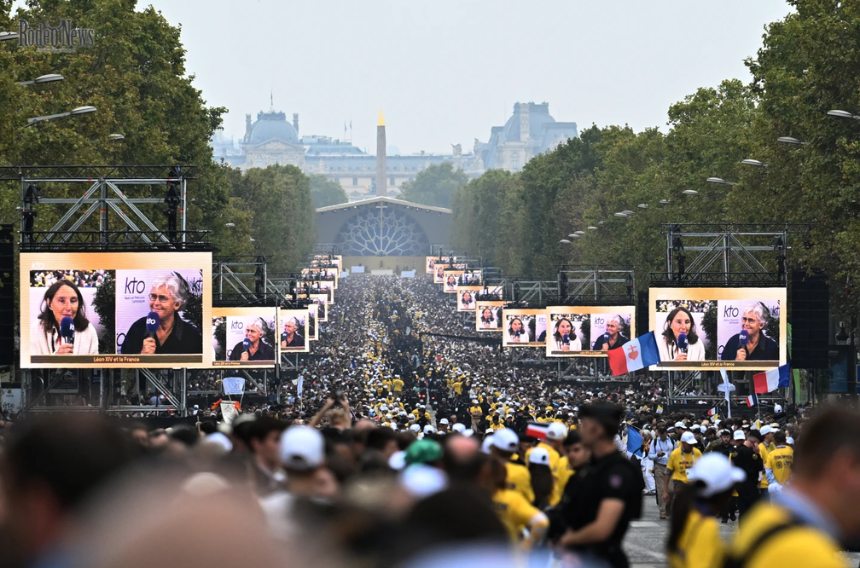
Crowds gathered along routes in Paris as the pope traveled through the city. Many supporters carried French and Vatican flags and waited for hours to see the popemobile.
The Vatican estimated that about 300,000 people came out to see Leo during Friday’s activities, including his appearance at a youth prayer gathering at the Stade de France.
The gathering gave Leo an opportunity to speak directly to younger Catholics at a time when religious affiliation and participation have changed significantly across Western Europe.
At Notre-Dame Cathedral, Leo celebrated evening prayer in the recently restored landmark. The event combined religious ceremony with the historic setting of one of France’s most recognizable buildings.
Pope Leo XIV Reaffirms Opposition to Nuclear Weapons
Peace was another central theme of Leo’s first day in France.
With conflicts continuing in Europe and the Middle East, the pope renewed the Vatican’s opposition to nuclear weapons. He also criticized the idea that lasting peace can be maintained simply through a balance of military power.
Instead, Leo emphasized dialogue and justice as foundations for peace.
The comments reflect a broader diplomatic approach that has become an important part of the Vatican’s international messaging. The pope has repeatedly called for negotiations and cooperation when addressing conflicts and global security concerns.
His visit to UNESCO also reinforced the importance he places on international institutions, culture and education as tools for promoting peaceful relations.
Macron and Leo Discuss Global Issues
Leo’s meeting with Macron also carried diplomatic significance.
The two leaders discussed major international and social issues, including technology, climate concerns and broader questions facing Europe and the international community.
The meeting comes during the final phase of Macron’s presidency, with France preparing for its next presidential election in 2027.
However, the Vatican has presented Leo’s journey primarily as a pastoral and diplomatic visit rather than an intervention in French domestic politics.
The pope’s message has instead focused on broader questions about human dignity, peace, technological change and the role of faith in modern society.
A Four-Day Journey Across France
The Pope Leo XIV France visit continues through September 28, with stops beyond Paris.
The pope is scheduled to visit Lourdes, one of the Catholic Church’s most important pilgrimage destinations, before traveling to Metz in northeastern France.
The journey gives Leo opportunities to meet different parts of the French Catholic community while also highlighting France’s historical and cultural importance to Christianity and Europe.
His trip comes at a complicated moment for the French Catholic Church. Questions surrounding declining religious participation and the legacy of clergy sexual abuse remain important issues for the institution.
Ahead of the visit, an independent French body reported that roughly 2,000 people who reported sexual abuse by Catholic clergy or other church representatives had sought reparations through its program. The report highlighted the continuing impact of the abuse crisis and the church’s efforts to address survivors’ claims.
What Comes Next for Pope Leo XIV
The next stages of the France visit will allow Leo to shift from diplomatic meetings in Paris toward pilgrimage, prayer and encounters with Catholic communities.
His opening day established several themes likely to remain central throughout the journey: protecting human dignity, responding to technological change, promoting peace and engaging with Europe’s Christian heritage.
The response in Paris also demonstrated the continued ability of a papal visit to attract large crowds, even in a country where religious practice has declined.
For Leo, France offers an opportunity to address Catholics while also speaking to a wider public. His message so far has emphasized that questions about technology, war and human life are not limited to religious institutions.
As the four-day journey continues, the pope is expected to combine traditional Catholic observances with broader appeals for dialogue, responsibility and human dignity.