
Trump and Xi Jinping Meet at White House as Trade and AI Take Center Stage
President Donald Trump welcomed Chinese President Xi Jinping to the White House on Thursday for a high-profile state visit centered on trade, artificial intelligence, technology and other major points of tension between the world’s two largest economies.
The meeting marked Xi’s first visit to the White House in more than a decade and featured an unusually elaborate welcome. Trump and first lady Melania Trump greeted Xi and his wife, Peng Liyuan, before the Chinese leader took part in a formal ceremony that included military honors, musical performances and a flyover.
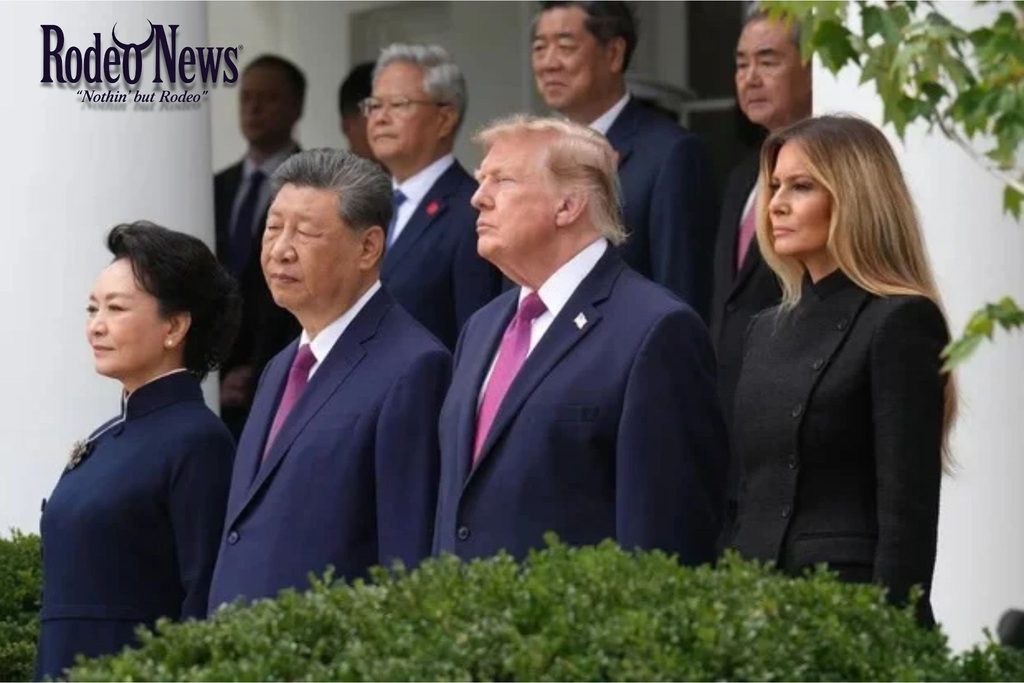
The two presidents later held extended talks in the Oval Office before preparing for a state dinner attended by prominent figures from the technology and business worlds. The highly choreographed visit came as Washington and Beijing attempt to maintain a fragile trade truce while competing over advanced technology and navigating disagreements involving Taiwan and Iran.
Trump and Xi Emphasize Their Relationship
During remarks at the White House, Trump highlighted his longstanding relationship with Xi and described the Chinese leader as a friend with whom he has maintained a direct line of communication.
Trump said the two countries had made progress on trade and market access, while also pointing to security and technology as areas requiring discussion.
The American president said artificial intelligence and what he referred to as “super intelligence” would be among the subjects discussed during the meeting. His comments came only days after he told world leaders at the United Nations that competition over AI would have enormous consequences for the global balance of power.
Xi also emphasized the importance of cooperation while making clear that technological development should remain under human control. The contrasting emphasis reflected a larger debate over how Washington and Beijing should manage increasingly powerful AI systems while competing for technological leadership.
Tariffs Remain a Major Issue
Trade was another central issue hanging over the summit.
The United States and China had previously imposed steep tariffs on each other’s goods, producing one of the most serious trade confrontations between the two economies in years. Although the two governments later reached a temporary truce, uncertainty surrounding tariffs has continued to affect businesses and global markets.
Ahead of Xi’s visit, U.S. and Chinese economic officials agreed to extend their tariff truce for another two months, according to Treasury Secretary Scott Bessent.
The extension provided additional breathing room for negotiations but did not resolve the broader disagreements between Washington and Beijing.
American officials have also been seeking greater access to the Chinese market for U.S. products, while Beijing has sought relief from restrictions affecting Chinese companies and technology.
Rare-earth materials are another important part of the economic relationship. China occupies a significant position in global supply chains for minerals and materials used in advanced manufacturing, electronics and defense technology, making the issue particularly important for American policymakers.
Artificial Intelligence Moves to the Forefront
AI emerged as one of the most closely watched subjects of the Trump-Xi meeting.
The United States and China are competing aggressively to develop advanced AI systems, semiconductor technology and the infrastructure needed to operate increasingly sophisticated models.
Trump has repeatedly argued that the United States needs to maintain its technological lead over China. His administration has also faced domestic pressure to establish stronger safeguards around powerful AI systems.
Bessent recently said Washington had proposed a system for notifying the other side about AI incidents that could pose national-security concerns. It remained unclear whether Trump and Xi would reach an agreement on such a framework.
Technology executives attending the state dinner underscored the importance of the issue. Among the guests were leaders and senior figures from companies including Nvidia, OpenAI, Qualcomm, Apple, Amazon and other major technology and financial firms.
The gathering placed some of the world’s most influential technology executives in the same room as the leaders of the United States and China at a moment when AI has become both an economic opportunity and a strategic competition.
Taiwan Remains a Sensitive Issue
Taiwan was another major issue surrounding the summit.
Beijing considers Taiwan part of China and has repeatedly said that reunification is a national objective. Washington, meanwhile, maintains longstanding ties with Taiwan and provides the island with military equipment despite not having formal diplomatic relations with its government.
The issue has become increasingly intertwined with the technology rivalry because Taiwan plays a central role in the global semiconductor industry.
Advanced chips produced in Taiwan are essential to AI development, military systems and a wide range of consumer electronics. The United States has been encouraging more semiconductor production at home, while China has sought to strengthen its own technological capabilities.
Trump and Xi have previously discussed Taiwan, but the subject remains one of the most difficult areas in the bilateral relationship.
Iran and Global Security Also Loom
The summit also took place against the backdrop of conflict involving Iran.
Trump has faced questions about China’s relationship with Iran after reports that Chinese entities may have provided satellite imagery before an Iranian attack on a U.S. military position. Trump rejected the report and has continued to describe his relationship with Xi in relatively positive terms.
China’s economic relationship with Russia is another concern for Washington, particularly as the United States considers additional measures targeting countries that purchase Russian energy.
Those issues mean the Trump-Xi relationship extends well beyond tariffs and technology. Decisions made by Washington and Beijing can influence conflicts, energy markets and diplomatic relationships far beyond the two countries.
A Carefully Choreographed State Visit
The symbolism of Xi’s visit was impossible to miss.
The White House arranged a formal arrival ceremony, military honors and a state dinner featuring an impressive list of corporate leaders. The visit was designed to project the importance of the U.S.-China relationship even as disagreements remain unresolved.
Trump said after his Oval Office meeting with Xi that the two had a “great meeting.” However, there was no immediate indication that the talks produced major breakthroughs on the most difficult issues.
The summit therefore represented both cooperation and competition. Washington and Beijing have strong economic incentives to prevent another major trade confrontation, while both governments continue to compete over technology, national security and strategic influence.
For Trump and Xi, the challenge will be determining how much progress can be achieved while those fundamental differences remain in place.
The White House visit provided a highly visible demonstration of diplomatic engagement between the two leaders. Whether that engagement leads to lasting agreements on tariffs, AI, technology or security will depend on negotiations that extend well beyond the ceremonies surrounding Xi’s state visit.