
Trump’s Proposed D.C. Arch Raises New Questions After Military Complex Plan
President Donald Trump’s proposed triumphal arch in Washington, D.C., is facing a new round of legal, aviation and historic-preservation questions after the administration said the massive structure could also function as a military complex.
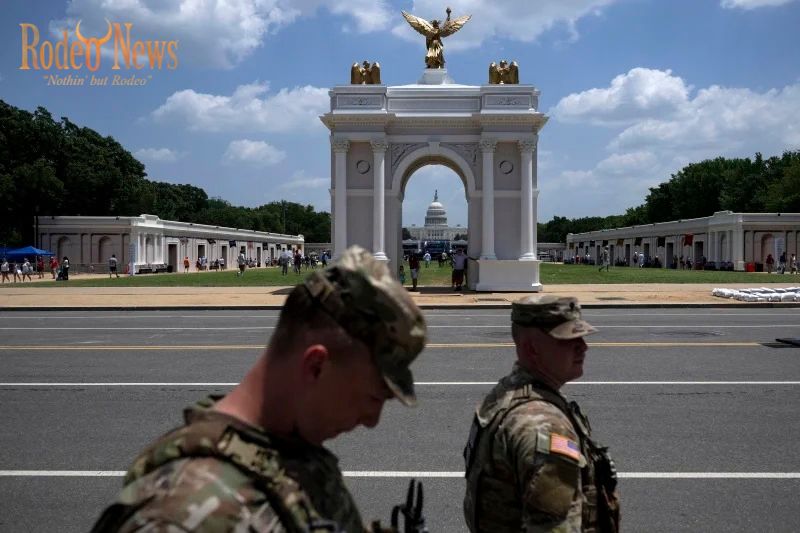
Trump announced over the weekend that the planned 250-foot arch near Arlington Memorial Bridge would be designed to accommodate drones, snipers and ammunition storage. The announcement represents a significant expansion of the project’s publicly described purpose and has raised questions about whether the plans will have to undergo additional federal reviews.
The structure was originally presented as a monumental addition to Washington and later described by the administration as part of the nation’s 250th anniversary celebrations. Earlier designs from the National Park Service included an observation deck overlooking the National Mall and Arlington National Cemetery, along with possible visitor amenities such as a cafe and gift shop.
The military component was not part of that original public description.
Trump now says the structure should be capable of housing and rapidly deploying large numbers of drones, while also providing positions for snipers and storage for ammunition. The president said the change was made at the request of the U.S. military and for national security purposes.
That explanation has prompted new questions about the project’s approval process.
A major change to the original plan
Historic-preservation advocates say the proposed military functions could fundamentally alter the project that federal agencies have been reviewing.
Charles Birnbaum, president of the Cultural Landscape Foundation, told NPR that changing the facility from a memorial and observation site into a fortified military installation could mean officials are effectively evaluating a different project.
The National Park Service had recently asked preservation organizations for comments on a proposed memorandum of agreement intended to move the project forward. The new military description, however, has raised uncertainty about whether additional features such as fencing, security installations and military infrastructure would have to be considered.
The arch still requires approval from the National Capital Planning Commission. That approval is also tied to completion of federally required historic-preservation reviews. A judge has previously intervened over the administration’s attempt to move the project forward before the necessary approvals were completed.
Questions surrounding Washington’s airspace
The proposed location also creates an aviation issue.
The arch would stand close to the flight path serving Ronald Reagan Washington National Airport. The Federal Aviation Administration recently completed a months-long evaluation and concluded that the structure itself would not create an unacceptable aviation hazard.
However, that assessment did not address the possibility of operating military drones from the site.
Rep. Don Beyer, a Virginia Democrat, has argued that the addition of a drone facility changes the aviation question substantially. If drones were launched from the location, regulators could be required to reconsider the earlier analysis.
The issue is particularly sensitive because the Washington area has tightly controlled airspace, and the proposed arch would be positioned near an active airport approach.
The location also carries heightened security concerns because it sits close to major federal and military facilities, including the Pentagon and Joint Base Myer-Henderson Hall.
The legal fight is already underway
The arch was facing legal challenges even before Trump announced the military component.
A group that includes three Vietnam War veterans filed a lawsuit challenging the project over the administration’s decision not to seek congressional authorization. The administration has pointed to a 1925 law involving plans for two columns at the location as part of its legal justification.
Opponents argue that the earlier legislation does not provide authorization for the proposed arch.
The administration’s new national-security explanation could become another point of contention. The lawyer representing the veterans has argued that describing the structure as a military facility does not resolve the underlying legal dispute.
The Pentagon has not publicly provided additional details beyond Trump’s announcement, according to NPR.
National security argument under scrutiny
The administration has increasingly used national-security considerations when defending some of Trump’s major construction projects.
That approach has also appeared in the controversy surrounding a planned White House ballroom and associated underground facilities. The Supreme Court recently allowed that construction to continue while a legal dispute proceeded, although the ruling addressed questions about the plaintiffs’ standing rather than definitively resolving the broader legality of the project.
For the arch, some military and legal experts have questioned why drones and snipers would need to be permanently incorporated into a new monument when Washington already contains extensive security infrastructure.
Mark Cancian, a retired Marine Corps colonel and military expert at the Center for Strategic and International Studies, told NPR that the administration had not previously articulated a specific military need for such a facility.
The question therefore extends beyond the design of the monument itself: officials and preservation groups must now determine whether the newly announced military purpose changes the project enough to require another round of reviews.
A project caught between monument and military installation
The proposed arch has already generated debate over its effect on Washington’s historic landscape. National Park Service planning documents have warned that the project could affect historic properties and important views connecting Arlington House, Arlington National Cemetery, the Arlington Memorial Bridge and the Lincoln Memorial.
Those concerns now intersect with questions about security, aviation and federal authorization.
Several lawmakers have called for construction to stop while the new plans are examined. On Tuesday, five Democratic lawmakers and one independent member of Congress sent a letter to Interior Secretary Doug Burgum challenging the project’s legality and raising concerns about its potential impact on historic sites.
For the administration, the arch is intended to become a major landmark in the nation’s capital. But the decision to add military functions has created a new set of questions that could complicate the project’s path through federal agencies and the courts.
Until those issues are resolved, the proposed structure remains caught between two very different identities: a monumental landmark intended for visitors and a military facility designed for security operations.