
Oil Prices Remain Above $100 as Saudi Supply Risks Persist
Oil prices remained above $100 a barrel on Monday, September 21, as investors assessed the impact of renewed Houthi attacks on Saudi Arabia against signs that the kingdom is restoring some disrupted oil exports.

Brent crude futures were down 81 cents, or 0.78%, at $103.06 a barrel at 0031 GMT. U.S. West Texas Intermediate crude fell 89 cents, or 0.89%, to $99.41 a barrel. Both benchmarks had declined in the previous session as traders weighed the possibility of improving Saudi supply. RReuters+1
The latest market movement highlights the difficult balance facing energy traders. On one side, attacks on Saudi infrastructure have raised concerns about future oil supplies. On the other, Saudi Arabia has been redirecting exports through alternative routes, helping crude flows recover.
Oil Prices React to New Riyadh Attack
The latest escalation came after Yemen’s Iran-backed Houthis said they had attacked what they described as “sensitive” sites in Riyadh with missiles and drones on Saturday.
The group also said it had targeted a Saudi Aramco facility in Yanbu, a major oil-export hub on the Red Sea.
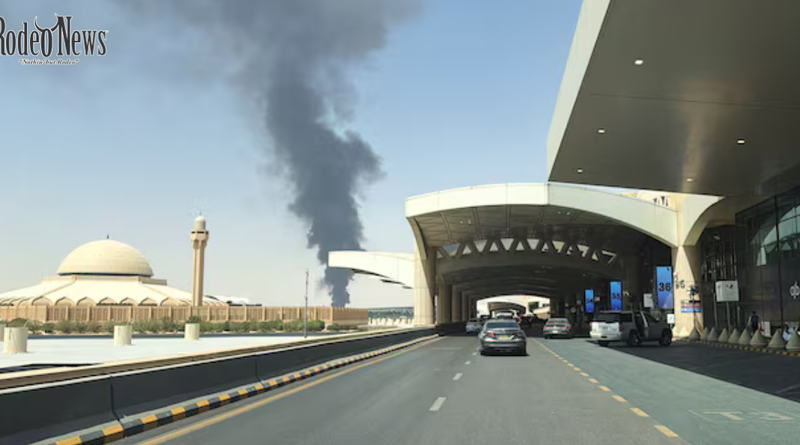
Reuters reported that a large plume of smoke was visible near Riyadh’s main airport following the incident. Saudi authorities issued warnings and its military coalition said air defenses had destroyed a missile fired toward the capital. RReuters
The attacks have added another layer of uncertainty to an already disrupted regional energy market.
For oil traders, the key question is not simply whether an attack occurs. The larger concern is whether repeated attacks can reduce the amount of crude reaching international markets for an extended period.
That distinction is important because short-term disruptions can sometimes be absorbed through inventories, alternative transportation routes and production adjustments. Longer disruptions, however, can place significantly greater pressure on prices.
Saudi Arabia Shifts Oil Exports Toward the Strait of Hormuz
Saudi Arabia has responded to damage affecting its East-West pipeline by increasing exports through the Strait of Hormuz, according to Reuters.
The shift has helped the world’s largest crude exporter recover some of the supply that was disrupted through its Red Sea route.
Provisional data from analytics firm Kpler showed Saudi exports had recovered to slightly more than 4 million barrels per day in September, compared with 2.4 million barrels per day in August. Reuters reported that the August level was the lowest in the data going back to at least 2013. RReuters
Satellite data cited by JPMorgan analysts also indicated a substantial increase in Saudi oil movements through the Strait of Hormuz.
Saudi shipments through the strategic waterway averaged about 2.9 million barrels per day over the six days before the Reuters report, compared with around 700,000 barrels per day in August. RReuters
This change helps explain why oil prices did not continue rising after the latest attack.
Markets are watching the actual volume of crude reaching buyers rather than reacting only to the military developments.
Why the Strait of Hormuz Matters
The Strait of Hormuz is one of the world’s most important energy corridors.
The narrow waterway connects the Persian Gulf with the Gulf of Oman and the Arabian Sea. A disruption there could affect shipments from several major oil-producing countries.
Saudi Arabia’s decision to move more crude through the strait demonstrates how important alternative export routes have become during the current regional crisis.
However, greater reliance on the waterway also exposes Saudi shipments to another potential point of disruption.
That creates a difficult situation for energy markets. Saudi Arabia can redirect crude, but the ability to do so does not eliminate geopolitical risk.
Saudi Aramco Faces Continued Infrastructure Pressure
Saudi state oil company Saudi Aramco has been at the center of the latest supply concerns.
The East-West pipeline normally provides Saudi Arabia with an important route for moving crude from its eastern oil-producing regions toward the Red Sea. This route can reduce the kingdom’s dependence on tanker shipments through the Strait of Hormuz.
Recent attacks have disrupted that infrastructure, forcing Saudi Arabia to adjust its export strategy.
Reuters previously reported that attacks on the East-West pipeline and disruptions at Yanbu had contributed to concerns about Saudi crude shipments. On September 15, oil prices settled sharply higher after shipping sources reported that crude loadings at Yanbu had been suspended and some cargoes for European customers had been canceled. RReuters
That earlier episode demonstrates how quickly infrastructure problems can translate into higher crude prices.
The market reaction has since become more complicated because Saudi Arabia has found ways to restore part of the lost export capacity.
Brent Crude and WTI Remain Closely Watched
Brent crude remains a key benchmark for international oil prices, while WTI is the primary U.S. crude benchmark.
On Monday, both benchmarks were trading around the psychologically important $100 level.
Brent was at $103.06 a barrel, while WTI stood at $99.41, according to Reuters. RReuters
The difference between the two benchmarks reflects several factors, including crude quality, transportation costs, regional supply conditions and expectations about future production.
For consumers, sustained oil prices above $100 could eventually have wider economic consequences.
Higher crude prices can increase the cost of gasoline, diesel, aviation fuel and other petroleum-based products. They can also contribute to broader inflation if increased energy costs spread through transportation, manufacturing and logistics.
The effects are not immediate or identical across countries, however. Currency movements, government fuel subsidies, taxation and local refining capacity all influence what consumers ultimately pay.
Global Oil Flows Have Not Collapsed
Despite the disruptions, oil flows from the broader Middle East have remained relatively strong.
JPMorgan analysts cited by Reuters estimated that regional oil flows averaged about 17.1 million barrels per day over a recent 10-day period. That was approximately 6.1 million barrels per day below the 2025 average, according to the analysts. RReuters
The figures suggest that the market is dealing with significant disruption without experiencing a complete collapse in regional exports.
That distinction is crucial.
If exporters can continue finding alternative routes, the impact on global supply could remain manageable. If attacks begin to affect multiple export facilities or major shipping routes simultaneously, however, the consequences could become considerably more serious.
Oil Prices Are Also Being Driven by Geopolitical Tensions
The Saudi attacks are taking place against a much wider regional confrontation involving Iran, the United States and other countries.
Reuters reported that Iran and the United States exchanged new threats on Sunday while diplomatic efforts remained stalled. U.S. President Donald Trump also said he was open to meeting Iranian President Masoud Pezeshkian during the United Nations General Assembly. RReuters
The diplomatic situation is being closely monitored by energy traders because any development affecting the Strait of Hormuz or the Bab el-Mandeb shipping route could have consequences for global oil supplies.
China has also reportedly asked Iran to help restrain the Houthis after Saudi Arabia appealed to Beijing, according to Iranian sources cited by Reuters. RReuters
Diplomatic efforts therefore represent another variable for the oil market.
A reduction in regional tensions could allow more stable energy flows and reduce the risk premium built into crude prices. Continued attacks or a wider escalation could have the opposite effect.
Saudi Oil Exports Will Remain a Key Market Indicator
The next major indicator for traders will be the pace at which Saudi Arabia restores and maintains its exports.
The recovery to more than 4 million barrels per day in September represents a significant improvement from August’s reported level.
However, the sustainability of that recovery remains important.
If Saudi Arabia can maintain alternative export routes and repair damaged infrastructure, supply concerns could ease. If further attacks disrupt those routes, the market could once again focus on the possibility of tighter global crude availability.
For that reason, traders are likely to monitor Saudi Aramco’s export activity, pipeline repairs, tanker movements and developments around the country’s Red Sea terminals.
What the Latest Oil Move Means for Consumers
The immediate decline in crude prices does not necessarily mean fuel prices will fall quickly.
Retail fuel prices generally respond to wholesale crude costs with a time lag. Refinery margins, transportation expenses, taxes and currency movements can also influence prices at the pump.
In addition, oil prices are only one component of the final cost of gasoline and diesel.
Nevertheless, sustained crude prices around or above $100 would remain an important concern for economies heavily dependent on imported energy.
Countries across Asia are particularly sensitive to changes in international crude prices because many rely significantly on imported oil.
Higher energy costs can increase transportation expenses and place additional pressure on businesses and households.
The Market Is Watching Supply, Not Just the Headlines
The latest movement in oil prices illustrates how financial markets can respond differently to the same geopolitical event over time.
The initial reports of attacks on Saudi Arabia increased concern about potential supply disruptions. Oil prices initially moved higher.
But as traders assessed Saudi Arabia’s ability to redirect exports and restore crude flows, the market response changed.
By Monday, Brent and WTI were both lower even though regional tensions remained high. RReuters+1
That does not mean the supply risk has disappeared.
Instead, it shows that traders are weighing two competing developments: the threat of further disruption and evidence that Saudi Arabia can partially compensate for damaged infrastructure.
What Comes Next for Oil Prices?
The direction of oil prices in the coming days will depend heavily on several factors.
First, investors will watch whether Houthi attacks continue and whether additional Saudi energy infrastructure is affected.
Second, markets will monitor Saudi Arabia’s ability to sustain crude exports through the Strait of Hormuz and other available routes.
Third, traders will watch developments between the United States and Iran, particularly any changes affecting regional shipping corridors.
Finally, the market will continue to assess global inventories. If stocks decline rapidly while supply disruptions persist, crude prices could face additional upward pressure.
Conversely, if Saudi exports recover and diplomatic tensions ease, some of the geopolitical premium in oil prices could diminish.
For now, the market remains caught between those two possibilities.
Oil Prices Remain Sensitive to Every Supply Disruption
The latest Saudi attacks demonstrate the continuing sensitivity of global oil markets to geopolitical developments.
While the initial reaction pushed oil higher, subsequent evidence of recovering Saudi exports helped prices retreat. Brent remained above $100 a barrel while WTI traded just below that level in early Monday trading. RReuters
The broader picture remains uncertain.
Saudi Arabia has demonstrated that it can redirect significant volumes of crude, but its alternative routes also face geopolitical risks. Meanwhile, continued attacks on energy infrastructure could make it more difficult for the kingdom to maintain stable exports.
As a result, traders are likely to remain focused on physical oil flows, infrastructure repairs and diplomatic developments rather than relying solely on headline-driven market moves.
The next phase of the crisis could therefore be determined not only by what happens on the battlefield, but also by how effectively Saudi Arabia and other regional producers can keep oil moving to international markets.
Source: Reuters original report
Suggested internal links:
- Energy Market News
- Oil Price Updates
- Middle East News
- Global Commodity Markets
Suggested external links:
- Reuters Energy coverage
- Saudi Aramco official website
Image ALT Text: Oil prices after Houthi attack on Saudi Arabia
Image suggestion: Use a licensed Reuters image showing the smoke/fire near Riyadh airport or a suitable Saudi oil facility image. The Reuters report itself identifies the Riyadh image as showing a plume of black smoke near King Khalid International Airport. RReuters
If you give me your target website/domain, I can replace the internal-link placeholders with a more SEO-friendly internal-link structure.