
Trump Says Proposed Washington Arch Will Become Military Complex With Drones and Snipers
President Donald Trump has unveiled a new and unexpected purpose for his proposed triumphal arch in Washington, D.C., saying the structure would also function as a military complex equipped to support drones, snipers and ammunition storage.
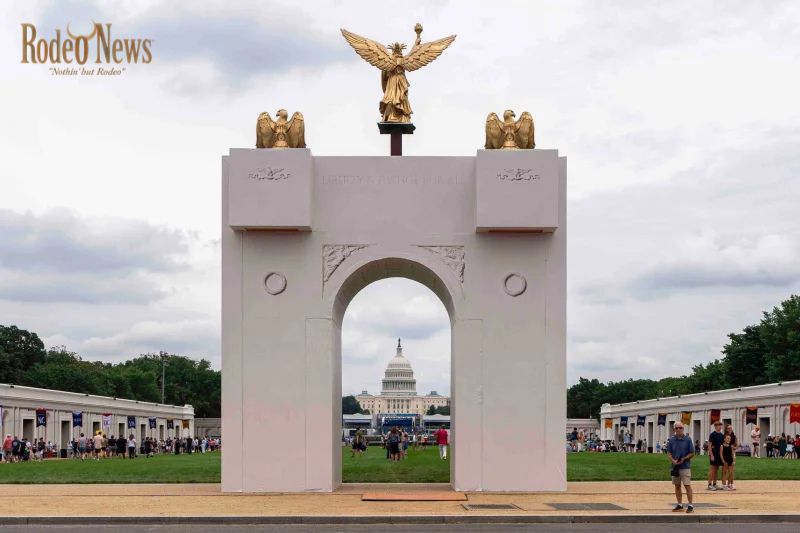
Trump announced the change Sunday, saying the military had strongly requested the additional capabilities and that the facility was necessary for national security. The proposed arch, which would stand about 250 feet tall, is planned for an area near Memorial Circle between Arlington National Cemetery and the Lincoln Memorial.
In a post on Truth Social, Trump described the planned structure as a combination of a monumental arch and a high-level military facility. He said it would be capable of housing and rapidly deploying large numbers of drones, while providing positions for military snipers on the roof and plaza.
The president also said the facility would be able to store substantial quantities of sniper ammunition.
The announcement adds a major new element to a project that has already generated controversy over its scale, location and potential impact on one of Washington’s most significant historic landscapes.
A Monument With a New Military Role
Trump has presented the arch as a major national monument connected to the country’s 250th anniversary. The structure would become one of the most prominent additions to the Washington landscape if it is ultimately approved and built.
The proposed location is particularly sensitive. The arch would rise near the Memorial Bridge and the National Mall, placing it within a landscape defined by the Lincoln Memorial, Arlington National Cemetery and other major national monuments.
At roughly 250 feet, the structure would be approximately twice the height of the Lincoln Memorial, according to NPR’s report on the proposal.
The addition of military functions has not previously been a central part of the public discussion surrounding the arch. The administration’s preservation review has involved historic preservation officials in Washington and Virginia, while federal agencies continue to consider the project’s implications.
The Washington Post reported that the military-complex concept had not previously been raised during the required preservation process.
Trump’s latest announcement therefore introduces questions about how the proposed military functions would fit into a project that was initially presented primarily as a monumental structure.
Opposition Has Already Emerged
The arch has faced opposition from veterans, preservation advocates and others who argue that the proposed construction would alter an important historic setting.
More than 100,000 public comments were submitted during the National Park Service review of the proposal, according to NPR.
A legal challenge has also complicated the administration’s plans. A group that includes Vietnam War veterans and an architectural historian has sued over the project, arguing that construction would improperly affect the historic grounds around Arlington National Cemetery. The lawsuit also challenges whether the president has the authority to proceed without congressional approval.
Earlier this month, U.S. District Court Judge Tanya Chutkan ordered the government to provide 48 hours’ notice before taking further action at Memorial Circle. The order warned that construction or demolition before the required federal authorization could violate the court’s directive.
The legal dispute comes as administration officials have continued discussing an accelerated timetable for the project.
Interior Secretary Doug Burgum previously said the administration intended to break ground on the arch within weeks, although several federal reviews and approvals remained outstanding at the time.
National Security Argument
Trump’s announcement reflects a broader pattern in which his administration has connected major Washington construction projects with national security.
The president has similarly described a proposed White House ballroom as serving a security-related purpose, in addition to its potential use for official events. The arch is now being presented in a comparable way, with military capabilities becoming part of its stated purpose.
The administration has not publicly detailed how drones and sniper positions would be used from the proposed arch, nor has it publicly identified a specific threat that would require such capabilities at the site.
That lack of detail is likely to become an important part of the debate as federal officials consider the proposal.
The location itself presents unusual logistical considerations. The proposed arch would stand in one of the most heavily visited and symbolically important areas of the nation’s capital, surrounded by major memorials, public roads and federal properties.
Critics have questioned whether military infrastructure is appropriate for such a prominent memorial setting.
Part of Trump’s Wider Washington Transformation
The arch is one element of a broader effort by Trump to reshape prominent parts of Washington.
Other projects associated with the administration include plans for a large White House ballroom, changes involving the Kennedy Center, work affecting the Lincoln Memorial Reflecting Pool and a proposed redevelopment of East Potomac Park.
The projects have attracted both supporters who view them as improvements to the capital and opponents who argue that historic sites and public spaces should not be substantially altered without broader consultation.
For the arch, the debate is now likely to extend beyond architecture and preservation. Trump’s description of the structure as a military complex raises additional questions about security, public access, operations and the appropriate role of military infrastructure in a national memorial landscape.
For now, the project remains subject to federal reviews and legal challenges. Whether the administration can proceed with its proposed timetable will depend on those processes.
Trump, however, has made clear that he sees the arch as more than a ceremonial monument. He says it will combine a symbol of national celebration with a facility capable of supporting military operations.
That combination is likely to make the proposed structure an even more closely watched part of the ongoing debate over the future appearance and function of Washington, D.C.