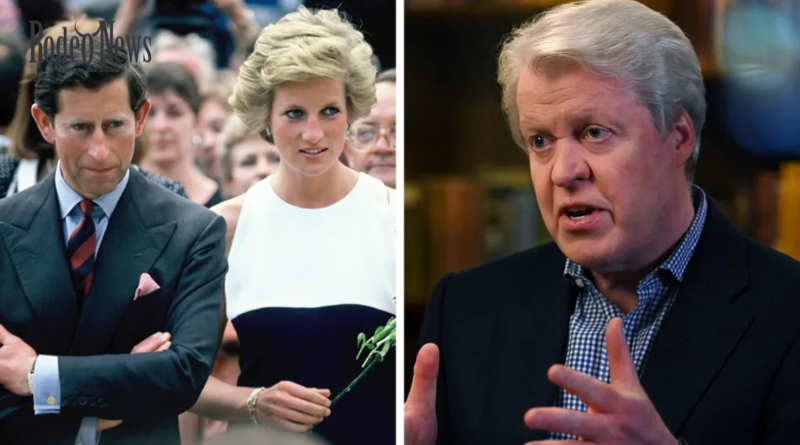
The Earl Spencer book about his sister, Diana, Princess of Wales, has triggered an unusually forceful response from Buckingham Palace after the memoir made a striking claim about King Charles and the aftermath of Diana’s death.
The forthcoming memoir, Swan Song: Diana, My Sister, is written by Charles Spencer, the 9th Earl Spencer and Diana’s younger brother. Extracts published ahead of its release describe a tense conversation between Spencer and the then-Prince Charles in the days surrounding Diana’s funeral in 1997.
According to Spencer’s account, the disagreement centered on whether Princes William and Harry, then aged 15 and 12, should walk behind their mother’s coffin during the funeral procession.
Spencer says he opposed the idea because he believed Diana would not have wanted her sons to endure such an emotionally difficult experience.
He claims that the disagreement led to an angry telephone conversation with Charles, during which the future king allegedly made a deeply controversial remark about Diana.
Buckingham Palace has rejected the implication of the account, responding that grief can affect memory and judgment many years after a traumatic event.
Earl Spencer Book Brings 1997 Back Into Focus
The controversy comes nearly three decades after Diana’s death and just before the publication of Spencer’s memoir.
Diana died in a car crash in Paris on August 31, 1997, aged 36. Her death prompted an extraordinary global outpouring of grief and placed the British royal family under intense public scrutiny.
At the time, Princes William and Harry were still children.
The decision for them to walk behind their mother’s coffin became one of the most memorable images from the funeral. The procession moved from Kensington Palace to Westminster Abbey, with the two young princes walking alongside their father and other members of Diana’s family.
Spencer now says he had serious reservations about the decision.
In excerpts from Swan Song, he recalls being informed by a senior royal aide that William and Harry would take part in the procession. Spencer says he responded that this would not happen.
He then describes receiving a telephone call from Charles.
According to Spencer’s account, the discussion became increasingly heated. He says Charles referred to his own experience of walking in the funeral procession for his great-uncle Lord Mountbatten in 1979.
Spencer then describes what he says was the most disturbing moment of the conversation.
He alleges that Charles told him: “We’ll forget her soon enough.”
The remark has not been independently established as a fact. It is Spencer’s recollection of a private conversation from 1997, and Buckingham Palace has challenged the reliability of that recollection.
Buckingham Palace Issues Rare Response
The Palace’s response has attracted almost as much attention as the allegation itself.
Buckingham Palace generally does not respond to claims contained in books about members of the Royal Family. In this case, however, it issued a pointed statement addressing the circumstances described by Spencer.
The Palace said that grief between siblings can affect memory, judgment and recollection, even many years later.
The wording was notable because it did not simply dismiss the book or decline to comment.
Instead, the Palace directly raised the possibility that Spencer’s memories of the conversation could have been affected by the trauma surrounding Diana’s death.
The response has drawn comparisons with the approach taken by the late Queen Elizabeth II after Prince Harry and Meghan’s 2021 interview with Oprah Winfrey.
At that time, Buckingham Palace famously said that “recollections may vary” in response to disputed claims.
The current statement has similarly focused attention on the difference between an individual’s recollection and an independently established historical record.
What Earl Spencer Says Happened
The central episode described in the Earl Spencer book concerns the days immediately before Diana’s funeral.
Spencer says he was deeply concerned about William and Harry being required to walk behind their mother’s coffin.
His concern was understandable within the context of the tragedy. Diana had died suddenly, and both boys were still teenagers and children. The funeral itself attracted enormous international attention.
Spencer says he believed putting the boys at the center of the procession would expose them to another traumatic experience.
His account describes a confrontation with Charles after he attempted to challenge the plan.
Spencer says the conversation became increasingly angry before Charles allegedly made the remark about Diana eventually being forgotten.
The book portrays the comment as evidence of what Spencer interpreted as Charles’s hostility toward Diana.
However, that interpretation belongs to Spencer’s account. The Palace has disputed the broader implication and questioned the reliability of memories formed during such an intense period of grief.
That distinction is important when assessing historical claims about private conversations.
Why William and Harry’s Funeral Walk Matters
The dispute is also significant because the funeral procession became one of the defining public images of Diana’s death.
William was 15 and Harry was only 12.
Images of the brothers walking behind their mother’s coffin were broadcast around the world.
The decision has subsequently been discussed many times in relation to the impact Diana’s death had on her sons.
Spencer’s account suggests that concern about their participation existed within the family at the time.
The book therefore provides another perspective on an event that was publicly visible but privately shaped by disagreements among family members.
The procession itself, however, is not in dispute. William and Harry did walk behind Diana’s coffin alongside their father, Earl Spencer and other members of the family.
What remains disputed is the private conversation and the motivation behind the decisions described by Spencer.
A Memoir Written From Diana’s Family Perspective
Swan Song: Diana, My Sister is not presented as a conventional royal biography.
Spencer has described it as an attempt to tell Diana’s story from the perspective of her brother.
He announced the book in August, saying that the approaching 30th anniversary of Diana’s death had prompted renewed requests for interviews.
Rather than repeatedly discuss his sister’s life through interviews, he decided to put his own memories and views into a book.
Spencer has said his goal is to provide what he considers his truthful perspective on Diana and to challenge accounts that he believes contain inaccuracies.
The book covers Diana’s life, her marriage to Charles, her relationship with the media and the events surrounding her death.
It also represents the first time Spencer has spoken at length about his sister in this particular format.
The timing is significant.
Diana’s 30th death anniversary will arrive in 2027, ensuring that interest in her life and legacy is likely to remain substantial.
Earl Spencer and the 1997 Funeral
Spencer has previously played a prominent role in the public story surrounding Diana’s funeral.
He delivered her eulogy at Westminster Abbey in September 1997.
The speech was emotional and included criticism of the intense media attention Diana had experienced during her lifetime.
Spencer also pledged to protect William and Harry and spoke about the role of Diana’s family in preserving her legacy.
His relationship with the Royal Family has therefore been connected to Diana’s story for decades.
The new memoir revisits that period from his perspective and provides additional details about the family tensions surrounding the funeral.
The Palace’s response demonstrates that the events of 1997 remain sensitive within the institution.
Why the Palace Response Is Significant
The unusual nature of the Palace response has become a major part of the story.
Royal households have historically avoided responding to every allegation contained in books, documentaries and interviews.
There is a practical reason for that approach. Responding to every claim can give additional publicity to allegations that might otherwise receive limited attention.
In this case, however, the Palace chose to address the claim directly.
Former royal communications secretary Julian Payne told the BBC that the statement demonstrated how strongly the institution felt about the allegation.
The statement also carefully avoided a detailed reconstruction of the private conversation.
Instead, it focused on the reliability of memory during grief.
That leaves the central allegation unresolved.
Spencer says the conversation happened as he remembers it.
The Palace has not accepted that version.
There is no publicly available recording or independent transcript of the alleged telephone conversation.
Charles and Diana’s Complicated History
The dispute cannot be separated completely from the complicated history between Charles and Diana.
The couple married in 1981 and separated in 1992 before divorcing in 1996.
Their relationship was heavily scrutinized by the British and international press.
Both later discussed aspects of the breakdown of their marriage publicly, creating an extensive historical record as well as years of media speculation.
Diana’s popularity also created a complicated dynamic with the Royal Family.
After her death, the public response was enormous. Large crowds gathered outside royal residences, flowers were left across London and millions watched the funeral.
The intensity of that reaction became an important moment in the modern history of the monarchy.
The new memoir returns to those events through the eyes of someone who was Diana’s brother and one of the central figures at her funeral.
The Memoir’s Release Date
Swan Song: Diana, My Sister is scheduled for publication on September 22, 2026.
The book is being released by Penguin Michael Joseph in the United Kingdom.
Interest has already increased because excerpts have been published before the full book reaches readers.
The release has also attracted unusual attention because reports say four copies of the Dutch edition were stolen from a delivery truck in the Netherlands ahead of publication. Dutch authorities were reported to be investigating the incident.
The theft has added another layer of intrigue to a publication already generating substantial media interest.
However, the principal story remains Spencer’s account of Diana’s final days and his recollections of the royal family’s response to her death.
William and Harry Face a New Chapter in Diana’s Story
The memoir arrives at a time when Diana’s sons occupy central positions in the modern Royal Family story.
Prince William is now the Prince of Wales and is carrying out official duties alongside Catherine, Princess of Wales.
Prince Harry has established a separate life in the United States while continuing to speak publicly about his experiences within the Royal Family.
Their mother’s death remains an important part of both brothers’ public biographies.
The publication of Spencer’s memoir therefore has the potential to revive questions about the circumstances surrounding the funeral and the decisions made when William and Harry were teenagers and a child.
Whether the book changes the historical understanding of those events will depend partly on what additional evidence or recollections it contains.
What Is Established and What Remains Disputed
Several facts surrounding the controversy are well documented.
Diana died in Paris in 1997.
William and Harry walked behind her coffin during the funeral procession.
Earl Spencer delivered the eulogy at Westminster Abbey.
Spencer’s new memoir is scheduled for publication on September 22.
And Buckingham Palace has issued an unusually direct response to his account.
The disputed element is the alleged private conversation between Spencer and Charles.
Spencer says Charles made the “we’ll forget her soon enough” remark.
The Palace has challenged the reliability of that recollection and has not accepted the account as an accurate representation of Charles’s words or attitude.
For readers, separating those established facts from the disputed allegation is essential.
A Royal Dispute With a Long Memory
The Earl Spencer book has reopened a chapter of royal history that remains emotionally powerful nearly 30 years after Diana’s death.
Its most controversial claim concerns an alleged conversation that took place during an extraordinarily difficult period for the Royal Family and the Spencer family.
Spencer presents his memories as an attempt to tell Diana’s story from her brother’s perspective.
Buckingham Palace has responded by questioning the reliability of memories formed during profound grief.
The disagreement means the full memoir is likely to receive intense attention when it is published on September 22.
For now, the central allegation remains a disputed account of a private conversation. What is beyond dispute is the continuing public interest in Diana, her family and the events surrounding her death.
As Swan Song: Diana, My Sister reaches readers, further excerpts may provide additional context about the relationship between Diana’s family and the Royal Family — and about how the events of 1997 continue to shape their story today.