Huawei Foldable Phone Launch Sparks Fierce Tech Battle
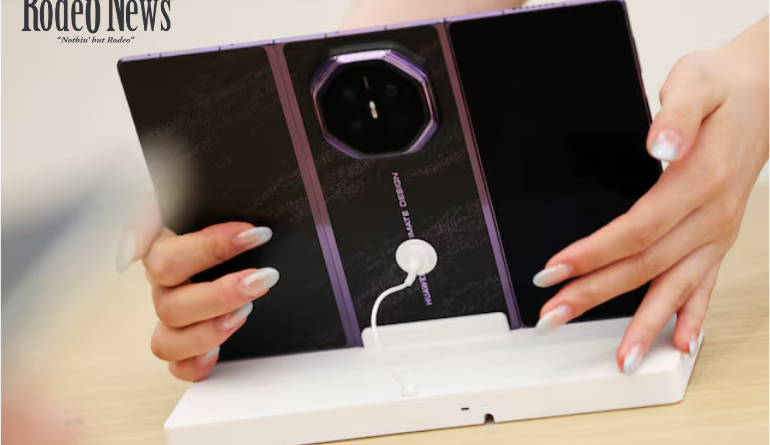
The Huawei foldable phone market push has taken another major step forward with the launch of the company’s latest flagship tri-fold smartphone, the Mate XT2. Huawei is using the new device to strengthen its position in China’s premium smartphone market as competition from Xiaomi and Apple intensifies.
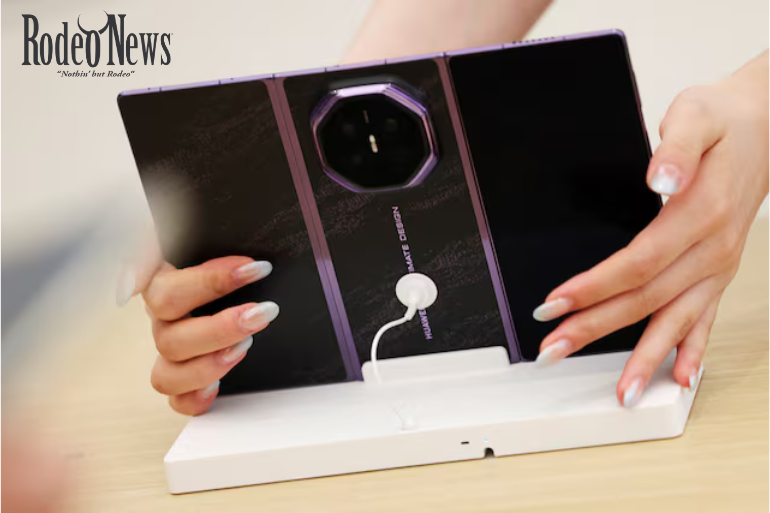
The new Mate XT2 combines a three-section folding design with Huawei’s latest Kirin 9050 Pro chip. The phone is priced from 19,999 yuan, or about $2,980, while the most expensive version reaches 24,999 yuan, or roughly $3,725. Huawei said the devices will go on sale on September 12.
The launch comes at a critical moment for the global smartphone industry. Foldable phones are moving from a niche category into a more important premium segment, while Chinese manufacturers are competing aggressively to develop new designs and technologies.
Meanwhile, Xiaomi is preparing its own high-end folding device, while Apple is also expected to enter the foldable smartphone market. That could make the next phase of the smartphone industry one of the most competitive in years.
Huawei Foldable Phone Targets Premium Smartphone Buyers
Huawei has made foldable smartphones an important part of its premium-device strategy.
The company’s latest Mate XT2 continues that approach with a tri-fold design that can transform between different screen configurations. Instead of folding once like conventional book-style foldables, the device uses multiple folding sections to provide a larger display while remaining relatively compact when closed.
Huawei says the new model brings improvements to the folding mechanism, water resistance and privacy features. The company also claims the device delivers a 42% performance improvement compared with previous models based on its internal testing.
The Mate XT2 is therefore more than a hardware refresh.
Huawei is presenting the smartphone as evidence that it can continue developing advanced consumer technology despite years of restrictions on its access to certain U.S. technologies.
That makes the launch significant not only for Huawei but also for China’s broader technology industry.
Huawei Mate XT2 Price Reaches Nearly $3,700
The price of the new Huawei foldable phone places it firmly in the luxury smartphone category.
According to Reuters, the Mate XT2 will be priced between 19,999 yuan and 24,999 yuan. The highest configuration therefore costs close to $3,700, making it substantially more expensive than conventional flagship smartphones.
That pricing strategy reflects the technology involved in creating a sophisticated tri-fold device.
Foldable phones generally require specialized flexible displays, complex hinge systems and reinforced materials. Tri-fold designs can add another layer of engineering difficulty because the manufacturer has to manage multiple folding points while maintaining durability.
For Huawei, however, the premium price could also help reinforce its position as a technology leader.
The company has already established itself as a major player in China’s foldable-phone market. Reuters reported that Huawei accounted for about 68% of China’s foldable smartphone market in the second quarter, demonstrating how dominant the company has become in this segment.
Huawei Foldable Phone Uses New Kirin 9050 Pro Chip
One of the most closely watched components of the Mate XT2 is its processor.
Huawei has equipped the new smartphone with the Kirin 9050 Pro chip. Reuters reported that Huawei is using technologies including its so-called “Tau Scaling Law” and LogicFolding design to improve chip efficiency and performance while working around restrictions imposed by the United States.
The chip is particularly important because semiconductors have become one of the biggest pressure points in the technology competition between China and the United States.
Huawei has faced significant restrictions on access to advanced semiconductor technologies. Despite those challenges, the company has continued developing its own chips and devices.
The Mate XT2 therefore gives Huawei another opportunity to demonstrate how far its domestic technology capabilities have progressed.
For consumers, the processor should influence everything from application performance to battery efficiency and artificial intelligence features.
For the broader technology industry, however, the significance goes further.
The chip represents another example of Huawei attempting to reduce its dependence on foreign technology while maintaining premium product performance.
Huawei Faces New Competition From Xiaomi
Huawei may currently dominate China’s foldable market, but competitors are moving quickly.
Xiaomi is preparing to launch its own premium folding smartphone, the Xiaomi 18 Fold. Reuters previously reported that the device is expected to use Xiaomi’s own Xring chip and could ship in the range of 200,000 to 300,000 units initially.
Another Reuters report said Xiaomi’s upcoming foldable phone is expected to use LPDDR6 memory supplied by Chinese semiconductor manufacturer ChangXin Memory Technologies.
The companies have said the new foldable phone will be released in September.
That timing is important.
Huawei’s Mate XT2 is going on sale on September 12, meaning Xiaomi’s new product will arrive in the same month. Consumers and technology analysts will therefore have an opportunity to compare competing Chinese approaches to high-end foldable hardware.
The competition could also push manufacturers to improve prices, durability, camera systems and battery technology.
Apple Could Transform the Foldable Market
The biggest potential disruption may come from Apple.
Apple has not historically been an early leader in foldable smartphones. However, expectations that the company could eventually introduce a foldable iPhone have grown considerably.
A foldable iPhone would give Apple access to a premium category where Huawei and Samsung have already established products.
Apple’s entry could dramatically increase consumer interest in foldable devices.
The company has an enormous global customer base and a powerful ecosystem connecting iPhones with services, computers, tablets and wearable products.
If Apple enters the market, foldable smartphones could move even further into the mainstream.
For Huawei, that would create both a challenge and an opportunity.
The challenge would be competition for premium customers.
The opportunity would be a rapidly expanding market where Huawei already has significant experience.
China’s Foldable Smartphone Market Is Becoming a Key Battleground
China has become one of the world’s most important markets for foldable smartphones.
Huawei’s strong position illustrates the scale of consumer interest. Reuters reported that Huawei shipped about 1.6 million foldable phones in China during the second quarter, giving the company approximately 68% market share.
Honor and Oppo followed behind Huawei, although with substantially smaller shares.
That market leadership gives Huawei an important advantage.
The company has years of experience designing foldable hardware and can use feedback from Chinese consumers to refine future generations.
However, Xiaomi’s expansion could challenge that dominance.
Xiaomi is already one of the world’s largest smartphone manufacturers. The company’s strength in value-oriented premium hardware could allow it to compete aggressively in the foldable category.
The key question is whether Xiaomi can turn its traditional strengths in pricing and hardware innovation into meaningful market share at the very high end.
Huawei Foldable Phone Shows China’s Technology Ambitions
The latest Huawei foldable phone also has significance beyond the smartphone market.
Huawei has become a symbol of China’s efforts to build advanced domestic technology capabilities.
The company’s smartphone business suffered major disruptions after U.S. restrictions limited its access to critical technologies. Yet Huawei has continued investing in semiconductor development, operating systems, artificial intelligence and consumer electronics.
The Mate XT2 represents another visible demonstration of that strategy.
Huawei’s official consumer business continues to promote smartphones and other connected devices as part of a broader technology ecosystem.
The company is attempting to compete not only through individual products but also through software and services.
That ecosystem strategy could become increasingly important as smartphone hardware becomes more similar across manufacturers.
Tri-Fold Technology Could Become the Next Smartphone Trend
Traditional foldable phones generally use one hinge.
Tri-fold devices introduce another possibility.
When unfolded, a tri-fold smartphone can provide a much larger screen than a conventional phone. Users could potentially use the device for multitasking, video, reading, gaming and productivity.
When folded, it can return to a smaller form suitable for carrying.
The biggest technical challenge is durability.
More hinges mean more mechanical complexity. Flexible displays must withstand repeated folding without developing visible damage, while the body must remain thin enough to be practical.
Huawei’s decision to continue investing in the tri-fold design suggests that the company believes consumers will accept the additional complexity in exchange for a larger display.
If that strategy succeeds, competitors may increasingly follow.
Huawei Foldable Phone Competition Could Lower Prices
One potential benefit for consumers is stronger competition.
The Mate XT2 carries a very high price, but increased competition could eventually bring advanced folding technology to less expensive devices.
Xiaomi is particularly important in this regard.
The company has built its reputation partly around delivering high-end specifications at competitive prices. If it can produce a compelling foldable device at a lower price than Huawei, it could force the market leader to respond.
Apple could create another type of competitive pressure.
Rather than competing primarily on price, Apple would likely compete through its ecosystem, software integration and brand strength.
That would give consumers several distinct choices rather than a single dominant approach.
U.S. Restrictions Remain Part of Huawei’s Story
Huawei’s smartphone comeback cannot be separated from geopolitical tensions.
The company has been subject to extensive U.S. restrictions because of national-security concerns raised by American officials. Huawei has consistently denied allegations that its products pose security threats.
The restrictions have made access to advanced semiconductor technologies more difficult.
Nevertheless, Huawei has invested heavily in domestic alternatives.
The Mate XT2’s Kirin 9050 Pro chip is therefore being watched closely by technology analysts because it provides another indication of Huawei’s ability to develop competitive processors under restrictions.
The issue extends beyond smartphones.
China and the United States are competing across semiconductors, artificial intelligence, telecommunications and advanced manufacturing.
Every major Huawei product launch is consequently examined within that larger technology rivalry.
Xiaomi Shares Fall After Huawei Launch
The competitive pressure was reflected in financial markets.
Reuters reported that Xiaomi shares fell about 3% following Huawei’s announcement.
The reaction illustrates how seriously investors are treating the foldable-phone competition.
Huawei’s strong position in the Chinese market means every new premium product can affect expectations for rival manufacturers.
For Xiaomi, the upcoming foldable launch is an opportunity to demonstrate that it can compete directly with Huawei in one of the industry’s fastest-developing premium categories.
A successful product could strengthen Xiaomi’s position.
A weak launch, however, could make it harder for the company to gain ground.
What the Huawei Foldable Phone Means for Apple
Apple faces a different challenge.
The company remains one of the world’s most powerful smartphone brands, but it has yet to establish a major presence in the foldable category.
Huawei’s success gives Apple an increasingly competitive market to enter.
If Apple eventually launches a foldable iPhone, it will have to compete against manufacturers that already have years of experience.
Huawei has already moved into tri-fold designs.
Samsung has established itself as one of the biggest names in conventional foldables.
Xiaomi is preparing new premium hardware.
That means Apple’s first foldable iPhone could arrive in a market that is much more mature than it was several years ago.
The Future of Foldable Smartphones
The launch of the Mate XT2 highlights a broader transformation in the smartphone industry.
For years, manufacturers competed mainly on camera quality, processor speed, battery capacity and display technology.
Now, physical design is becoming increasingly important.
Foldable phones give manufacturers a new way to differentiate their products.
Tri-fold phones take that idea even further.
However, widespread adoption will depend on more than impressive specifications.
Consumers will want better durability, thinner designs, longer battery life and lower prices.
Software will also play an important role. Large foldable displays are only useful if applications can take advantage of the additional screen space.
Huawei, Xiaomi and Apple therefore face the same fundamental challenge: convincing consumers that folding technology is worth paying for.
Conclusion
The new Huawei foldable phone marks another major development in the race to define the future of premium smartphones.
The Mate XT2 combines a tri-fold design with Huawei’s Kirin 9050 Pro processor and a price reaching nearly $3,700. The company is betting that consumers will pay a premium for advanced folding technology while it works to maintain its dominant position in China’s foldable market.
But Huawei will not have the market to itself.
Xiaomi is preparing a new premium foldable phone, while Apple could eventually enter the category with a foldable iPhone. Those developments could dramatically increase competition and accelerate innovation.
For consumers, the battle could mean more choices and faster improvements.
For Huawei, however, the stakes are even higher.
The Mate XT2 is not simply another smartphone. It is a statement that Huawei intends to remain at the center of China’s premium technology industry — even as competitors from China and the United States prepare for the next major battle in mobile devices.