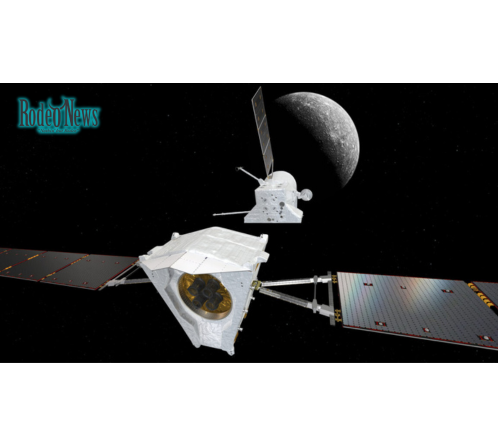
BepiColombo Mission Enters Final Approach to Mercury
The BepiColombo mission has reached one of the most important stages of its extraordinary journey, with the European-Japanese spacecraft now on its final approach to Mercury after spending eight years traveling through the inner Solar System.
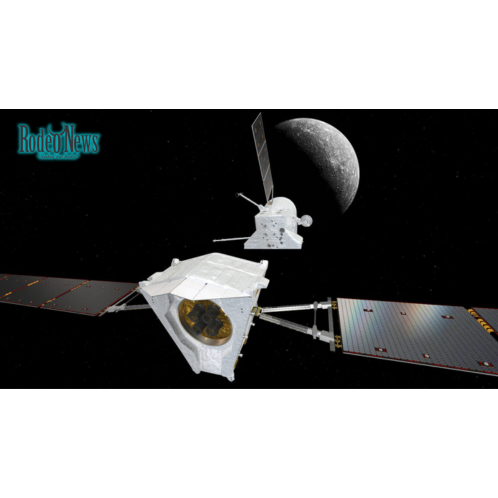
Launched in October 2018, BepiColombo was designed to tackle one of the most difficult destinations in planetary exploration. Getting a spacecraft into orbit around Mercury is surprisingly challenging because the planet sits deep inside the Sun’s gravitational well. Rather than simply flying toward Mercury, the spacecraft has spent years carefully losing orbital energy through electric propulsion and gravity-assist maneuvers.
Now, the mission is entering its arrival sequence.
On Sept. 3, the Mercury Transfer Module separated from the two scientific orbiters it had carried across space. The next major milestone is expected in November, when the spacecraft will attempt to enter orbit around Mercury.
The arrival will mark the beginning of a new phase for a mission intended to reveal some of Mercury’s biggest mysteries.
Why the BepiColombo Mission Took Eight Years
At first glance, an eight-year trip to Mercury might seem excessive.
Mercury is the closest planet to the Sun and can come within roughly 77 million kilometers of Earth. Yet reaching the planet is not simply a matter of pointing a rocket inward and accelerating toward it.
The Sun’s gravity makes the journey exceptionally complicated.
A spacecraft leaving Earth already has considerable orbital velocity around the Sun. If it simply traveled toward Mercury, it would reach the planet moving too quickly to be captured easily by Mercury’s comparatively weak gravity.
In effect, a spacecraft heading toward Mercury has to brake against the Sun’s gravitational pull.
The BepiColombo mission solved this problem through a combination of solar-electric propulsion and planetary gravity assists. The spacecraft used one Earth flyby, two Venus flybys and six Mercury flybys to progressively reshape its trajectory and reduce its energy relative to the Sun.
That process takes time.
It also requires extremely precise navigation.
ESA explains that reaching Mercury can require more energy than sending a spacecraft toward much more distant destinations such as Pluto, because the spacecraft must lose orbital energy rather than simply accelerate away from the Sun.
A Major Separation Has Already Happened
The BepiColombo mission recently reached an important milestone in its arrival sequence.
On Sept. 3, the Mercury Transfer Module, or MTM, separated from the two scientific spacecraft. The MTM supplied power and propulsion during the long cruise from Earth to Mercury. With that phase complete, control of the spacecraft’s trajectory has shifted to the propulsion systems aboard ESA’s Mercury Planetary Orbiter.
This separation is more than a routine mechanical event.
It means the spacecraft has entered the final stage of its journey.
The remaining components will eventually become two independent scientific orbiters: ESA’s Mercury Planetary Orbiter, known as MPO, and the Japan Aerospace Exploration Agency’s Mercury Magnetospheric Orbiter, known as Mio.
Together, they will investigate Mercury from complementary perspectives.
The BepiColombo Mission Has Two Scientific Orbiters
One of the most important features of the BepiColombo mission is that it does not rely on a single spacecraft to conduct all of its research.
Instead, two orbiters will work around Mercury.
ESA’s Mercury Planetary Orbiter
The MPO is designed primarily to study Mercury’s surface and internal structure.
Its instruments will map the planet in detail, investigate its chemical and elemental composition and examine geological features. Scientists hope these measurements will provide new information about Mercury’s formation and evolution.
The spacecraft will eventually operate in a relatively low polar orbit, approximately 480 by 1,500 kilometers above Mercury’s surface, after the arrival sequence and orbit adjustments are completed.
JAXA’s Mio Orbiter
The second spacecraft, Mio, is operated by JAXA and is designed to focus heavily on Mercury’s magnetic environment.
Its instruments will study the planet’s magnetosphere, plasma, magnetic field and interactions with the solar wind.
This is especially important because Mercury is the only rocky planet besides Earth known to possess a global magnetic field.
Understanding how that field works could help scientists understand not only Mercury but also how magnetic environments develop around rocky planets more generally.
The Next Big Challenge: Entering Mercury Orbit
The spacecraft’s arrival at Mercury will not happen in one dramatic moment.
Instead, it will unfold through a carefully choreographed sequence.
Current ESA planning calls for BepiColombo’s two orbiters to be captured into a polar orbit around Mercury on Nov. 21, 2026. Mio would then be released into its final elliptical orbit in December. The MPO would subsequently release Mio’s protective sunshield and use its own thrusters to descend toward its dedicated orbit.
The process will continue well into 2027.
ESA currently expects MPO to reach its final orbit around March 10, 2027, with the main science phase scheduled to begin around April 6. Dates could change for operational reasons.
That means the spacecraft’s arrival at Mercury is only the beginning.
The most important discoveries will come afterward.
Why Mercury Remains a Scientific Mystery
Mercury is one of the least explored planets in the inner Solar System.
NASA’s Mariner 10 became the first spacecraft to obtain close-up views of Mercury during flybys in 1974 and 1975. Decades later, NASA’s MESSENGER spacecraft studied Mercury from orbit between 2011 and 2015.
Those missions transformed scientists’ understanding of the planet.
But they also raised new questions.
BepiColombo is designed to investigate many of them with more sophisticated instruments and observations from two complementary spacecraft.
Mercury is particularly intriguing because it has a disproportionately large iron core compared with the planet’s overall size.
Scientists want to understand why.
They also want to determine how Mercury formed so close to the Sun, how its surface evolved and why the planet still maintains a magnetic field despite its small size.
BepiColombo Mission Will Search for Clues About Water Ice
Perhaps one of Mercury’s most surprising mysteries concerns water.
The planet’s daytime surface can become extraordinarily hot, with temperatures reaching about 430 degrees Celsius. Yet some craters near Mercury’s poles never receive direct sunlight.
Those permanently shadowed regions can remain extremely cold.
Observations from MESSENGER and Earth-based radar have provided strong evidence that water ice may exist inside some of these polar craters.
That creates an unusual picture of Mercury.
A planet known for extreme heat may simultaneously contain deposits of frozen water hidden in permanently dark locations.
The BepiColombo mission will investigate these regions in much greater detail.
Scientists hope its observations will help determine the distribution, composition and history of the suspected ice deposits.
Mercury’s Surface Holds More Clues
Mercury’s heavily cratered surface preserves evidence of billions of years of impacts, volcanic activity and tectonic changes.
During its previous Mercury encounters, BepiColombo has already captured striking images of the planet.
Its sixth and final Mercury flyby took place in January 2025, bringing the spacecraft as close as about 295 kilometers above the surface. The spacecraft passed over Mercury’s northern regions, providing views of permanently shadowed craters and extensive volcanic plains.
The flyby also provided observations of the Caloris Basin, Mercury’s enormous impact structure.
But those images were only previews.
Once the scientific orbiters begin operating around Mercury, they will be able to conduct systematic observations instead of relying primarily on brief flybys.
That distinction is crucial.
The BepiColombo Mission Could Transform Mercury Maps
Previous missions have left scientists with an incomplete picture of Mercury’s surface, especially in polar regions.
BepiColombo’s orbiters will provide new measurements across multiple wavelengths and will examine Mercury from polar orbits.
The mission is expected to produce global maps of the planet’s surface composition and investigate geological processes such as volcanism, tectonic activity and the effects of impacts.
Scientists will also be able to compare new measurements with observations collected by MESSENGER more than a decade earlier.
That could reveal changes in Mercury’s environment and help researchers refine models of how the planet evolved.
A Spacecraft Built for an Extreme Environment
Getting to Mercury is only half the challenge.
Operating there is another.
Mercury orbits extremely close to the Sun, exposing spacecraft to intense solar radiation and severe thermal conditions.
The BepiColombo spacecraft therefore required specialized engineering to survive an environment unlike that encountered by most planetary missions.
Its journey also relied heavily on solar-electric propulsion.
The spacecraft’s ion thrusters generated relatively low thrust, but they could operate for extremely long periods. This allowed BepiColombo to gradually alter its trajectory while using far less propellant than a conventional chemical-propulsion approach would have required.
In June 2026, ESA announced that BepiColombo’s solar-electric propulsion system had completed its final thrust arc, ending the long cruise phase and beginning the spacecraft’s arrival at Mercury.
That was a major engineering milestone.
After years of continuous propulsion and navigation, the spacecraft was finally entering the final approach.
Why Two Spacecraft Are Better Than One
The BepiColombo mission’s two-orbiter design offers a major scientific advantage.
Mercury’s surface, interior, magnetic field and surrounding space environment are connected.
The MPO can focus heavily on the planet itself, while Mio can investigate the magnetosphere and space environment around it.
Together, their measurements can provide a more complete picture.
For example, scientists can examine how the solar wind interacts with Mercury’s magnetic field while simultaneously studying how that environment affects the planet’s surface.
ESA describes having two spacecraft at Mercury as a major advantage for understanding how the solar wind interacts with a small rocky planet.
That information could have implications beyond Mercury.
Many exoplanets orbit close to their stars. Studying Mercury’s extreme environment provides researchers with a nearby laboratory for understanding how rocky planets behave under intense stellar radiation.
What Happens After Arrival?
The most exciting part of the BepiColombo mission will begin only after the spacecraft completes its complex orbital insertion and commissioning activities.
The orbiters will need time to deploy, configure and test their instruments.
According to ESA’s current timeline, the main science phase is expected to begin in April 2027.
Once that happens, scientists will begin receiving a much more detailed picture of Mercury.
The mission’s research program includes several major questions:
- Why does Mercury have such a large iron core?
- How did the planet form so close to the Sun?
- Why does Mercury possess a magnetic field?
- How does the solar wind interact with that magnetic field?
- What is Mercury’s surface made of?
- How has volcanic activity shaped the planet?
- Are water-ice deposits preserved inside permanently shadowed craters?
- How has Mercury changed throughout its history?
The answers could reshape scientists’ understanding of the smallest planet in the Solar System.
An Eight-Year Journey Reaches Its Defining Moment
The BepiColombo mission is a reminder that planetary exploration is often a test of patience as much as technology.
From its launch in 2018 to its final approach in 2026, the spacecraft has spent years navigating the complex gravitational environment of the inner Solar System.
It has flown past Earth, Venus and Mercury, using those encounters to gradually adjust its trajectory.
Now the spacecraft is finally preparing to become an orbiter of Mercury.
The mission’s journey has been unusually long because reaching Mercury safely requires an intricate balance of speed, gravity and propulsion. ESA notes that BepiColombo’s route involved nine planetary flybys in total: one at Earth, two at Venus and six at Mercury.
The payoff could be enormous.
Mercury remains one of the least understood worlds in our planetary neighborhood. With two specialized orbiters preparing to study it from different perspectives, scientists are about to gain an unprecedented opportunity to investigate its surface, interior, magnetic field and mysterious polar regions.
The BepiColombo mission has spent eight years getting to Mercury.
Now, the real scientific adventure is about to begin.