China and U.S. Agree on Tariff Cuts and New AI Dialogue
China and the United States have reached a new understanding on tariffs and agreed to establish a formal dialogue on artificial intelligence, giving both sides a temporary path to manage tensions after years of trade and technology disputes.
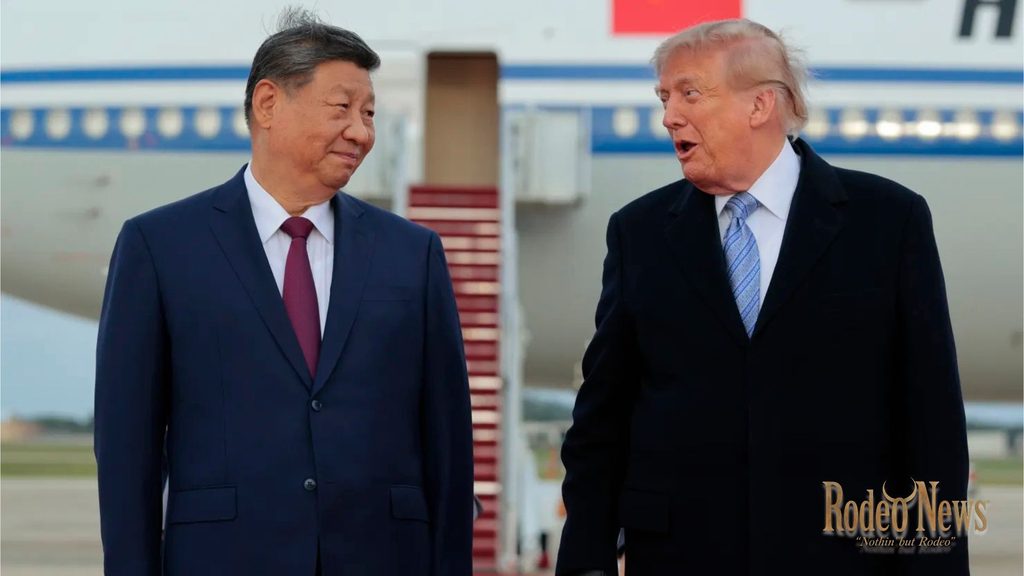
The agreements were reached during Chinese President Xi Jinping’s three-day visit to the United States, where he met President Donald Trump in Washington. The discussions produced an eight-point consensus that includes a reciprocal tariff-reduction arrangement involving about $30 billion in goods, the creation of a bilateral trade council and new communication channels focused on artificial intelligence.
The developments do not resolve the broader economic and strategic disagreements between Washington and Beijing. Instead, the latest arrangements appear to create additional time for negotiations while reducing the immediate risk of another escalation in the trade dispute.
U.S. and China Agree on Tariff Reductions
One of the central elements of the new agreement is a plan to reduce tariffs on selected goods traded between the two countries.
The arrangement is focused on products considered less sensitive to national security concerns. U.S. agricultural products and medical devices are among the categories discussed, while Chinese consumer products are also expected to receive tariff relief.
U.S. Trade Representative Jamieson Greer said the two countries had reached agreements covering a subset of goods and indicated that additional details would be announced later. The precise products covered and the scale of the tariff reductions are expected to become clearer as officials finalize the arrangement.
The limited nature of the agreement is significant because tariffs have become one of the most persistent sources of friction between the world’s two largest economies.
Rather than removing tariffs across the board, the latest arrangement focuses on selected non-sensitive goods. Reporting indicates that each country could identify roughly $30 billion worth of products for preferential treatment, creating a combined pool of approximately $60 billion in trade that would receive protection from some future tariff measures.
Existing Trade Truce Extended
The two governments have also agreed to extend an existing trade truce.
The current arrangement, which had been scheduled to expire in November, has been extended until January 10, 2027. The extension gives negotiators additional time to work on unresolved issues involving tariffs, trade and economic policy.
The temporary agreement follows months of negotiations in which Washington and Beijing sought to prevent their economic confrontation from developing into another full-scale tariff escalation.
Both sides have previously used tariffs, export controls and restrictions on critical materials as negotiating tools. China has also tightened controls involving rare-earth resources, while the United States has maintained restrictions on certain advanced technologies.
The new extension therefore provides a period in which the two governments can continue negotiations without immediately returning to the higher level of trade uncertainty seen during previous confrontations.
Artificial Intelligence Becomes a New Diplomatic Issue
Artificial intelligence was another important part of the latest discussions.
The United States and China have agreed to establish a formal channel for dialogue on AI, including communication related to potentially dangerous incidents involving the technology.
Officials have discussed the possibility of a notification system that could allow the two governments to communicate when an AI-related incident reaches a significant national-security threshold. The proposal emerged from earlier meetings between U.S. Treasury Secretary Scott Bessent and Chinese Vice Premier He Lifeng.
The purpose of the mechanism is not necessarily to limit the development of AI itself. Instead, the initial discussions have focused on reducing the risk that an AI-related incident could escalate because the two governments lack direct communication.
Potential areas of concern include cyberattacks, biological misuse, attacks on critical infrastructure and other scenarios involving increasingly capable artificial intelligence systems.
The two countries remain competitors in AI development, making the establishment of a communication channel particularly notable.
Advanced AI Chips Remain Outside the Deal
Despite the new AI dialogue, there was little indication of a breakthrough over advanced semiconductors.
The United States continues to impose restrictions on China’s access to some of the world’s most advanced AI chips, citing national security concerns. Those export controls have become a major source of tension between Washington and Beijing.
Greer said national-security-related export controls were not part of the latest tariff negotiations. That means the new agreement does not represent a broad relaxation of American restrictions on advanced semiconductor technology.
The distinction is important because tariffs and technology controls are increasingly being handled as separate issues.
While Washington and Beijing have found areas where limited economic cooperation is possible, advanced computing technology remains closely tied to national-security policy.
More Talks Planned
The latest agreements are also expected to be followed by additional meetings between Trump and Xi.
The two leaders are scheduled to continue engaging through upcoming international meetings, providing another opportunity to discuss trade and technology issues.
The November meeting in Shenzhen is expected to include further discussions involving AI and other areas of bilateral relations. The leaders are also expected to meet at the Group of 20 summit in Miami later in the year.
The continued meetings indicate that neither government is ending negotiations despite unresolved disagreements.
For businesses, the immediate benefit of the tariff arrangement could be greater clarity over selected products and a temporary reduction in uncertainty. However, companies operating across the two markets will continue to monitor negotiations because the broader tariff structure remains subject to change.
A Limited Step Toward Stability
The latest U.S.-China agreements represent a combination of economic concessions and continued strategic competition.
Washington and Beijing have found common ground on selected tariff reductions, extended their existing trade truce and agreed to establish a new channel for AI-related communication. At the same time, major disputes over advanced semiconductors, technology restrictions and other strategic issues remain unresolved.
The coming months will show whether the limited agreements can develop into a broader trade arrangement or remain temporary measures designed to prevent another escalation.
For now, the tariff reductions and AI dialogue give both countries additional mechanisms for communication while leaving many of the most difficult issues between Washington and Beijing for future negotiations.