
Bat Evolution: 103 Genomes Reveal New History
The story of bat evolution has taken a major turn after scientists analyzed chromosome-level genomes from 103 bat species and combined the genetic evidence with information from fossils. The study, published in Nature on September 23, 2026, reconstructs the evolutionary relationships of all 21 currently recognized bat families and proposes a new explanation for where bats originated.
The research suggests that bats and their remarkable ability to fly most likely originated in Europe during the late Palaeocene, rather than in Africa, Asia or North America as proposed by earlier studies.
The findings also provide new evidence about one of the most distinctive features of bats: laryngeal echolocation. The researchers argue that echolocation may have appeared before the diversification of modern crown-group bats, potentially linking the development of flight and echolocation much earlier in bat history than previously understood.
The results come from the Bat1K project, an international effort to generate high-quality reference genomes for all living bat species.
Bat Evolution Gets a Major Genetic Upgrade
Understanding bat evolution has been difficult for scientists for decades.
Bats are unusual among mammals because they combine powered flight with sophisticated echolocation, long lifespans relative to body size in some species, hibernation and notable resistance to several diseases. Yet their deep evolutionary relationships have remained surprisingly difficult to resolve.
One major problem has been the quality and availability of genomic data.
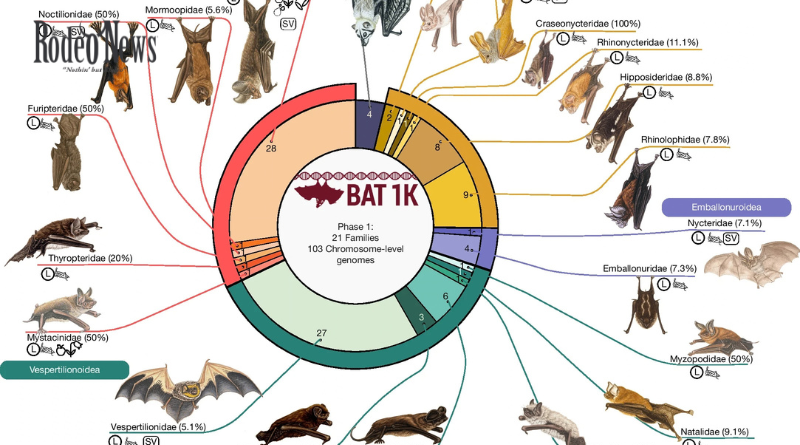
The new Nature study substantially expands that evidence base. Researchers generated 42 new reference-quality genome assemblies representing 41 species. When these were combined with previously available high-quality genomes, the researchers assembled a dataset covering 103 bat species and every one of the 21 currently recognized bat families.
The new assemblies were produced using long-read sequencing and Hi-C technologies, allowing researchers to reconstruct genomes at the chromosome level.
Twenty-six of the newly generated genomes were also haplotype-resolved, providing additional information about genetic variation within individual species.
Together, the dataset gives researchers a much broader foundation for studying bat ancestry.
What the Bat1K Project Revealed
The Bat1K project was created to develop reference-quality genomes representing living bat diversity.
For the new study, the researchers included species from several unusual and geographically restricted families. These included Craseonycteridae, found in Thailand and Myanmar; Mystacinidae from New Zealand; and Myzopodidae from Madagascar.
The dataset also included representatives of several recently recognized families, including Cistugidae, Rhinonycteridae and Miniopteridae.
Nature’s Figure 1 provides a visual overview of the project. It shows the 103 genome assemblies distributed across the 21 bat families, while also indicating species coverage within each family.
The researchers then used multiple genomic datasets and analytical approaches to test competing evolutionary relationships.
This included whole-genome alignments, protein-coding genes, mitochondrial genomes, neutrally evolving DNA regions and neutral single-nucleotide polymorphisms.
The goal was not simply to produce another bat family tree. Instead, the researchers wanted to determine why previous studies had produced conflicting results.
A New Bat Family Tree Emerges
One of the study’s most important findings concerns the deep branches of the bat family tree.
The researchers found strong support for the division between the two major bat suborders, Yinpterochiroptera and Yangochiroptera. Their analysis also rejected the traditional idea that all echolocating bats form a single evolutionary group.
The study also produced a significant revision involving Myzopodidae.
Rather than occupying the position assigned to it in some previous classifications, the family was placed within Vespertilionoidea. The researchers found Emballonuroidea to be its sister group in the revised arrangement.
That result helps clarify a long-running uncertainty in bat phylogeny.
Importantly, the researchers did not rely on one type of genetic evidence. Different genomic datasets and analytical methods were compared, and the resulting trees largely converged on the same broad evolutionary structure.
This consistency strengthens the case that the revised relationships are not simply the result of one particular analytical method.
The Surprising Origin of Bats
Perhaps the biggest headline from the study concerns the geographical origin of bats.
Where did the first bats evolve?
Scientists have proposed several possibilities over the years.
Previous fossil-informed work suggested North America. Earlier biogeographical models pointed toward Africa, while more recent analyses based on living species suggested Asia.
The new study reaches a different conclusion.
The researchers’ models indicate that the common ancestor of bats most likely originated in Europe during the late Palaeocene. Their analysis assigned a 99.2% posterior probability to Europe as the ancestral region for the earliest bat lineage.
From Europe, the researchers reconstructed subsequent dispersal toward Africa.
Bats then appear to have expanded repeatedly into other parts of the world, including Asia, Australia and the Americas.
The researchers argue that this pattern became possible because bats possess an extraordinary biological advantage: powered flight.
Flight allows bats to cross geographical barriers that restrict many terrestrial mammals. As a result, their modern global distribution can make it difficult to identify their original homeland simply by looking at where living bats occur today.
Why Fossils Matter to Bat Evolution
Genomes provide enormous amounts of information, but DNA alone cannot fully reconstruct ancient evolutionary history.
That is why the researchers incorporated fossil evidence into their analysis.
They combined genomic data with a morphological dataset containing 699 characteristics from 65 species, including 44 pre-Quaternary fossil species and representatives of most living bat families.
This approach allowed the team to build evolutionary models that included both living and extinct bats.
The fossil record is particularly important because many of the major evolutionary transitions occurred millions of years ago, long before genetic material from those organisms could be directly recovered.
By combining fossils with genomic relationships among living species, researchers can estimate when important evolutionary branches appeared and where ancestral populations may have lived.
Echolocation May Be Older Than Previously Thought
Flight is not the only major feature highlighted by the study.
The researchers also investigated the origins of laryngeal echolocation, the biological sonar system used by many bats to navigate and detect prey.
The placement of the fossil bat †Vielasia in the oldest Eochiroptera lineage is particularly significant.
According to the study, this placement indicates that laryngeal echolocation likely predates the diversification of crown-group bats.
In other words, echolocation may have been present very early in bat evolutionary history.
That finding could help scientists better understand how bats developed their unusual combination of powered flight and acoustic sensing.
It also raises questions about whether the two traits evolved together or whether one created evolutionary opportunities for the other.
The study does not establish a simple cause-and-effect sequence, but it provides a much stronger framework for investigating the relationship.
Bat Chromosomes Offer Another Evolutionary Clue
The new research also examined how bat chromosomes changed over evolutionary time.
Researchers reconstructed an ancestral bat genome containing 26 chromosomes.
Their analysis suggests that modern bat genomes most likely developed primarily through chromosome fusions rather than through chromosome fissions or translocations.
That finding provides another window into the evolutionary constraints affecting bats.
Chromosome structure can influence how genomes change over millions of years. Understanding those changes can help researchers compare bats with other mammals and investigate why some genomic architectures remain relatively stable while others undergo extensive rearrangement.
The work therefore extends beyond the question of where bats came from.
It provides a genetic framework for studying how their genomes themselves evolved.
Bat Families Expanded During a Period of Global Change
The researchers also connect the diversification of major bat groups with a period of dramatic environmental change.
The major bat superfamilies appear to have radiated around the Palaeocene–Eocene Thermal Maximum, approximately 56 million years ago.
That period was characterized by rapid global warming and major environmental changes.
The timing does not by itself prove that warming caused the diversification of bats. However, the close correspondence gives scientists another evolutionary relationship to investigate.
Environmental changes can alter habitats, food availability and ecological opportunities. For flying mammals capable of dispersing across large distances, such changes could potentially open new routes for expansion and diversification.
The study provides a framework for examining those possibilities in greater detail.
Why 103 Bat Genomes Matter
The significance of the research extends beyond reconstructing a single evolutionary tree.
The 103 genome assemblies provide a major resource for future studies of bat biology.
Researchers can use the datasets to investigate traits associated with flight, echolocation, longevity, hibernation, disease resistance and other unusual characteristics found across bats.
The genomes may also help researchers compare bats with other mammals.
Because bats represent one of the most distinctive branches of mammalian evolution, understanding their genomes can reveal which genetic changes are associated with their unique biology and which characteristics are shared more broadly across mammals.
The authors also note that their genome alignments can be used for benchmarking and methodological comparisons because the datasets are based on the same collection of reference assemblies.
That makes the resource useful not only for bat researchers but also for scientists developing methods for comparative genomics.
What the New Study Changes
The new research does not mean that every question about bat evolution has been solved.
Instead, it provides a substantially larger evidence base for questions that have remained controversial.
The researchers identify several major conclusions:
- Bats most likely originated in Europe during the late Palaeocene.
- The ancestral bat lineage subsequently expanded into Africa and other regions.
- Myzopodidae is placed within Vespertilionoidea.
- Emballonuroidea and Vespertilionoidea are identified as sister groups.
- Laryngeal echolocation likely predates crown-bat diversification.
- An ancestral bat genome is reconstructed with 26 chromosomes.
- Major bat lineages diversified around the Palaeocene–Eocene Thermal Maximum.
- The Bat1K dataset now includes 103 chromosome-level bat genome assemblies covering all 21 recognized families.
Together, these findings provide a revised framework for understanding the early history of one of the most unusual groups of mammals.
A New Chapter in Bat Evolution
The history of bats has long been complicated by gaps in the fossil record, incomplete genomic sampling and the extraordinary mobility of flying mammals.
The new Nature study tackles those problems by combining three powerful sources of evidence: modern genomes, fossil morphology and biogeographical modeling.
The result is a revised picture of bat evolution in which the earliest bats most likely emerged in Europe before expanding into Africa and eventually across much of the world.
The findings also suggest that echolocation has much deeper roots than the diversification of modern bats and that the genomic architecture of ancestral bats can be reconstructed in considerable detail.
Perhaps most importantly, the study demonstrates how much can change when researchers move from a limited number of genomes to a dataset representing every living bat family.
With 103 chromosome-level genomes now available, scientists have a far stronger foundation for exploring how bats evolved their extraordinary abilities—and how those adaptations helped one of the world’s most distinctive mammalian groups spread across the planet.