
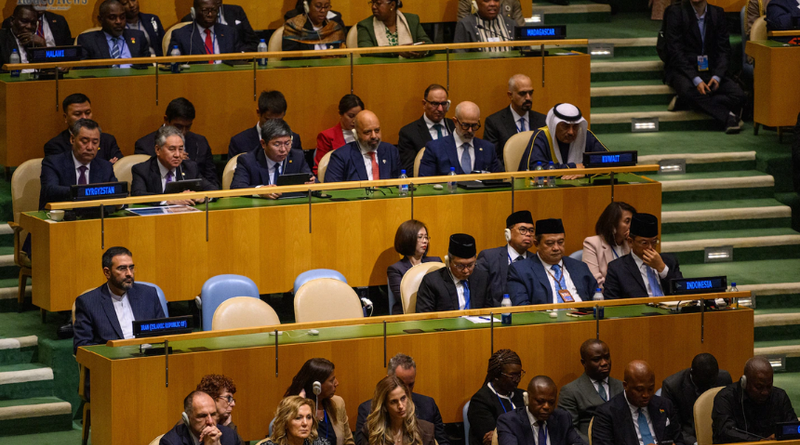
Trump at UN: Iran War Overshadows Diplomacy
NEW YORK — President Donald Trump used his address to the United Nations General Assembly on Tuesday to defend the Trump Iran war policy while warning that the conflict could take an even more severe turn if Tehran does not agree to a settlement.
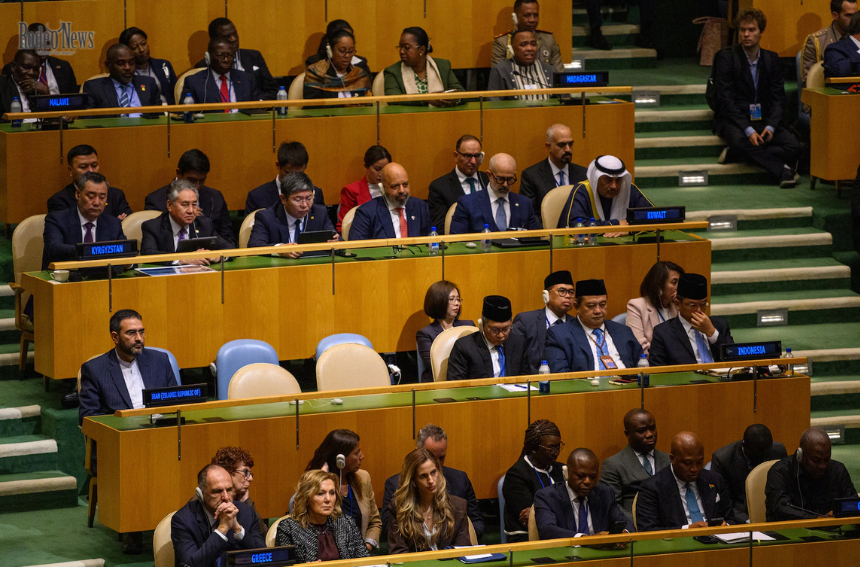
The speech placed the war with Iran at the center of a day that was otherwise expected to focus on diplomacy. Trump presented the U.S. military campaign as necessary to prevent Iran from developing a nuclear weapon, while also suggesting that a negotiated agreement remained possible.
At one point, Trump framed the choice as a decision between reaching a deal that would allow Iran to rebuild and taking much more drastic military action. He also called on Tehran to reopen the Strait of Hormuz and return to negotiations. TThe Washington Post+1
The contrasting messages underscored the complicated situation surrounding the conflict. While Trump’s speech emphasized military strength, diplomatic contacts were also taking place behind the scenes.
Trump Defends Iran War at United Nations
Trump told world leaders that the United States had acted while other countries hesitated. He argued that the military campaign was intended to prevent Iran from obtaining a nuclear weapon and said the consequences of allowing such a development would have been severe.
The president also rejected suggestions that the war had demonstrated weakness in U.S. policy. Instead, he portrayed American military power as a central factor in shaping the conflict and the wider international order.
His remarks came as the war continued to affect energy markets and shipping routes across the Middle East. The Strait of Hormuz has become a particularly important point of concern because disruptions there can affect global oil supplies and international trade. AAudacy+1
The conflict has also created pressure beyond the immediate U.S.-Iran confrontation. Attacks linked to Iran-backed forces in Yemen have raised additional concerns about commercial shipping in the Red Sea and surrounding waters.
Diplomacy Continues Despite Threats
Despite the aggressive tone of parts of Trump’s speech, diplomacy remained an important part of the day’s events.
Trump said the United States and Iran could still reach an agreement. He called for the reopening of the Strait of Hormuz and suggested that Tehran could pursue a future in which its economy and society recover after the fighting.
Later, Trump confirmed that U.S. and Iranian officials had met on the sidelines of the U.N. gathering. He described the meeting as very good but did not provide extensive details about what was discussed. Eeuronews+1
The development highlighted the unusual balance surrounding the conflict. Public statements from both sides remain confrontational, yet diplomatic channels have not completely disappeared.
Regional governments have also been working to encourage negotiations. Qatar and other Gulf states have pushed for measures that could restore shipping through the Strait of Hormuz and create conditions for broader discussions between Washington and Tehran. IIran International | Iran International
Strait of Hormuz Becomes Central Issue
The Strait of Hormuz has emerged as one of the most important issues in attempts to end the conflict.
The narrow waterway is a major route for international energy shipments. Continued disruption has raised concerns about oil supplies, transportation costs and wider economic consequences.
Gulf governments have therefore become increasingly involved in discussions surrounding the war. Their concerns extend beyond the fighting itself to the security of energy infrastructure and maritime trade.
The diplomatic push is also taking place as countries consider how the region could be stabilized after the conflict. Discussions have included proposals for greater regional cooperation and new security arrangements involving Iran and Gulf Arab states. IIran International | Iran International
For Washington, reopening the waterway would represent an important step toward reducing economic pressure caused by the conflict. For Tehran, however, the issue remains closely connected to the broader terms of any possible settlement.
Trump Faces Wider Diplomatic Agenda
The Iran conflict was not the only issue on Trump’s schedule in New York.
The president was also expected to meet with numerous foreign leaders as part of a broad diplomatic program surrounding the General Assembly. Discussions included the wars in Ukraine and the Middle East, relations with European governments and security concerns involving Gulf states.
Trump also addressed other elements of his foreign policy during his speech, including Venezuela, Greenland and international institutions.
The U.N. appearance therefore became a showcase for a foreign policy agenda that extends well beyond Iran. However, the continuing war made it difficult for the administration to separate its diplomatic activities from the conflict.
Iranian President Masoud Pezeshkian was also in New York for the General Assembly, creating an unusual setting in which representatives of countries at war were present at the same international gathering. AAudacy+1
What Comes Next for the Iran Conflict?
The immediate future of the Trump Iran war policy remains closely tied to whether diplomatic contacts can produce a workable agreement.
Trump has indicated that he is willing to consider a negotiated settlement while simultaneously maintaining pressure on Tehran. Iran, meanwhile, has continued to signal resistance to demands it views as unacceptable.
That leaves several major questions unresolved.
A potential agreement would need to address the conflict itself, the reopening of key shipping routes and broader security concerns. The two sides would also have to determine how Iran’s nuclear program would be handled and what guarantees would accompany any settlement.
For now, the diplomatic effort is continuing alongside military pressure.
Trump’s U.N. appearance made that contradiction especially clear. The president defended the decision to go to war while also talking about the possibility of ending it through negotiations.
As leaders gathered in New York, the central question was no longer simply how the conflict began. Increasingly, attention was turning toward whether diplomacy can prevent another escalation and establish a path toward an eventual settlement. RReuters+1