
Sense and Sensibility 2026 Review: A Fresh Austen Adaptation
The Sense and Sensibility 2026 review conversation is already shaping up to be one of the more interesting film discussions of the autumn, largely because director Georgia Oakley has chosen not to simply reproduce the familiar visual language of Jane Austen adaptations.
Based on Austen’s 1811 novel, the new film stars Daisy Edgar-Jones as Elinor Dashwood and Esmé Creed-Miles as Marianne Dashwood. Caitríona Balfe plays their mother, while George MacKay, Frank Dillane, Herbert Nordrum and Fiona Shaw round out the principal cast.
The film is directed by Oakley, whose previous feature Blue Jean established her as a filmmaker interested in intimate character relationships and social pressures. Screenwriter Diana Reid adapts Austen’s novel for this new version.
Rather than treating the story purely as a polished period romance, the 2026 film appears determined to make its characters feel physically and emotionally closer to modern audiences.
That approach is visible in everything from the performances and costumes to the naturalistic cinematography.
The result is a Sense and Sensibility 2026 review landscape that is considerably more divided than a straightforward prestige Austen adaptation might suggest. Some critics have praised the film’s earthy visual identity and emotional intensity, while others have questioned whether its restrained approach sacrifices some of the wit and romantic energy traditionally associated with the story.
Sense and Sensibility 2026 Puts Sisterhood at the Center
At the heart of the new adaptation are Elinor and Marianne Dashwood.
Their relationship has always been central to Austen’s story, but Oakley’s version places particularly strong emphasis on the sisters as individuals who influence and learn from one another.
Daisy Edgar-Jones plays Elinor, the older sister whose practical nature forces her to suppress much of what she feels. Esmé Creed-Miles plays Marianne, whose emotional openness and romantic idealism put her on a very different path.
The contrast between them gives the story its familiar title and structure.
Elinor represents restraint and careful judgment. Marianne is more instinctive and passionate. Yet the new film does not necessarily present one sister as simply wiser than the other.
Reuters reported that Oakley views the sisters’ relationship as more symbiotic, with both women learning from each other rather than having one serve as the obvious guide for the other.
That interpretation gives the film a slightly different emotional emphasis.
Instead of asking which sister has the correct philosophy about love, the story can be read as an exploration of how both approaches have strengths and weaknesses.
Elinor’s self-control protects her from some forms of heartbreak, but it also prevents her from expressing what she wants. Marianne’s emotional honesty allows her to experience romance intensely, but it can leave her vulnerable to disappointment.
Their eventual growth therefore becomes less about choosing between “sense” and “sensibility” and more about finding a balance between them.
Daisy Edgar-Jones Leads the New Adaptation
Daisy Edgar-Jones takes on one of Austen’s most recognizable heroines as Elinor Dashwood.
The role requires a quieter performance because Elinor spends much of the story controlling her emotions rather than openly displaying them.
That restraint is an important part of the character.
Elinor understands the financial and social realities facing her family. After the Dashwoods lose their estate, she becomes increasingly aware that marriage, money and reputation are connected in ways that can determine the family’s future.
Her romantic relationship with Edward Ferrars, played by George MacKay, consequently carries emotional tension beyond simple attraction.
The film’s interpretation of Elinor has received mixed responses from critics. The Times argued that Edgar-Jones’s restrained approach sometimes becomes too subdued, while other reviews have highlighted the vulnerability beneath her controlled exterior.
That difference in interpretation is important.
Austen’s original Elinor is deliberately difficult to read. Her emotions are powerful, but she rarely allows other people to see them. A performance that makes that internal struggle highly visible could undermine the character, while a performance that hides too much can risk appearing emotionally distant.
The new film therefore takes a considerable gamble with its central heroine.
Esmé Creed-Miles Brings a Different Energy as Marianne
If Elinor is defined by control, Marianne is defined by intensity.
Esmé Creed-Miles plays the younger Dashwood sister, who falls passionately for John Willoughby, portrayed by Frank Dillane. Her romantic idealism is one of the defining elements of Austen’s novel, and the 2026 film gives her a particularly physical and expressive presence.
The contrast between Creed-Miles and Edgar-Jones helps establish the central tension of the movie.
Marianne does not simply disagree with Elinor.
She reacts emotionally to music, nature and romance. She believes that genuine feeling should be expressed rather than concealed. However, that openness also makes her susceptible to people who do not share her honesty.
Critics have noticed the intensity of this interpretation.
The Independent described the new film as a more modern and earthy take on Austen, highlighting the performances of Creed-Miles and Edgar-Jones as a major part of its identity.
That emphasis makes Marianne feel less like a traditional costume-drama heroine and more like a young woman experiencing emotions with little interest in maintaining social composure.
Georgia Oakley Gives the Film a Distinct Visual Identity
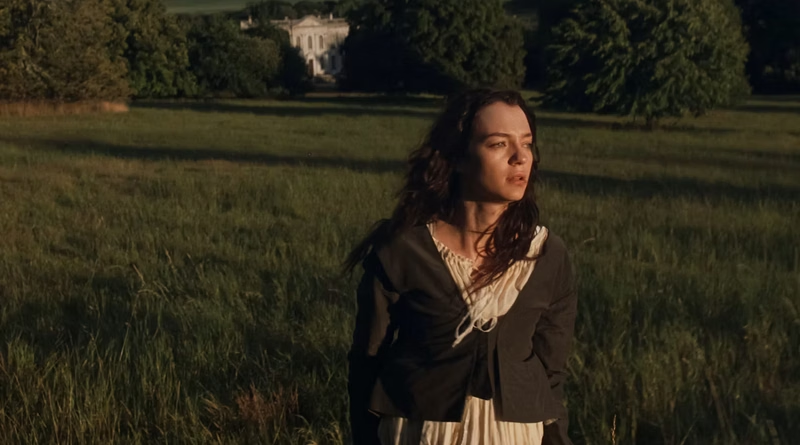
One of the clearest differences between this adaptation and previous versions is its visual style.
The film was shot on 35mm film, with cinematographer Arnaud Potier using natural lighting to create a softer, more organic appearance. The Independent noted the film’s deliberately earthy aesthetic, while Vogue highlighted the production’s tactile approach to costumes and historical materials.
This is not the glossy Regency world audiences may immediately associate with Austen.
The characters are presented with a more physical relationship to their surroundings. The countryside feels lived-in rather than decorative, while clothing is designed to reflect changes in the characters’ emotional and social circumstances.
Costume designer Grace Snell explained that the production deliberately moved away from conventional Austen imagery, using antique textiles, natural dyes and simpler silhouettes. The costumes also track the Dashwood family’s journey from mourning and loss toward a new life in Devon and later experiences in London.
That approach gives the movie a stronger connection between character development and visual design.
Instead of simply dressing the actors in historically accurate clothing, the production uses clothing as part of the storytelling.
The Romance Takes a More Restrained Route
Romance remains essential to Sense and Sensibility, but this version approaches it with less emphasis on traditional period-drama spectacle.
Elinor’s relationship with Edward Ferrars is built around silence, hesitation and misunderstanding.
Marianne’s relationship with Willoughby is more immediate, but it also demonstrates how quickly emotional certainty can collapse.
Meanwhile, Colonel Brandon, played by Norwegian actor Herbert Nordrum, offers another version of romantic devotion.
Previous adaptations have given Brandon a memorable combination of dignity and melancholy. Alan Rickman’s performance in Ang Lee’s acclaimed 1995 film remains particularly associated with the character. The new version takes a quieter approach, which some critics have found less emotionally forceful.
That comparison is inevitable.
The 1995 film remains one of the best-known Austen adaptations, with Emma Thompson as Elinor, Kate Winslet as Marianne and Hugh Grant as Edward Ferrars. It also won an Academy Award for Best Adapted Screenplay.
The 2026 movie therefore faces a difficult challenge.
Audiences already know this story.
The new production needs to demonstrate why another version is worth watching.
The 2026 Film Moves Away From the 1995 Formula
Comparisons with Ang Lee’s 1995 adaptation are unavoidable.
The earlier movie balanced comedy, romance and emotional drama with a highly accessible visual style. The new film deliberately moves in another direction.
The Guardian described Oakley’s adaptation as more sober and introspective than Lee’s version, noting that it does not reproduce the earlier film’s exuberant romantic payoff.
That difference may be the single most important factor for audiences approaching the 2026 film.
Viewers expecting a direct successor to the 1995 movie may find the new tone surprising.
Instead, Oakley’s version appears interested in emotional atmosphere, physical landscapes and the relationship between the sisters.
That does not necessarily make it less faithful to Austen.
It simply reflects a different interpretation of what the novel’s central appeal is.
Fiona Shaw Adds Energy to the Supporting Cast
Among the supporting performances, Fiona Shaw’s Mrs. Jennings has emerged as one of the more distinctive elements.
Mrs. Jennings can easily become a broad comic character in adaptations of Austen. Shaw, however, brings a stronger presence to the role, providing some of the film’s energy amid its more restrained dramatic passages.
The supporting cast also includes Caitríona Balfe as Mrs. Dashwood, Bodhi Rae Breathnach as Margaret Dashwood, Frank Dillane as Willoughby and George MacKay as Edward Ferrars.
The film also makes several less conventional casting choices.
Eliot Sumner plays Mr. Palmer, while Herbert Nordrum brings an international dimension to the cast as Colonel Brandon.
These decisions contribute to the production’s effort to avoid simply recreating the visual and performance conventions of earlier Austen adaptations.
A Modern Austen Adaptation for a New Audience
The question underlying almost every Sense and Sensibility 2026 review is whether the movie successfully makes Austen feel contemporary without losing the qualities that made the original story endure.
Oakley has clearly decided that the answer involves emotional accessibility rather than modernization through a rewritten setting.
The characters remain in Austen’s historical world.
The social rules remain important.
Money, inheritance, marriage and reputation still determine what the characters can realistically do.
Yet the filmmaking makes the emotions feel less distant.
The characters run through fields, interact physically with their surroundings and appear less formally composed than in many traditional period productions.
The approach may particularly appeal to younger viewers who are encountering Austen through modern adaptations rather than through established costume-drama conventions.
The New Yorker described the film as a version of Austen tailored toward Generation Z audiences, emphasizing concepts such as yearning and emotional connection.
That does not mean the film abandons the original novel.
Instead, it attempts to translate Austen’s emotional concerns into a cinematic language that feels more immediate.
Release Date and Where to Watch
Sense and Sensibility will have different theatrical release dates depending on the market.
The film is scheduled to open in the United Kingdom on September 25, 2026, while its United States theatrical release is October 16, 2026. Focus Features lists the film as a romance and drama with a runtime of approximately two hours and 12 minutes.
The film is distributed by Focus Features and produced by Working Title Films alongside November Pictures and Kiddo Films.
For audiences who want to see the movie before reading reviews, the theatrical release provides an opportunity to experience Oakley’s visual approach on the big screen.
That is particularly relevant given the film’s use of 35mm photography and natural landscapes.
Final Thoughts on Sense and Sensibility 2026
The emerging Sense and Sensibility 2026 review picture is not one of a simple remake.
Georgia Oakley’s adaptation takes a recognizable Austen story and approaches it through a more earthy, intimate and contemporary visual language.
Daisy Edgar-Jones and Esmé Creed-Miles anchor the production as Elinor and Marianne, with their sisterly relationship serving as one of the film’s strongest thematic elements.
The film’s biggest distinction is its willingness to step away from the familiar template.
It does not attempt to recreate the 1995 Ang Lee movie. Instead, it emphasizes the emotional and physical experience of Austen’s characters, from the Dashwoods’ displacement to their complicated relationships and romantic disappointments.
That choice has produced sharply different critical reactions.
Some critics have praised the performances, cinematography and fresh interpretation, while others have found the restrained tone less emotionally satisfying than previous versions.
What is clear is that the 2026 adaptation has its own identity.
For longtime Austen fans, that may make the movie an intriguing reinterpretation rather than a replacement for earlier versions. For newcomers, it offers another entry point into one of English literature’s most enduring romantic stories.
The central question remains the same one Austen posed more than two centuries ago: how should people balance what they feel with what circumstances demand?
Oakley’s film simply asks that question in a visual and emotional language designed for a new generation.