
Supermassive Black Holes: 5 Ways They Shape Galaxies
Supermassive black holes may do far more than quietly sit at the centers of galaxies. New observations suggest that supermassive black holes can actively reshape their surroundings, influencing the gas, shock waves and star formation that help determine how galaxies evolve.
Astronomers studied nine nearby galaxies containing actively feeding central black holes. Using the Very Large Telescope’s Multi Unit Spectroscopic Explorer, or VLT/MUSE, researchers mapped different forms of activity around the galactic centers and identified a recurring pattern involving star-forming rings, ionized gas and powerful shocks.
The findings offer a more complicated picture of what scientists call active galactic nucleus feedback, or AGN feedback.
For years, astronomers have known that material falling toward a supermassive black hole can release enormous amounts of energy. That energy can heat surrounding gas, drive powerful winds and launch jets of plasma extending thousands of light-years.
Such activity can suppress the formation of new stars by disturbing or removing the cold gas needed to create them.
But the new research suggests that the story does not always end there.
Under some circumstances, the activity associated with a growing black hole may also help organize or potentially promote star formation farther from the galactic center.
The researchers’ study was published Sept. 14 in The Astrophysical Journal.
Supermassive Black Holes Are More Active Than They Look
Most large galaxies are thought to contain a supermassive black hole at their center.
These objects can contain millions or billions of times the mass of the Sun. However, their behavior varies enormously depending on how much material is available to feed them.
Our own Milky Way contains Sagittarius A*, the supermassive black hole at its center. Today, Sagittarius A* is relatively quiet compared with the brilliant active galactic nuclei observed in distant galaxies.
When a black hole is actively consuming gas and dust, material can form a rapidly rotating accretion disk around it.
Friction and extreme gravitational forces heat that material to extraordinary temperatures. The resulting radiation can make the center of a galaxy shine far more brightly than it otherwise would.
Some active black holes also produce jets.
These narrow streams of highly energetic plasma can emerge from the regions surrounding the black hole and travel outward at enormous speeds.
The combination of radiation, winds and jets gives an actively feeding black hole an influence that extends far beyond the immediate region around its event horizon.
That is why scientists increasingly study black holes as part of the larger ecosystem of their host galaxies.
The New Study Examined Nine Nearby Galaxies
The researchers focused on nine nearby Type 2 Seyfert galaxies.
These galaxies contain active galactic nuclei, meaning their central supermassive black holes are actively accreting material.
The galaxies are relatively close in astronomical terms, with redshifts below 0.026. That made them useful targets for detailed spatial observations.
The researchers used the MUSE instrument on the European Southern Observatory’s Very Large Telescope in Chile.
Unlike an ordinary image, an integral-field spectrograph such as MUSE can provide information about the light coming from different locations across a galaxy. This allows scientists to build a much more detailed picture of the physical processes occurring throughout the system.
The team also used a three-dimensional diagnostic method developed to distinguish between different sources of excitation in galactic gas.
That distinction is important.
A region of glowing gas can be energized by newly forming stars, radiation from an active black hole or shocks produced when fast-moving material crashes into surrounding gas.
Without separating those processes, astronomers can have difficulty determining exactly what is happening around an active galaxy.
The new approach allowed the team to examine those components separately.
Supermassive Black Holes Create a Striking Pattern
The observations revealed a recurring structure across the nine galaxies.
Researchers found star-forming rings or arcs at projected distances of approximately 0.8 to 6 kiloparsecs from the centers of the galaxies. One kiloparsec is about 3,260 light-years, meaning these structures can extend thousands to tens of thousands of light-years from the central black hole.
At the same time, the scientists observed cone-shaped regions of ionized gas extending away from the active galactic nuclei.
Closer to the centers, they found regions dominated by fast shocks.
These shocks frequently extended in directions perpendicular to the ionized cones.
That geometry was one of the most notable findings.
The researchers said the pattern appeared consistently across all nine galaxies.
The observations suggest that the central black holes are participating in a complicated cycle in which material falls inward while energy and matter are simultaneously pushed outward.
Peixin Zhu, the study’s lead researcher, said the observations showed that the black holes do not simply consume material but also eject material, linking accretion and outflow processes.
What Are AGN Shocks?
A shock occurs when rapidly moving material interacts violently with surrounding gas.
Imagine a powerful outflow leaving the center of a galaxy and encountering clouds of interstellar gas.
The collision can compress, heat and accelerate that gas.
The result is a shock front that can travel through the interstellar medium.
In an active galaxy, those shocks may be produced by jets launched by the black hole or by powerful winds flowing from its surrounding environment.
The new research found that the central fast shocks were broadly consistent with interactions between AGN jets and the interstellar medium. However, the scientists also noted that black-hole winds may contribute, particularly in galaxies where the jets are relatively weak.
This distinction matters because not every active black hole produces identical outflows.
The energy released by an AGN depends on factors including the amount of material being accreted and the physical conditions around the black hole.
By studying multiple galaxies, scientists can begin to identify patterns that apply beyond a single unusual system.
Supermassive Black Holes May Help Shape Star Formation
One of the most interesting implications involves the relationship between black holes and new stars.
The traditional picture of AGN feedback often emphasizes its ability to suppress star formation.
The reasoning is straightforward.
Stars form from relatively cold, dense clouds of gas. If a black hole injects enough energy into that gas, it can heat or disperse the material, making it harder for the clouds to collapse and form stars.
But feedback can be more complicated.
A shock wave can compress gas rather than simply destroy it.
If the conditions are suitable, compressed gas can become denser and potentially contribute to the process of star formation.
The new observations do not establish that black-hole activity directly caused every star-forming ring seen in the nine galaxies. The researchers note that the rings are also consistent with structures created by resonances associated with galactic bars. Positive AGN feedback may contribute as well.
That distinction is important.
The study identifies a common pattern and provides evidence that black-hole activity and star formation can coexist within the same galactic environment.
It does not mean that supermassive black holes universally create stars.
Instead, it strengthens the case that AGN feedback can have both suppressing and potentially enhancing effects depending on the circumstances.
The Rings Could Reveal a Galactic Feedback Cycle
The recurring arrangement of rings, cones and shocks gives astronomers a new way to think about the relationship between a black hole and its host galaxy.
At the center, gas feeds the black hole.
The resulting accretion process releases energy.
That energy drives radiation, winds and potentially jets into the surrounding environment.
Those outflows interact with the interstellar medium and generate shocks.
Farther out, regions of star formation appear in rings or arcs.
The entire system therefore resembles a feedback loop rather than a one-way process.
Lisa Kewley, an astrophysicist at the Center for Astrophysics | Harvard & Smithsonian and one of the researchers involved in the study, described the black holes as actively reshaping their surroundings rather than merely consuming material at the centers of galaxies.
Understanding that feedback cycle could help explain one of the biggest questions in astronomy: how galaxies develop their structures and stellar populations over cosmic time.
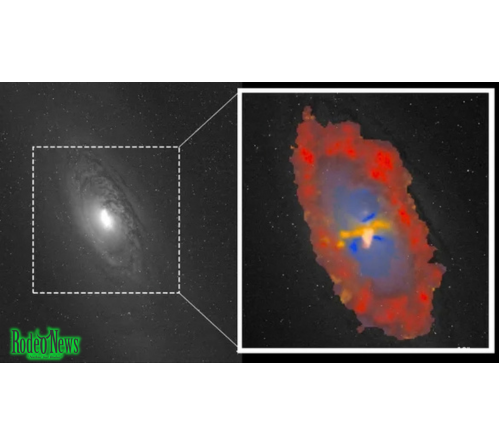
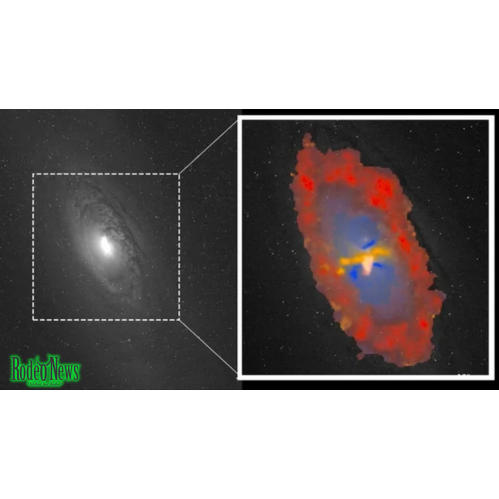
NGC 1386 Offers a Detailed Example
One of the galaxies highlighted in the research is NGC 1386.
Images of the galaxy can separate different components of the central environment, including star formation, black-hole radiation and shock activity.
The resulting maps provide a visual demonstration of how different physical processes occupy different parts of a galaxy.
The researchers’ analysis indicates that the same broad arrangement is not limited to NGC 1386.
Instead, comparable patterns appeared throughout the nine-galaxy sample.
That consistency is particularly valuable.
Astronomers often encounter unusual structures in individual galaxies, but it can be difficult to determine whether those structures are representative of a wider phenomenon.
Finding a recurring configuration across several galaxies suggests that the underlying physical processes may be common among at least some active galaxies.
Why the Findings Matter for Galaxy Evolution
Galaxies are not static collections of stars.
They continuously exchange energy and matter between their central regions, disks and surrounding environments.
Gas can fall inward.
Stars can form.
Massive stars can explode and return material to space.
Black holes can release energy through radiation and outflows.
All of those processes interact.
For decades, computer simulations of galaxy formation have incorporated AGN feedback because scientists know that black holes can profoundly affect their surroundings.
However, accurately representing that feedback is difficult.
A model that assumes black-hole activity always shuts down star formation could miss situations where shocks or other processes have more complicated effects.
The new observations provide additional information that can help scientists refine those models.
The study’s authors specifically emphasize the importance of accounting for shock excitation when interpreting AGN feedback.
Supermassive Black Holes Are Not Simply Cosmic Destroyers
The popular image of a black hole is often dominated by destruction.
Anything crossing an event horizon cannot escape.
An actively feeding black hole can also produce enormous amounts of radiation and eject powerful jets.
But from the perspective of an entire galaxy, the situation is more nuanced.
A black hole’s gravitational influence alone does not mean that it controls every star in its galaxy.
Instead, its energetic outflows can affect the gas that surrounds it.
That gas is the raw material from which future stars can form.
The new research therefore adds another layer to scientists’ understanding of black holes.
Rather than treating AGN feedback simply as a mechanism that turns star formation off, astronomers are increasingly investigating how it can redistribute gas, generate shocks and potentially influence where new stars appear.
The distinction is important because the effects may depend on distance, outflow strength, gas density and the structure of the host galaxy.
What Scientists Still Do Not Know
Despite the new findings, several questions remain unanswered.
The biggest is causality.
The researchers observed star-forming rings alongside active black holes and shock structures, but the observations alone do not prove that the black-hole outflows created the stars.
The rings may partly arise from another process.
The study notes that bar-driven resonances provide one explanation for the circumnuclear star-forming structures, while positive AGN feedback could also contribute.
Scientists therefore need larger samples and observations across different types of galaxies.
They also need to examine systems at different stages of evolution.
Another challenge is understanding exactly how jets and winds interact with the surrounding gas.
In galaxies with powerful jets, jet-ISM interactions appear to provide a plausible explanation for the observed shocks.
In galaxies with weaker jets, winds from the active black hole may play a larger role.
Future observations should help distinguish those mechanisms.
The James Webb Space Telescope Could Add More Clues
Modern observatories are making it increasingly possible to study the environments around distant black holes in unprecedented detail.
The James Webb Space Telescope is particularly useful because it can observe infrared wavelengths that penetrate dust surrounding active galactic nuclei.
Earlier JWST observations have already provided new information about how supermassive black holes feed and interact with their environments.
Combining infrared observations with optical data from instruments such as MUSE and X-ray observations from NASA’s Chandra Observatory could provide an even more complete picture.
The researchers in the new study used Chandra X-ray morphology as an independent source of support for their decomposition of the different structures.
That multiwavelength approach is essential because black-hole activity produces signals across the electromagnetic spectrum.
No single telescope can capture the entire process.
A New View of the Galactic Architects
The latest research does not mean that supermassive black holes literally design galaxies in the same way an architect designs a building.
The phrase is a shorthand for a much more subtle physical relationship.
Black holes can influence their surroundings through radiation, winds and jets. Those outflows can interact with gas across thousands of light-years, potentially changing where gas accumulates, where shocks develop and where stars form.
The nine-galaxy study provides evidence for a recurring pattern linking these processes.
Researchers observed star-forming rings or arcs, ionized bicones and central shock regions across the sample. The central shocks often extended perpendicular to the AGN outflows, a pattern the team said appeared consistently across all nine galaxies.
The findings add to a growing body of evidence that galaxy evolution is governed by interconnected processes rather than isolated events.
Black holes are part of that system.
Stars feed galaxies with new elements when they evolve and explode. Gas fuels both star formation and black-hole growth. Black holes then release energy that can reshape the same environment from which they drew their fuel.
That creates a cosmic feedback cycle.
And by mapping that cycle in nearby galaxies, astronomers are getting a clearer view of how some of the universe’s largest structures evolve over billions of years.
What Comes Next
The next stage of research will be determining whether the pattern identified in these nine nearby galaxies is common throughout the universe.
Astronomers will need to observe more galaxies, including systems with different masses, structures and levels of black-hole activity.
They will also need observations at greater distances to determine whether similar processes were occurring when galaxies were much younger.
The current study provides an important observational foundation because it demonstrates a repeatable pattern rather than relying solely on theoretical predictions.
For now, the evidence points to a more complicated relationship between active black holes and star formation than a simple “shutdown” model suggests.
Supermassive black holes can consume material, but they can also eject enormous amounts of energy into their surroundings.
That energy can generate shocks and reshape the interstellar medium.
And in at least some galaxies, the same environment contains rings and arcs where new stars are forming.
The result is a more dynamic picture of galaxy evolution — one in which the central black hole and the galaxy around it are connected through an ongoing exchange of matter and energy.