
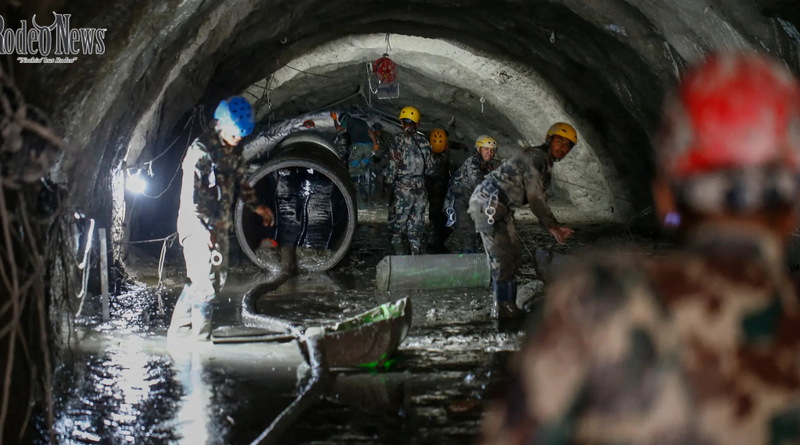
Nepal Floods Leave Rescue Teams Searching Hydropower Tunnels
The Nepal floods have entered a difficult recovery phase, with rescuers continuing to search hydropower facilities and other damaged areas weeks after a devastating flash flood swept through northern Nepal.
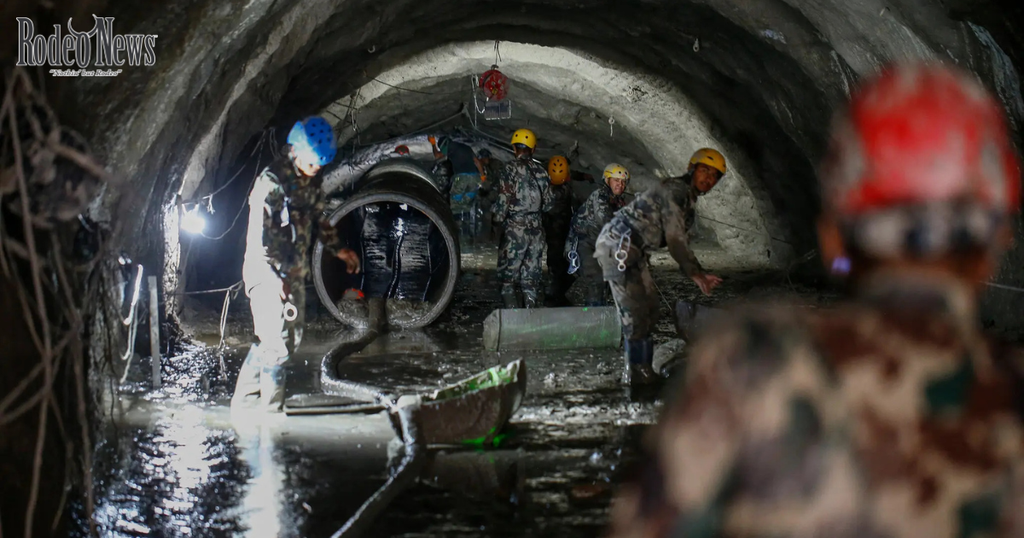
Three bodies were recovered from a tunnel at the Chilime hydropower project in Rasuwa district on September 16, according to Nepali media reports. Rescue teams had been working to reach people believed to have been trapped inside the underground facility following the August 26 disaster. K\Kathmandu Post+1
The discovery underscores the continuing human toll of the disaster. Authorities are still working to determine the fate of thousands of people who remain unaccounted for, while many recovered bodies have yet to be formally identified.
The disaster has also exposed the vulnerability of Nepal’s hydropower infrastructure to extreme mountain events.
Nepal Floods Continue to Affect Missing Workers
The Chilime hydropower project has become one of the major search locations in the aftermath of the disaster.
Rescue teams have been working in difficult conditions inside tunnels and damaged infrastructure. The terrain, debris and continuing access problems have made recovery operations particularly challenging.
According to Reuters reporting published September 16, Nepalese authorities said about 5,200 people, including hundreds of foreigners, remained unaccounted for at that stage. At least 1,399 deaths had been confirmed. Authorities had collected DNA samples from unidentified bodies and relatives of missing people as part of efforts to establish identities. RReuters
Only a small proportion of recovered bodies had been identified, creating an additional burden for families waiting for information about relatives.
The scale of the missing-persons operation has forced authorities to combine conventional search-and-rescue work with drones, helicopters and specialist teams.
What Happened During the August Disaster?
The disaster began on August 26, when a massive collapse in the Himalayan region triggered a destructive chain of events involving ice, rock, water and debris.
The resulting flood moved rapidly through river valleys and infrastructure corridors, damaging roads, bridges, homes and hydropower facilities.
The Trishuli River corridor was among the areas heavily affected.
The event was particularly destructive because communities and industrial facilities are concentrated along river valleys in Nepal’s mountainous terrain. Hydropower projects, which depend on rivers and are often built in steep and difficult-to-access locations, were directly exposed to the flood and debris.
A recent scientific assessment has also examined how rising temperatures may have contributed to the instability of the mountain environment.
Researchers with the World Weather Attribution group concluded that human-caused climate change was highly likely to have played a significant role in the conditions surrounding the glacier and rock collapse. Their analysis linked rising temperatures to glacier thinning and thawing ice and permafrost within the Himalayan landscape. KKSL News+1
That does not mean climate change alone caused the disaster. Scientists have pointed to multiple interacting geological and environmental factors.
Chilime Hydropower Plant Becomes a Major Search Site
The Chilime facility is located in Rasuwa, a mountainous district north of Kathmandu and close to Nepal’s border with China.
The hydropower plant has underground infrastructure, making rescue operations especially complicated when tunnels are flooded or blocked by debris.
The recovery operation at Chilime has continued for weeks. Nepalese rescuers have already faced similar challenges at other hydropower sites affected by the disaster.
Nepal News reported on September 16 that search teams recovered nine bodies from two hydropower project tunnels in Rasuwa, including locations associated with Chilime and the Upper Trishuli projects. NNepal News
The recovery of bodies has provided some answers to families but has also demonstrated how much debris and destruction remain inside the affected facilities.
Workers at hydropower projects were among those particularly exposed because many facilities are located directly beside rivers and inside steep mountain corridors.
Nepal’s Hydropower Sector Faces Severe Damage
The Nepal floods have created consequences that extend well beyond the immediate humanitarian crisis.
Hydropower is central to Nepal’s electricity system and has become an increasingly important part of the country’s economy. The disaster damaged or disrupted multiple hydropower facilities, reducing domestic generation capacity and affecting Nepal’s ability to export electricity.
Reuters reported that more than a dozen hydropower plants were swept away or seriously damaged during the disaster. The damage has forced Nepal to increase reliance on imported electricity while reconstruction begins. RReuters
India has responded by approving additional electricity exports to Nepal.
Under the arrangement reported in September, India approved exports of up to 654 megawatts for 18 hours a day through the end of 2026. The measure is intended to help Nepal manage the electricity shortage created by damage to its power infrastructure. RReuters+1
The development highlights how a natural disaster in one sector can quickly affect energy security, trade and regional cooperation.
Power Shortages Add to Nepal’s Recovery Challenge
Nepal had increasingly used hydropower not only to meet domestic electricity demand but also to export surplus power during periods when generation exceeded local consumption.
The flood damage has disrupted that model.
With generating facilities damaged and transmission infrastructure affected, Nepal has had to rely more heavily on electricity imports.
India’s decision to provide additional power is therefore significant for the immediate recovery period. It can help stabilize electricity supplies while Nepal assesses the condition of damaged plants and begins reconstruction.
However, rebuilding hydropower infrastructure in mountainous terrain is likely to require substantial time and investment.
The physical damage is only one part of the challenge. Access roads, bridges and communications infrastructure must also be restored before many damaged facilities can return to normal operation.
Thousands of Families Still Waiting for Answers
For families of missing people, the disaster remains an unresolved tragedy.
Authorities have collected DNA samples to help match unidentified remains with relatives. Reuters reported that more than 1,200 unidentified bodies had been sampled, alongside DNA from nearly 1,900 relatives of missing people. At the time of the report, only 105 bodies had been successfully identified and returned to their families. RReuters
The identification process is particularly difficult when bodies are recovered weeks after a disaster involving high-speed water, mud and debris.
Families may also be separated geographically, adding another layer of difficulty to the process.
The continued recovery operation means the final death toll may change as authorities gain access to additional areas.
A Disaster With Regional Consequences
The consequences of the August disaster have not been confined to Nepal.
The flooding and associated mountain collapse also affected areas across the border in Tibet. The overall death toll from the disaster has reached well above 1,300, according to multiple reports, while thousands remain missing. TThe Guardian+1
The event has therefore become a major example of the risks facing communities in the high Himalayas.
Mountain regions are particularly sensitive to changes in temperature because warming can affect glaciers, snow cover, permafrost and the stability of steep slopes.
Researchers have warned that these interconnected processes can increase the likelihood of cascading hazards, in which a single mountain collapse can produce flooding, landslides and infrastructure destruction over a large area.
Climate Change and the Himalayan Risk
The scientific findings released after the disaster have added a climate dimension to the discussion.
The World Weather Attribution assessment found that temperatures in the region were unusually high before the collapse and concluded that long-term warming had increased the likelihood of the environmental conditions that contributed to the event. TThe Guardian+1
Scientists have emphasized an important distinction: attributing a disaster partly to climate change does not mean every individual flood or landslide can be explained by warming alone.
Mountain disasters are influenced by geology, precipitation, glacier conditions, earthquakes, slope stability and human development.
The 2015 earthquake in Nepal, for example, has also been discussed as a possible factor in long-term mountain instability.
The latest research instead points to climate change as one factor that can alter the background conditions under which these hazards occur.
Nepal Faces a Long Reconstruction
The immediate priority remains finding missing people, recovering bodies and supporting survivors.
But the country also faces a major reconstruction task.
Roads and bridges must be repaired. Hydropower stations require detailed inspections. Damaged tunnels and transmission lines need to be assessed. Communities that lost homes and businesses will require financial and logistical assistance.
The economic cost could be substantial.
Nepal has already sought international assistance as it assesses the scale of the destruction. The damage to energy infrastructure is particularly important because electricity generation is closely connected to the country’s broader development plans.
Reconstruction will also raise questions about how infrastructure can be made more resilient in areas exposed to floods, landslides and other mountain hazards.
Search Operations Continue at Chilime
At Chilime, the recovery effort remains focused on areas where workers may still be trapped or where additional remains could be located.
The recovery of three bodies from a tunnel on September 16 marks another stage in the operation, but it does not bring the search to an end. Nepali authorities and rescue teams continue to work through difficult underground conditions. KKathmandu Post
The operation is also part of a much wider national effort.
Across Nepal, authorities continue to investigate damaged infrastructure and search areas cut off by debris and destroyed roads.
For the families waiting for news, every recovered body can provide an answer. For the country as a whole, the continuing operation is a reminder that the consequences of the August disaster will persist long after floodwaters have receded.
The Nepal floods have therefore become more than a single catastrophic event. They have developed into a prolonged humanitarian, infrastructure and energy crisis, with the full scale of the damage still emerging.
As rescuers continue searching tunnels and damaged river corridors, Nepal faces the difficult task of recovering the missing, identifying the dead and rebuilding critical infrastructure while preparing for a future in which extreme mountain hazards may pose increasingly complex risks.
Suggested Image
Recommended image: Rescue personnel working inside or around the flood-damaged Chilime hydropower facility in Rasuwa, Nepal.
Image ALT Text:
Nepal floods: rescuers search the damaged Chilime hydropower tunnel in Rasuwa
Suggested External Sources
- Reuters reporting on the missing and confirmed deaths following the disaster. RReuters
- The Kathmandu Post report on the recovery of three bodies from the Chilime hydropower project. KKathmandu Post
- Nepal News report on recoveries from hydropower tunnels in Rasuwa. NNepal News
- Reuters reporting on India’s electricity exports to Nepal following the hydropower damage. RReuters
- World Weather Attribution findings as reported by Reuters and other outlets. RReuters+1
Note: Since no target website was provided, I have not invented internal links. Once you give me the domain, I can add appropriate internal-link placements and anchor text.