
Hunga Tonga Methane Discovery Reveals Surprising Climate Clue
The Hunga Tonga methane discovery is giving scientists an unexpected look at how volcanic eruptions can influence greenhouse gases in the atmosphere. Researchers studying the enormous 2022 eruption of the underwater Hunga Tonga-Hunga Ha’apai volcano found evidence that the volcanic plume may have destroyed methane at an unusually rapid rate.
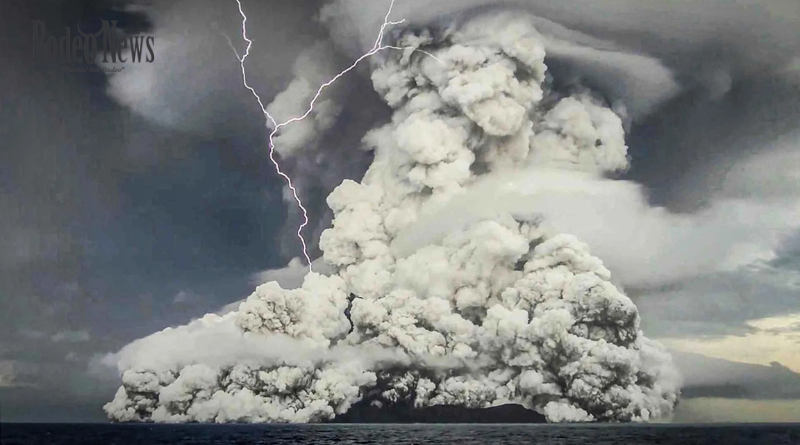
The finding is significant because methane is a powerful greenhouse gas and one of the most important contributors to near-term global warming. The study suggests that chemical reactions inside the volcanic plume accelerated methane oxidation, potentially removing methane that the eruption itself had released.
The research, published in Nature Communications, used observations from the TROPOMI instrument aboard the European Space Agency’s Sentinel-5P satellite. Scientists tracked formaldehyde, a short-lived chemical produced as methane is broken down, inside the enormous plume created by the January 15, 2022, eruption.
The results reveal a previously underappreciated atmospheric process and may also provide scientists with a new way to monitor future attempts to accelerate methane removal.
Hunga Tonga Methane Reaction Surprised Scientists
The Hunga Tonga-Hunga Ha’apai eruption was one of the most powerful volcanic events of the modern era. Because the volcano was located beneath the South Pacific Ocean, the eruption sent huge amounts of volcanic material and seawater high into the atmosphere.
Researchers examining satellite measurements noticed something unusual inside the resulting plume.
They detected exceptionally high concentrations of formaldehyde, or HCHO, at approximately 30 kilometers above Earth’s surface. According to the researchers, the enhancement reached as much as 12 parts per billion and remained detectable for at least 10 days.
That observation mattered because formaldehyde has a short atmospheric lifetime. It is produced during the oxidation of methane and normally disappears within hours.
Therefore, a persistent formaldehyde signal suggested that methane was continuing to break down inside the moving volcanic plume.
ScienceDaily reported that researchers were able to follow the unusual cloud for about 10 days, including its movement toward South America. The observation provided an unusual natural laboratory for studying methane destruction on a large atmospheric scale.
How Hunga Tonga Methane Was Destroyed
The proposed explanation involves a complicated interaction between volcanic ash, seawater, sulfur compounds, iron, chlorine and sunlight.
When Hunga Tonga erupted beneath the ocean, it injected enormous quantities of seawater and volcanic material into the atmosphere. Some of this material reached the stratosphere.
Scientists believe that iron-containing volcanic ash coated with sulfate particles provided a surface where chemical reactions could occur. Sunlight then helped drive photochemical reactions capable of producing highly reactive chlorine.
Chlorine atoms are extremely reactive.
Once formed, they can attack methane molecules and initiate chemical reactions that ultimately break methane down.
The underlying study identifies iron-chloride photochemistry on sulfate-coated volcanic ash as a plausible explanation for the unusually strong methane oxidation observed in the plume. However, the researchers also note that the estimated chlorine production required to sustain the observed reaction is not fully explained by mechanisms already known.
That uncertainty is important.
The research does not mean scientists have completely solved the chemistry inside volcanic plumes. Instead, it provides evidence for a potentially important mechanism that deserves further investigation.
A Huge Amount of Methane Was Oxidized
The numbers reported in the study are striking.
Researchers estimated that methane oxidation inside the Hunga Tonga plume reached approximately 900 ± 220 megagrams per day. They also estimated that at least 330 gigagrams of volcanic methane had been injected into the stratosphere.
To put the scale into perspective, ScienceDaily compared the daily methane oxidation rate with the methane emissions associated with roughly two million cows.
However, the comparison should not be interpreted as meaning that a volcano permanently removed an equivalent amount of methane from the global atmosphere.
The observed reaction occurred within a specific volcanic plume and over a limited period. The study instead demonstrates that methane oxidation can become dramatically enhanced under particular atmospheric conditions.
That distinction matters when considering the wider climate implications.
Why Methane Matters for Climate Change
Methane is less abundant than carbon dioxide, but it has a much stronger warming effect over shorter periods.
The Nature Communications study describes methane as the second most important greenhouse gas after carbon dioxide and notes that its atmospheric lifetime is roughly a decade.
That relatively short lifetime is one reason methane reduction has attracted increasing scientific attention.
Reducing carbon dioxide is essential for long-term climate stabilization because CO2 can remain influential in the climate system for a very long time. Methane behaves differently. Because atmospheric methane is removed comparatively quickly, reductions in methane emissions can influence warming over much shorter timescales.
Methane comes from both human and natural sources.
Agriculture, fossil-fuel production, waste, wetlands and other natural systems all contribute to the atmospheric methane budget. Scientists must therefore account for both methane entering the atmosphere and methane being removed through natural chemical processes.
The Hunga Tonga study suggests that some forms of atmospheric dust may play a larger role in this removal process than previously recognized.
The Discovery Could Change Methane Budget Calculations
Scientists use the term methane budget to describe the accounting of methane entering and leaving the atmosphere.
It includes sources such as agriculture, fossil-fuel operations, waste and wetlands. It also includes the chemical processes responsible for removing methane.
Understanding both sides of that equation is critical.
If atmospheric dust, volcanic ash and similar particles can accelerate methane destruction under certain conditions, those processes could influence calculations of the global methane budget.
The researchers say atmospheric dust has not previously been fully incorporated into methane-budget calculations in the way suggested by their findings.
This does not automatically mean that current climate models are fundamentally wrong.
Instead, it suggests that researchers may need to examine additional chemical pathways when estimating how quickly methane disappears from the atmosphere.
The effect could be particularly relevant when unusual atmospheric events inject large quantities of mineral material into high-altitude regions.
TROPOMI Satellite Provided the Key Evidence
One of the most important aspects of the research is the role of satellite observations.
The team used TROPOMI, an instrument aboard the European Space Agency’s Sentinel-5P satellite. TROPOMI is designed to monitor atmospheric gases associated with air pollution, climate and atmospheric chemistry.
In this case, scientists used formaldehyde as an indirect indicator of methane oxidation.
That approach offers a major advantage.
Direct satellite measurements of methane are difficult in some environments, particularly over oceans. Formaldehyde can provide another route for identifying where methane is being chemically destroyed. The researchers demonstrated that the short-lived molecule could act as a measurable signature of enhanced methane oxidation.
However, the analysis was technically challenging.
The volcanic plume was located in the stratosphere, outside the normal conditions for which TROPOMI’s formaldehyde measurements are optimized. Researchers had to account for the unusual altitude of the plume and interference caused by high concentrations of sulfur dioxide.
After making those corrections, the researchers concluded that the formaldehyde signal was genuine.
That allowed them to reconstruct the methane-oxidation process from space.
Could Scientists Copy the Hunga Tonga Methane Process?
Perhaps the most intriguing question is whether researchers could deliberately reproduce the chemistry.
The study does not propose that people should simply release volcanic ash or other materials into the atmosphere. Any attempt to manipulate atmospheric chemistry would involve significant scientific, environmental and regulatory questions.
Instead, the researchers say the natural process provides a proof of concept.
If scientists can understand exactly how the volcanic particles accelerated methane oxidation, they may eventually be able to investigate safer approaches to increasing methane destruction.
The satellite technique could become particularly useful in that research.
One major challenge for atmospheric methane-removal technologies is proving that they actually work. Methane is distributed throughout the atmosphere, so detecting a relatively small change can be difficult.
The Hunga Tonga event offered scientists a natural experiment in which the methane-destruction signal was large enough to be detected from space.
That could provide a framework for monitoring future atmospheric methane-removal experiments.
A Natural Climate Experiment in the South Pacific
The Hunga Tonga eruption effectively created a massive atmospheric chemistry experiment.
The volcano released methane, seawater and mineral material into an environment where intense sunlight could drive chemical reactions. Scientists then watched the consequences using instruments orbiting hundreds of kilometers above Earth.
The result was a rare opportunity to study methane oxidation under conditions that cannot easily be reproduced in a conventional laboratory.
The researchers found that the volcanic plume contained an unusually strong formaldehyde signal and that the signal persisted for more than 10 days. Their calculations indicate that methane oxidation occurred at a rate of roughly 900 megagrams per day.
The findings therefore connect several fields of science at once: volcanology, atmospheric chemistry, satellite observation and climate research.
What the Discovery Does — and Does Not — Mean
The Hunga Tonga methane discovery should not be interpreted as evidence that volcanoes can solve the climate problem.
Volcanic eruptions can have complex effects on climate. They can release greenhouse gases and aerosols, alter atmospheric chemistry and influence radiation. Their overall climate effects vary depending on eruption size, composition, altitude and other factors.
The new research focuses on one specific process: enhanced methane oxidation inside the Hunga Tonga plume.
It also does not suggest that methane removal can replace emissions reductions.
Preventing methane from entering the atmosphere remains a critical part of addressing methane-related warming. The new research instead adds another piece to scientists’ understanding of what happens to methane after it has been released.
That distinction is especially important when considering possible future technologies.
Why This Study Matters for Future Climate Research
The significance of the discovery extends beyond the 2022 eruption.
The researchers have demonstrated a method for detecting enhanced methane oxidation from satellite observations. That capability could become useful if scientists develop future methods intended to increase atmospheric methane destruction.
The study also raises new questions.
How frequently does mineral dust accelerate methane oxidation?
Do other volcanic eruptions produce similar chemical reactions?
How important is this process globally?
Could similar chemistry occur in dust storms or other high-altitude aerosol environments?
And can scientists reproduce any part of the mechanism without creating harmful side effects?
Those questions remain unanswered.
The study itself identifies the iron-chloride chemistry as a plausible explanation rather than a completely established account of every reaction occurring in the plume. The researchers also note that the chlorine production required by their observations remains difficult to explain using currently known mechanisms.
The Bigger Picture
The Hunga Tonga eruption was initially famous for its extraordinary explosive power and its enormous atmospheric plume.
Four years later, it is also helping scientists investigate an unexpected question: how can a volcanic eruption affect the atmospheric lifetime of methane?
The answer appears to involve a complex chemical interaction between volcanic ash, seawater-derived material, sunlight and highly reactive chlorine.
Satellite observations provided the crucial evidence.
According to the peer-reviewed study, the volcanic plume produced a strong formaldehyde signal at around 30 kilometers altitude, with enhanced methane oxidation estimated at approximately 900 ± 220 megagrams per day. The research suggests that at least 330 gigagrams of volcanic methane entered the stratosphere.
The discovery does not turn a volcanic eruption into a climate solution.
Instead, it gives scientists something arguably more valuable for research: a natural demonstration of atmospheric methane destruction occurring at a scale that can be observed from space.
As researchers continue studying methane and its atmospheric chemistry, the Hunga Tonga event may become an important reference point for understanding how Earth’s atmosphere naturally processes one of its most consequential greenhouse gases.