
NVIDIA RTX PRO 5500: 84GB Blackwell Powerhouse
NVIDIA has expanded its professional Blackwell graphics lineup with the new NVIDIA RTX PRO 5500, a workstation-focused GPU that combines 21,760 CUDA cores with a massive 84GB of GDDR7 memory. The new card is positioned between the RTX PRO 5000 and RTX PRO 6000, but its unusually large memory capacity brings it much closer to NVIDIA’s flagship professional hardware in demanding AI, simulation and graphics workloads.
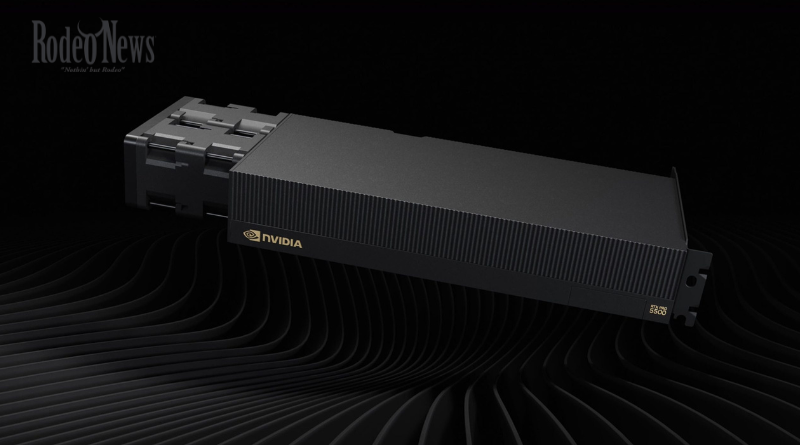
The NVIDIA RTX PRO 5500 is built around NVIDIA’s Blackwell architecture and uses the GB202 GPU family, the same silicon generation associated with some of the company’s most powerful graphics products. Its 21,760 CUDA cores also match the core count of the GeForce RTX 5090, although the professional card is designed for a very different market and workload profile.
Unlike a typical consumer graphics card, the RTX PRO 5500 is designed primarily for professional workstation and rack-mounted deployments. NVIDIA says the card is intended to accelerate agentic AI, physical simulation and advanced graphics workloads that require substantial GPU memory and compute resources.
NVIDIA RTX PRO 5500 packs 21,760 CUDA cores
At the center of the NVIDIA RTX PRO 5500 is a Blackwell-based GB202 GPU. The card reportedly contains 21,760 CUDA cores, putting it on the same level as the GeForce RTX 5090 in raw CUDA-core count.
That does not mean the two GPUs are identical.
The RTX PRO 5500 is designed for professional applications rather than gaming. Its combination of large memory capacity, professional features and workstation-oriented deployment options makes it more suitable for workloads where memory capacity and reliability can be more important than conventional gaming performance.
The GPU reportedly carries a 600W power limit. That is a substantial amount of power for a workstation graphics card, but it also reflects the class of workloads the RTX PRO 5500 is expected to handle.
NVIDIA’s professional Blackwell lineup already includes the RTX PRO 6000, RTX PRO 5000, RTX PRO 4500 and other models. The new RTX PRO 5500 fills an interesting position because it offers substantially more memory than the RTX PRO 5000 while retaining nearly the same core count as the higher-end RTX PRO 6000.
NVIDIA RTX PRO 5500 gets 84GB of GDDR7
The headline feature of the NVIDIA RTX PRO 5500 may be its 84GB of GDDR7 memory.
For professional GPU users, memory capacity can be just as important as raw compute performance. Large AI models, complex 3D scenes, physical simulations and high-resolution professional content can quickly exceed the memory available on conventional desktop graphics cards.
The RTX PRO 5500’s 84GB capacity gives developers and workstation users considerably more room to keep large datasets and workloads directly on the GPU.
According to the published specifications, the card can deliver up to 1,398GB/s of memory bandwidth. That puts it slightly above the reported bandwidth of the RTX PRO 5000, although it remains below the 1,792GB/s figure associated with the RTX PRO 6000 and RTX 5090-class configurations.
The memory is also reported to include ECC support, an important feature for professional environments where data integrity matters.
A strange memory-bus specification
There is, however, an important technical question surrounding the RTX PRO 5500’s published specifications.
PNY’s listing reportedly identifies the card with a 416-bit memory interface while simultaneously specifying 84GB of GDDR7 memory and up to 1,398GB/s of bandwidth. Those figures do not fit together neatly under conventional memory configurations.
A 416-bit interface represents 13 32-bit memory channels. That makes an 84GB configuration difficult to explain using conventional GDDR7 memory arrangements.
Notebookcheck has pointed out that a 448-bit interface paired with fourteen 6GB memory packages would make considerably more sense for an 84GB design. At roughly 25Gbps memory speeds, such a configuration would also produce bandwidth close to the reported 1.4TB/s figure.
As a result, the 416-bit specification should be treated cautiously until NVIDIA or its hardware partners provide a definitive technical explanation.
NVIDIA RTX PRO 5500 targets AI and professional workloads
The new GPU is not simply a larger-memory graphics card.
NVIDIA is positioning the RTX PRO 5500 around emerging workloads such as agentic AI, physical AI and advanced simulation. These applications can require large amounts of GPU memory because models, datasets and intermediate calculations need to remain accessible during processing.
The 84GB memory pool could therefore become one of the card’s biggest advantages.
For AI developers, a larger local GPU memory pool can reduce the need to split workloads across multiple GPUs. Depending on the software and model, that can simplify deployment and potentially improve efficiency.
The same principle applies to professional visualization.
Large CAD assemblies, engineering simulations, digital twins, film production assets and scientific visualization can consume substantial amounts of graphics memory. A GPU with 84GB available gives professionals considerably more headroom than consumer cards with much smaller memory capacities.
NVIDIA’s broader professional Blackwell platform is designed around these types of demanding workloads. The company’s professional GPU portfolio is increasingly being positioned not just as a replacement for traditional workstation graphics cards, but as infrastructure for AI-assisted design and engineering.
Multi-Instance GPU support adds flexibility
Another notable feature of the NVIDIA RTX PRO 5500 is support for Multi-Instance GPU, or MIG.
MIG allows the GPU to be partitioned into isolated instances so that different workloads can share the same physical hardware.
In the RTX PRO 5500’s case, the available configuration can divide the GPU into two instances with 42GB of memory each, according to the published specifications.
That could be particularly useful in enterprise workstation environments.
Instead of dedicating an entire 84GB GPU to a single application, organizations could potentially divide resources between separate users, virtualized environments or workloads.
For example, one instance could be assigned to an AI development task while another handles visualization or simulation. The exact benefits will depend on NVIDIA’s software stack and the applications being used.
This flexibility is one of the features that separates professional GPUs from conventional consumer graphics cards.
PCIe 5.0 and DisplayPort 2.1b connectivity
The RTX PRO 5500 also includes modern connectivity designed for high-end workstations.
The card uses a PCIe 5.0 x16 interface, providing a high-bandwidth connection to compatible workstation platforms. It also supports up to four DisplayPort 2.1b outputs, making it suitable for multi-monitor professional environments.
For professionals working with multiple high-resolution displays, this can be important.
Designers, engineers, financial analysts, video professionals and visualization specialists often operate multiple monitors simultaneously. A professional GPU needs to support that environment without requiring additional display hardware.
The card is also designed around a single 16-pin power connector, reflecting its high 600W power envelope.
A 600W workstation GPU is serious hardware
The RTX PRO 5500’s 600W power rating deserves attention.
This is not a graphics card designed for an ordinary office PC. NVIDIA and its partners are targeting the RTX PRO 5500 at high-end workstation and rack-mounted systems where power delivery and cooling can be designed around professional GPU workloads.
The published specifications indicate that both air-cooled and liquid-cooled versions are planned. The standard card reportedly uses a dual-slot form factor, while the liquid-cooled version should provide an alternative for systems that need more specialized thermal management.
A 600W GPU also means system builders will need to pay close attention to the power supply, chassis airflow and thermal design.
That is particularly important for AI workloads because GPUs can remain under heavy load for extended periods. A graphics card that consumes hundreds of watts for a few minutes during rendering is one thing. A professional AI accelerator operating continuously under load is another.
How the RTX PRO 5500 compares with other Blackwell GPUs
NVIDIA’s professional Blackwell lineup is becoming increasingly broad.
The flagship RTX PRO 6000 reportedly offers 24,064 CUDA cores, 96GB of GDDR7 memory and up to 1,792GB/s of bandwidth. At the other end, the RTX PRO 5000 offers 14,080 CUDA cores and configurations ranging from 48GB to 72GB of memory.
The RTX PRO 5500 sits between them in an unusual way.
It has fewer CUDA cores than the RTX PRO 6000 but substantially more than the RTX PRO 5000. At the same time, its 84GB memory capacity puts it much closer to the flagship model.
Key specifications
| Specification | NVIDIA RTX PRO 5500 |
|---|---|
| Architecture | Blackwell |
| GPU | GB202 |
| CUDA cores | 21,760 |
| GPU memory | 84GB GDDR7 |
| Memory bandwidth | Up to 1,398GB/s |
| Reported memory bus | 416-bit* |
| Power | Up to 600W |
| Interface | PCIe 5.0 x16 |
| Display outputs | Up to 4x DisplayPort 2.1b |
| NVENC | 3x 9th generation |
| NVDEC | 3x 6th generation |
| MIG | Yes |
| Cooling | Air or liquid |
| Target market | Professional workstations/rack systems |
*The reported 416-bit interface is potentially inconsistent with the 84GB memory configuration and should be regarded as unconfirmed pending clarification.
NVIDIA RTX PRO 5500 could be valuable for large AI models
The most interesting application for the RTX PRO 5500 may ultimately be AI.
GPU memory has become one of the defining limitations for local AI development. As models grow larger, developers increasingly need GPUs with enough memory to load models without distributing them across numerous devices.
An 84GB GPU does not eliminate that problem for every large model, but it significantly expands what can fit on a single workstation GPU.
That makes the RTX PRO 5500 particularly interesting for organizations developing AI agents, simulation systems and other GPU-intensive applications.
The GPU’s professional positioning could also make it attractive for companies that need a workstation-based AI platform rather than a conventional gaming GPU.
NVIDIA itself describes the card as being built for agentic AI, physical simulation and graphics workloads, reinforcing the idea that this is primarily an enterprise and professional product rather than a consumer graphics solution.
Pricing and availability remain unclear
One major detail has not yet been confirmed: the price.
NVIDIA and its partners have not published a definitive retail price for the RTX PRO 5500 in the available specifications. That is not particularly surprising given the card’s professional positioning.
Professional RTX PRO products can command significantly higher prices than consumer GeForce graphics cards because they are sold as workstation hardware with specialized drivers, support and enterprise-oriented features.
For comparison, Wccftech reports that the RTX PRO 5000 Blackwell 48GB model has been listed around $9,200, providing some indication of the price territory for this class of hardware.
However, that figure should not be interpreted as the official price of the RTX PRO 5500.
The availability picture is similarly limited. Current listings describe the RTX PRO 5500 as coming soon rather than providing a finalized consumer-style launch date.
Why the RTX PRO 5500 matters
The arrival of the RTX PRO 5500 highlights how quickly professional GPU requirements are changing.
Traditional workstation graphics focused heavily on CAD, rendering and visualization. Those workloads remain important, but modern professional GPUs increasingly need to handle AI inference, model development, physical simulation and increasingly sophisticated digital workflows.
That shift makes memory capacity particularly important.
The RTX PRO 5500 combines 21,760 CUDA cores with 84GB of GDDR7, creating a configuration that is unusual even within NVIDIA’s high-end Blackwell family. Its memory capacity is significantly higher than mainstream consumer GPUs, while its professional features are designed for enterprise environments.
The card also demonstrates that NVIDIA is willing to create GPUs that sit between conventional product tiers rather than forcing professional users into a single flagship option.
Final thoughts on the NVIDIA RTX PRO 5500
The NVIDIA RTX PRO 5500 is shaping up to be one of the more unusual professional Blackwell GPUs yet.
Its 21,760 CUDA cores give it the same headline CUDA-core count as the GeForce RTX 5090, while its 84GB of GDDR7 memory provides more than twice the memory capacity of NVIDIA’s flagship consumer card. The combination is aimed squarely at professionals working with AI, simulation, visualization and other memory-intensive workloads.
The card’s 600W power envelope and workstation-focused design make clear that this is serious professional hardware. Support for MIG, PCIe 5.0, DisplayPort 2.1b and both air- and liquid-cooled configurations further reinforces that positioning.
There are still unanswered questions, particularly around the unusual 416-bit memory-interface specification and the final price and availability. Until NVIDIA or its partners clarify those details, some of the RTX PRO 5500’s specifications should be considered provisional.
Nevertheless, the overall package is compelling.
For companies that need large amounts of GPU memory without moving immediately to even more expensive flagship workstation hardware, the RTX PRO 5500 could become an important middle ground. If NVIDIA’s pricing is competitive for the professional market, this 84GB Blackwell GPU could prove especially attractive for AI developers, engineers and visualization professionals.